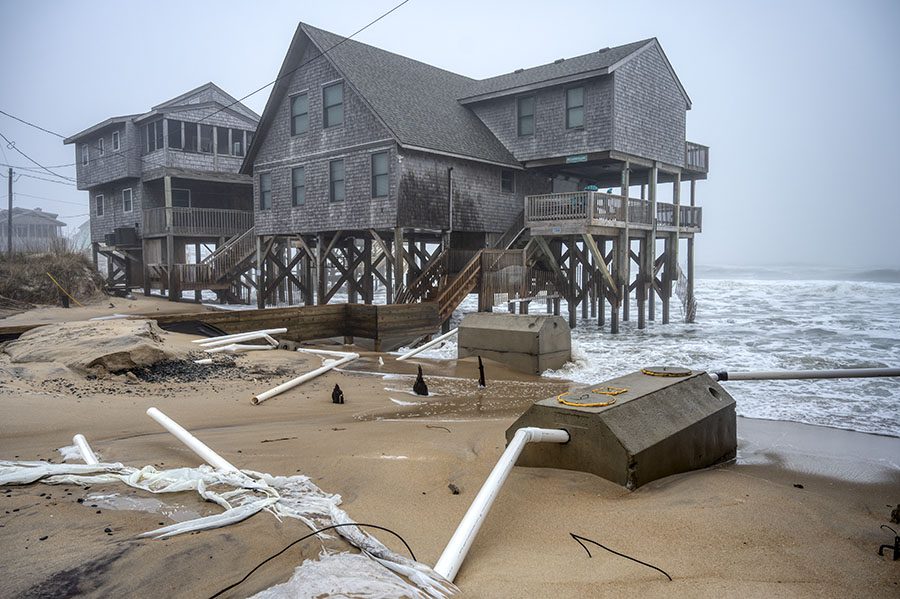
MANTEO — Over two days last week, the North Carolina Coastal Resources Commission and its advisory panel viewed presentations with vivid views of battered oceanfront buildings, severely eroded beaches and remains of various sand barriers and traps designed to hold back ocean forces.
With legislation that would repeal the state’s landmark ban on hardened structures parked in a state Senate committee awaiting further action, the commission had asked its Science Panel and agency staff to provide updated information in a report on the effects of seawalls, jetties and other permanent erosion control structures on the open ocean coastlines.
Supporter Spotlight

After months of research and minor tweaking, the final report, “Effects of Hard Structures on Sandy, Open-Ocean Coastlines.” was presented to the commission during its Aug. 27 meeting at the Dare County Government Complex. But through each iteration, the analysis remained consistent: Blocking or trapping sand at one area of beach takes sand from another area of beach.
According to the Division of Coastal Management’s recently updated erosion data, 140 miles of the state’s 320 miles of ocean shoreline are eroding at an average annual rate greater than 2 feet; 135 miles at less than 2 feet yearky; and 100 miles of beach is accreting. Some of the highest erosion rates are on the Outer Banks, where 32 oceanfront houses have collapsed in Rodanthe and Buxton since 2020.
“There is such desire — and it’s completely understandable — to stop long-term, chronic erosion,” Science Panel Chair Laura Moore told commissioners during her presentation about the final report. “Yet in some cases, there’s a desire for a solution, but there really isn’t a solution. What we can do is buy time.
“It’s like getting older, right?” she said. “The inevitable is going to happen, but we can make choices that allow us to do what we want to do for longer … and long-term chronic erosion that’s been occurring for hundreds of years in these particular places is a little bit like that.”
Boiled down to its essence, not much has changed in the rationale since 1984, when North Carolina was one of the first states in the nation to ban the structures. Except now the state is not alone.
Supporter Spotlight

“Every state is moving away from hardened structures, but there’s not a complete ban,” Daniel Govoni, N.C. Division of Coastal Management policy section chief, told the commission, summing up a presentation of 17 coastal states’ current policies.
While Govoni said that it was difficult to compare the complexities of permitting erosion control structures, in general, he concluded, they all preferred beach nourishment and retreat, and the majority discouraged the structural measures.
‘What is the intent?’
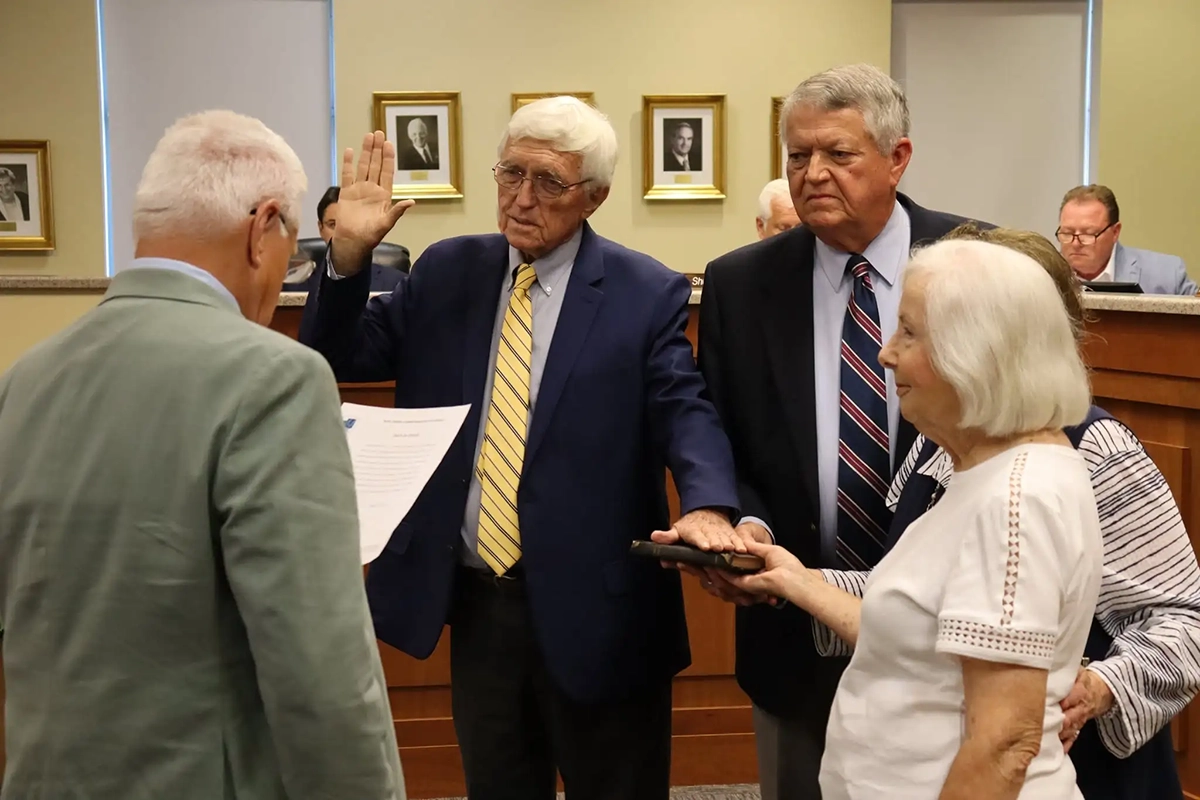
For a long moment, members of the panel sat silently, pokerfaced. Soon, Commissioner Jordan Hennessy asserted that some measures may still be worth trying: “I think there are processes in other states we can look at,” he said.
Member Joseph Hollowell followed, asking what would happen “if some miracle comes along” that is a hardened structure that is banned in North Carolina.
“What is the intent of the science committee?” he asked. “Is it to formulate a campaign to keep the law as it currently is? Was it to be innovative … creative?”
Commission Chair Renee Cahoon responded that the CRC was “not trying to rewrite the law.” Instead, she said, the panel is trying to understand the options so it can provide recommendations to the legislature.
The commission decided at this point to interrupt the discussion to allow CRC Assistant General Counsel Christy Goebel to provide her overview of the hardened structures law, which began life as commission policy in January 1985. The ban was upheld in court in 2000, and the policy became state law in 2003. Then, in 2011, a law was passed that allowed four terminal groins, which trap sand near inlets or the end of islands, as pilot projects. The opening has since been expanded to allow seven groins.
Even with the law in place, structures have been allowed to protect infrastructure like roads and bridges as well as historic structures.
Today, she said, there are at least 15 hardened structures on the North Carolina shoreline. Sandbags, which have always been permitted as temporary structures, are currently allowed to stay in place for eight years. At least 12 sites currently have large sandbags as protective measures on the beach.
Hollowell then made a motion to support the proposed legislation to “do away with” the current hardened structures ban. That would open consideration of “all kinds of new technologies that seem to be out there,” he said.
Hennessy seconded the motion.
But Cahoon objected: “That’s asking this commission to take a political stand, which is not something the commission will do,” she said.
As an alternative, she suggested consulting with the North Carolina Collaboratory, which was established in 2016 by the General Assembly to handle research needs and provide expertise on state issues. “If the legislature passes a bill, they will ask us for direction.”
Commissioner Steve Shuttleworth asked for clarification on the motion.
“I would have a hard time supporting or opposing a motion to support something that I don’t understand what they’re asking us to vote on,” he said. “At the end of the day, my two cents, it’s political. It’s been political for 40 years. Sometimes the legislators go one way, and sometimes, now, they want to go a different way.”
Another commissioner, Katherine Skinner, also questioned whether such a motion was premature, considering that the proposed bill was stalled in committee.
“I feel incredibly uncomfortable backing a bill that has not had full debate in the House and the Senate,” she said. “And we are picking a side that we are not being well-informed on.”
The motion failed in a 6-4 vote, with three members abstaining. Then Hennessy followed with a similar motion, which also failed.
‘Life Is Full of Tradeoffs’
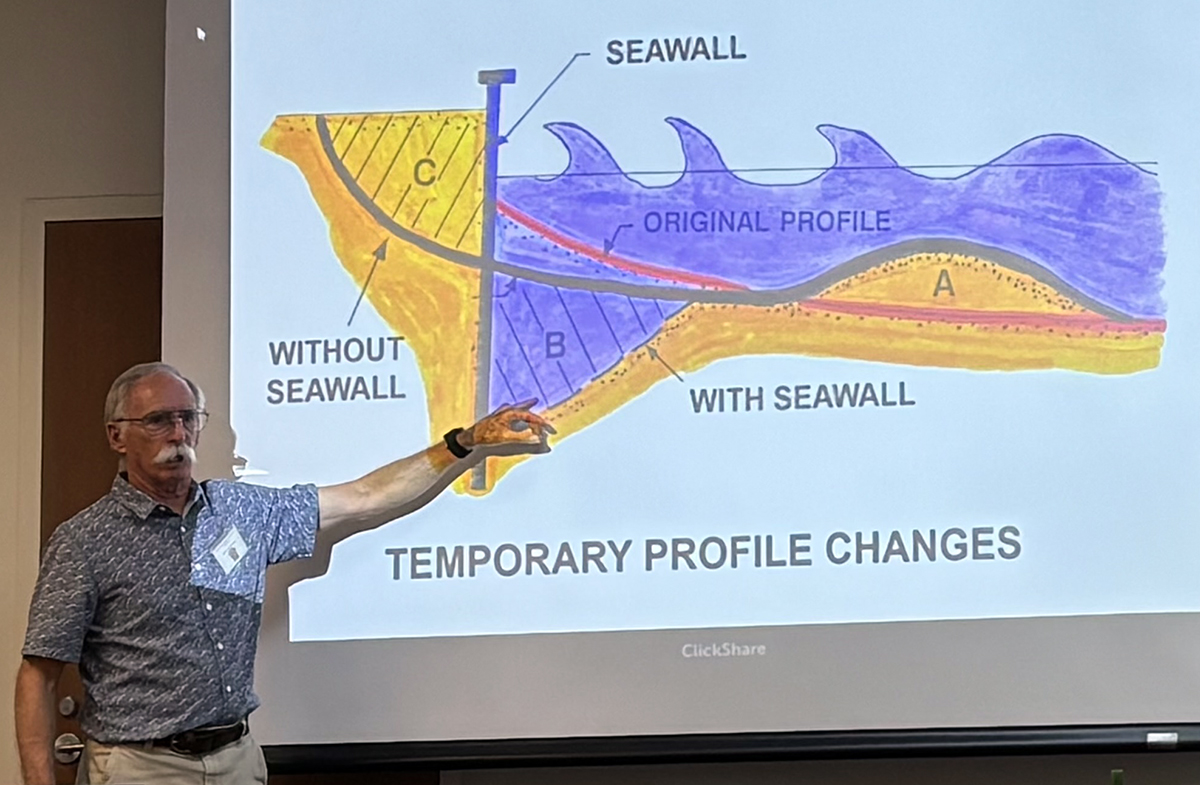
In his presentation on Aug. 26 to the Coastal Resources Advisory Committee, titled “Erosion Management Options, Life Is Full of Tradeoffs,” Spencer Rogers, a member of the Science Panel, detailed how waves and currents interact to transport sand to and from the beach. “The beach changes at rates that are far beyond what most people appreciate,” he said.
It is the water depth that controls the height of waves as they head to the beach. With shallower water, friction starts to slow down the wave, Rogers said. When the wave breaks, it forms a smaller wave. Even during a Category 3 storm in North Carolina, he said, the largest wave on land is likely about 6 feet.
Rogers said the wave-breaking phenomenon is critically important in thinking about development on the coast.
“That 30-foot wave is going to break miles offshore, not on your house,” he said.
Even though ocean currents don’t sound very fast — the Gulf Stream, for instance, is considered speedy with its typical 5 mph pace — but they move tons and tons of sand daily.
On high-energy beaches, such as those on the Outer Banks, the coastal processes that move sand are intensified. That may explain why beach nourishment cannot be assumed to always mitigate the erosion created by hard structures like revetments or offshore reefs.
“The problem with that approach is that almost every place that is likely to come forward with an erosion problem … beach nourishment has already failed,” Rogers said.
Successful beach nourishment requires a moderate erosion rate and regular maintenance, he added. When the erosion rate is too high, which is likely the case in Buxton, “you really can’t afford long-term beach nourishment,” he said.
“And if beach nourishment is successful, you don’t really need a structure,” Rogers said.
The tradeoff between having a beach or protecting a structure works at Fort Fisher, which has an erosion rate of 10 feet and no beach, he said. But the historic structure is protected.
Such a tradeoff, Rogers noted, would no doubt be “more difficult” in locations like Nags Head.
In a letter to the division in support of the Science Panel’s report, the North Carolina Coastal Federation, which publishes Coastal Review, said the hardened structures policy was a product of years of research and observation of impacts in other states.
“The report does not suggest that hardened structures are a solution without consequence,” wrote Ana Zivanovic-Nenadovic, the Coastal Federation’s chief program officer. “Rather, it demonstrates that these approaches involve significant tradeoffs that must be carefully weighed against their limited and localized benefits. At a time when sea level rise, stronger storms, and increasing coastal development are creating unprecedented challenges, North Carolina should continue to lead rather than retreat from the principles that have guided coastal management for decades.”
As the CRC wrapped up its hardened structures discussion on Thursday, several members expressed continued optimism that perhaps new technological advances in erosion-control methods, such as reef balls or offshore breakwaters, could offer reasonable mitigation to chronic erosion. But so far, Moore responded, the future offers no easy or ready solution.
“The Science Panel has reviewed all technologies that are available and there is not anything new and flashy on the horizon,” Moore said. “This is a so well-known, challenging problem that’s been addressed in different ways with differing degrees of success and adverse impacts along coastlines throughout the world for a long time. So there’s just not a magic silver bullet.”