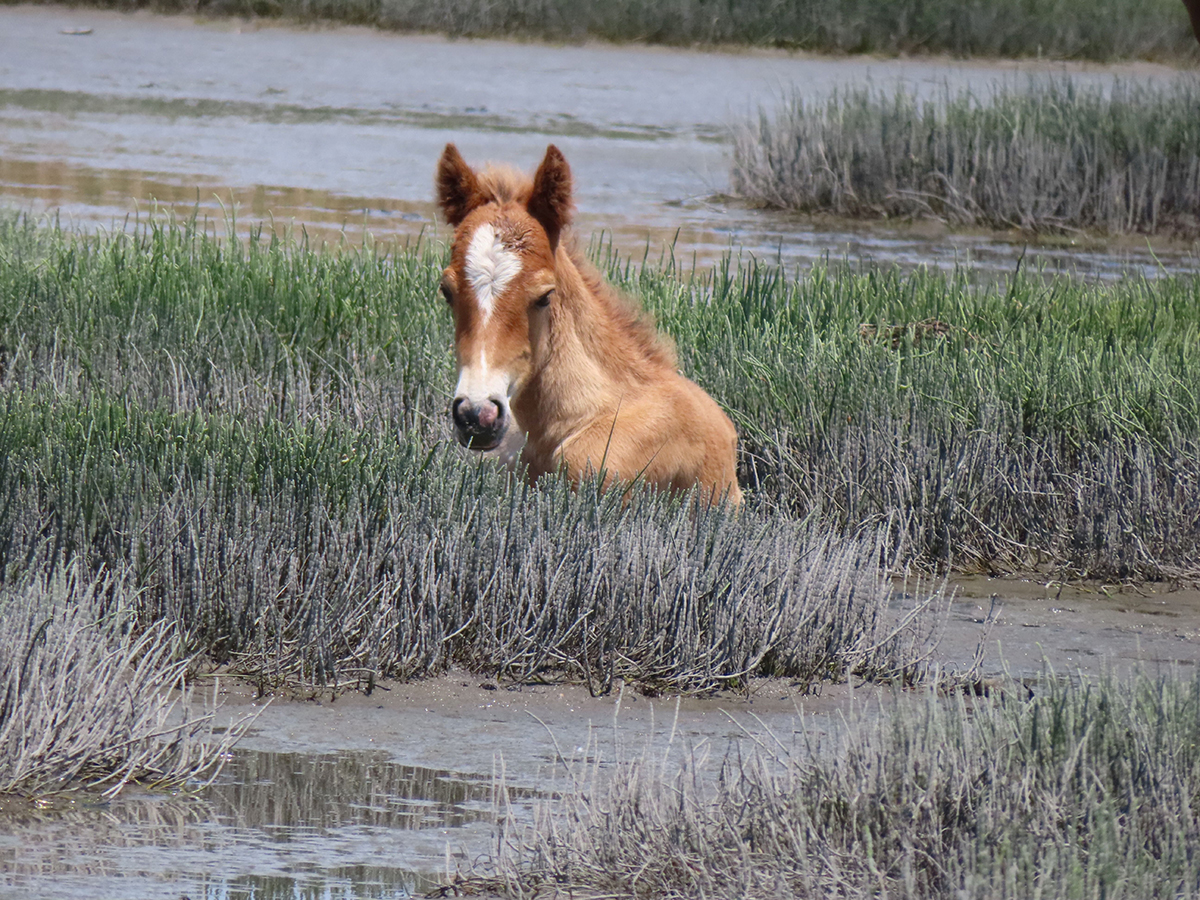
Twenty years from now, the Atlantic’s barrier islands will look different. Beaches will have migrated, marshes shifted, and storms will have redrawn the shore. Yet descendants of a 500-year-old bloodline will likely still be grazing a coastline that never stops changing.
Wild horses have survived here for centuries not because this landscape is stable, but because they learned to survive one that is not.
Supporter Spotlight
Few wildlife populations allow such a direct comparison. From the Delmarva Peninsula to North Carolina’s Outer Banks, five horse herds share the same Colonial Spanish ancestry, but not the same conservation trajectories. Though other feral horses exist along the Atlantic Coast, these five are distinguished by centuries of adaptation to barrier-island life, coupled with deliberate management efforts to preserve their historic bloodlines.
Whether their ancestors arrived through shipwrecks, early settlements, or expeditions from the Caribbean remains debated. Their genetics do not. A 2022 study that compared a horse tooth from the abandoned colony of Puerto Real in present-day Haiti with modern populations found its closest living relatives among Assateague’s feral horses. The finding complemented decades of analysis by Texas A&M geneticist Gus Cothran, whose research identified Colonial Spanish lineage in several barrier-island herds. While their bloodlines remained a common thread, the challenges facing each herd did not – leading to not one conservation model, but five.
Congressional protection
Of the five herds, the Shackleford Banks is the only herd protected by an act of Congress – after the isolation that had preserved its ancestry became its greatest vulnerability. The Shackleford Banks Wild Horses Protection Act of 1998 requires the National Park Service to maintain a minimum of 110 horses on the island, a threshold genetic research found necessary for the population’s long-term viability. The law requires the agency and the private Foundation for Shackleford Horses jointly manage the herd using PZP, a contraceptive vaccine, and, when necessary, the selective removal or adoption of individual animals.
Today, park service personnel at the Cape Lookout National Seashore say rising seas, marsh loss, overwash, erosion, changing vegetation, and declining freshwater availability are reducing the island’s capacity to support the horses. In 2025, herd mortality reached 17%, compared with a long-term average of 6%, with most deaths linked to poor body condition associated with inadequate forage.
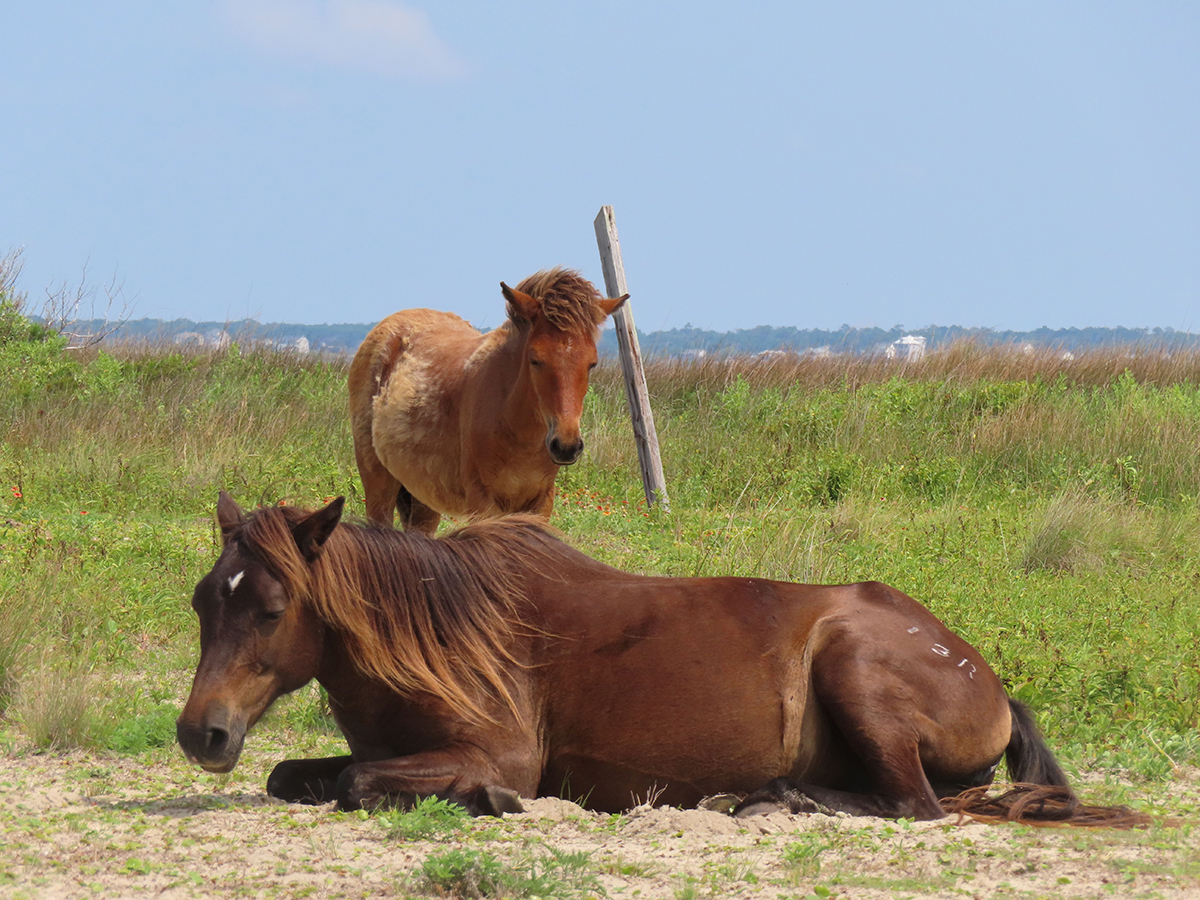
Dr. Sue Stuska, the park service biologist who manages the herd, said limited forage particularly affects the most vulnerable horses, including older animals, youngsters, and lactating mares.
Supporter Spotlight

“Our long-term goal is to maintain the herd along with healthy natural resources,” Stuska stated. “We cannot have the first without the second.”
The Corolla model
Corolla follows a different model, relying on local stewardship rather than federal protection. Roughly 100 horses roam about 7,500 acres in Currituck County at the northern end of the Outer Banks, moving across wetlands, maritime forests, beaches, and developed neighborhoods. The Corolla Wild Horse Fund was formed in 1989 in response to vehicle-horse collisions that increased following the paving of N.C. Highway 12 between Duck and Corolla. Today, the nonprofit manages the herd through fertility control, veterinary care, habitat protection, and partnerships with local, state, and federal agencies.
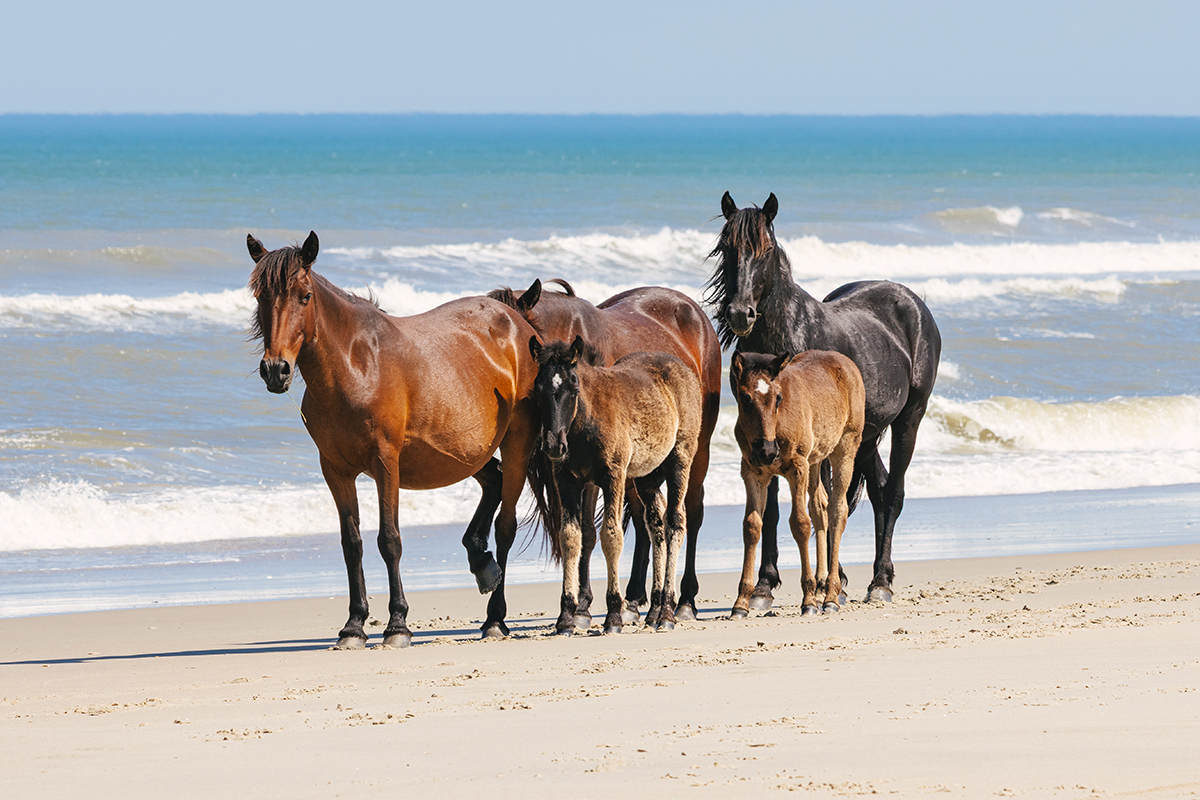
Testing in 1992 revealed the herd had experienced a severe genetic bottleneck, leaving it with extremely low genetic diversity and a single maternal line. In 2014, a Shackleford Banks stallion was introduced to diversify the Corolla population while preserving its historic Iberian lineage.
Director of Herd Management Meg Puckett has watched those changes unfold over the past decade. She told Coastal Review that the most significant shift has come since the pandemic, bringing “more tourists and more year-round residents in the (four-wheel-drive) area.” She added, “We’re fortunate to work for an organization that allows us to respond in near-real time.”
As more visitors unfamiliar with the animals have arrived, public education has become even more vital to the organization’s work, while preserving the habitat that allows the horses to remain wild is equally important. In Corolla, conservation increasingly means protecting the space they have left to move.
Ocracoke’s compromise
Ocracoke Island embodies a different kind of compromise: conservation through confinement. Like Corolla, the arrival of N.C. Highway 12 brought cars and horses closer together. In response to the increased traffic after the final 3-mile stretch was completed in 1958, local Boy Scouts, who ran the nation’s only mounted Scout troop using the island’s ponies, built a pen under a special-use permit the following year. Mike Barber, a National Park Service public affairs specialist, said the move “marked the first formal management of the herd.” At the request of the local community, the park service assumed responsibility for the horses in 1974.
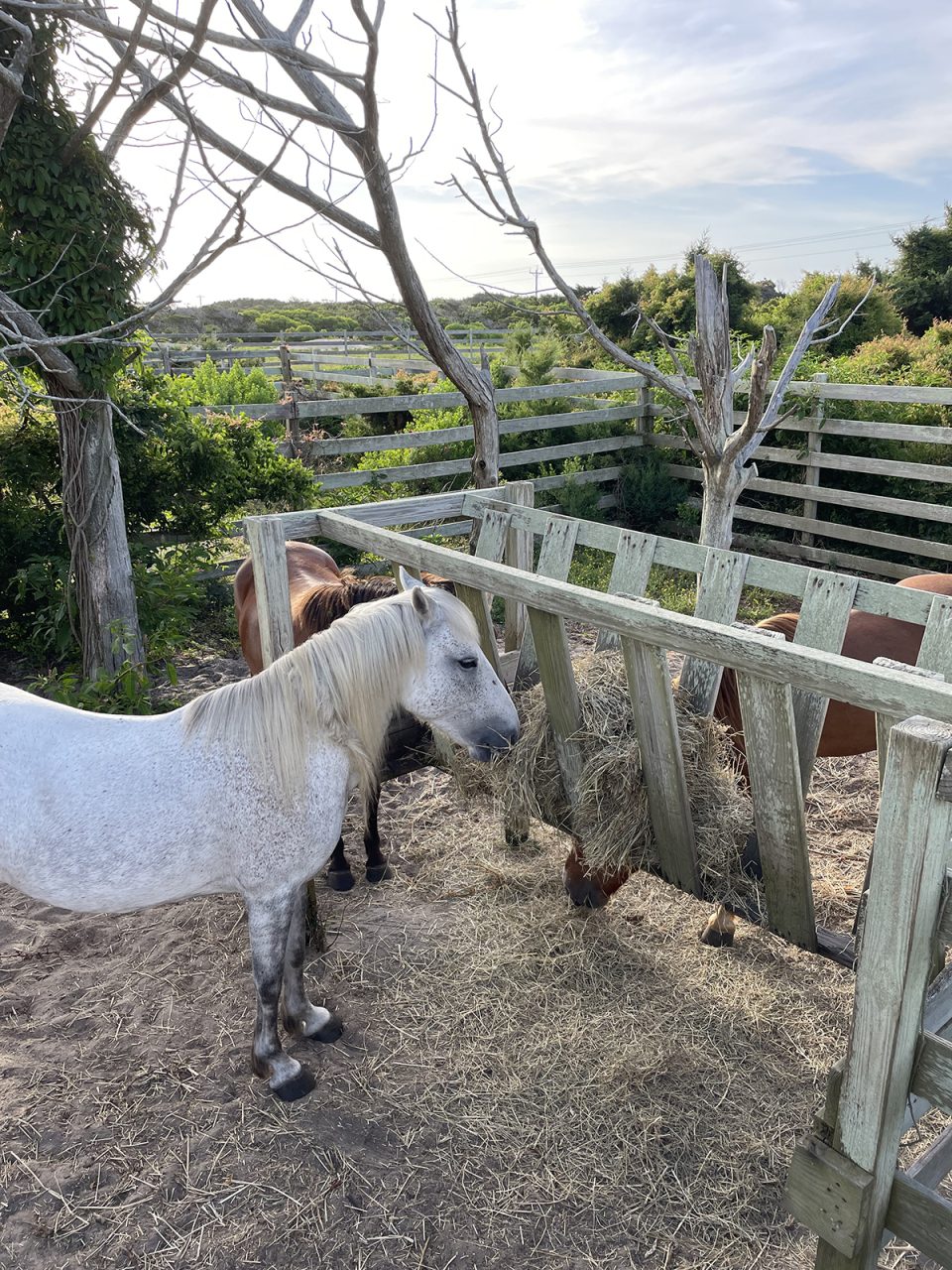
Today, fewer than 20 horses remain at the Ocracoke Pony Pen, where park service staff and volunteers provide daily feeding and coordinate medical care. Barber said the herd is now managed with its “safety and welfare” as the priority. Unlike Corolla, Ocracoke’s solution traded freedom for safety. Both approaches ultimately rely on fencing, but for different purposes. At Corolla, fences define the boundaries of a landscape where the horses can still roam free; on Ocracoke, they form a protective enclosure. More than six decades later, the park service is developing a new management plan as sea level rise continues to reshape Ocracoke. Barber said rising sea levels are expected to “increasingly affect facilities, forage, and freshwater access.”
Assateague Island’s two approaches
Nearly 200 nautical miles north of Ocracoke, on the Delmarva Peninsula, Assateague Island offers a striking contrast. One barrier island, divided by the Maryland-Virginia line, supports two horse herds and two distinct management philosophies.
In 1961, nine ponies were released on the Maryland side of the island. After Assateague Island National Seashore was established in 1965, a fence went up along the state line to keep the two populations separate. On the Maryland side, the National Park Service manages its herd as a wildlife population, relying on PZP contraception to hold numbers within a target range of 80 to 100 horses. Rather than relying on roundups or removals, biologists control the one variable they can: reproduction. Park service officials credit the program with extending lifespans well into the horses’ 20s and 30s.
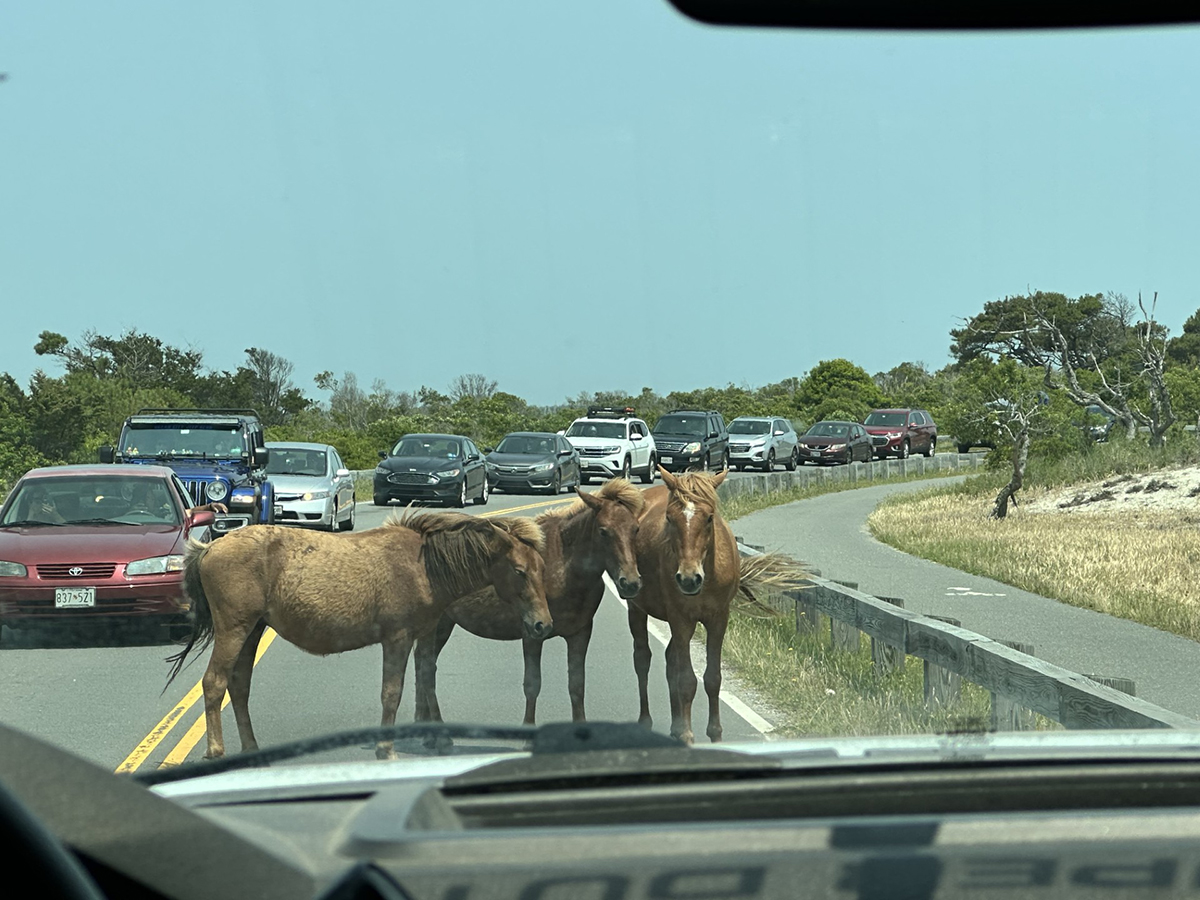
Aside from fertility control, feeding and veterinary care are kept to a minimum. That freedom carries its own risks, however, and in August 2026, two horses were struck and killed by vehicles within 13 days. In a statement to Coastal Review, the park service said its staff were “looking at possible changes to traffic rules,” but no decisions have been announced. After the most recent collision, the mare’s foal was relocated below the state line “where he will receive veterinary care and become part of the Chincoteague herd. This move is permanent.”
Cross the fence into Virginia, and the conservation model changes completely; from a largely hands-off to a decidedly hands-on approach. Here, the horses are owned by the Chincoteague Volunteer Fire Co., which maintains about 150 adult ponies.
Every year on the last Wednesday in July, saltwater cowboys drive the horses across Assateague Channel to Chincoteague Island for the annual Pony Penning. Most of that year’s foals are sold at auction the following Thursday, with proceeds helping fund the fire company’s continued stewardship – a tradition dating to 1925. When the pandemic forced the auction online in 2020, organizers introduced the remote bidding that continues today through simulcast.
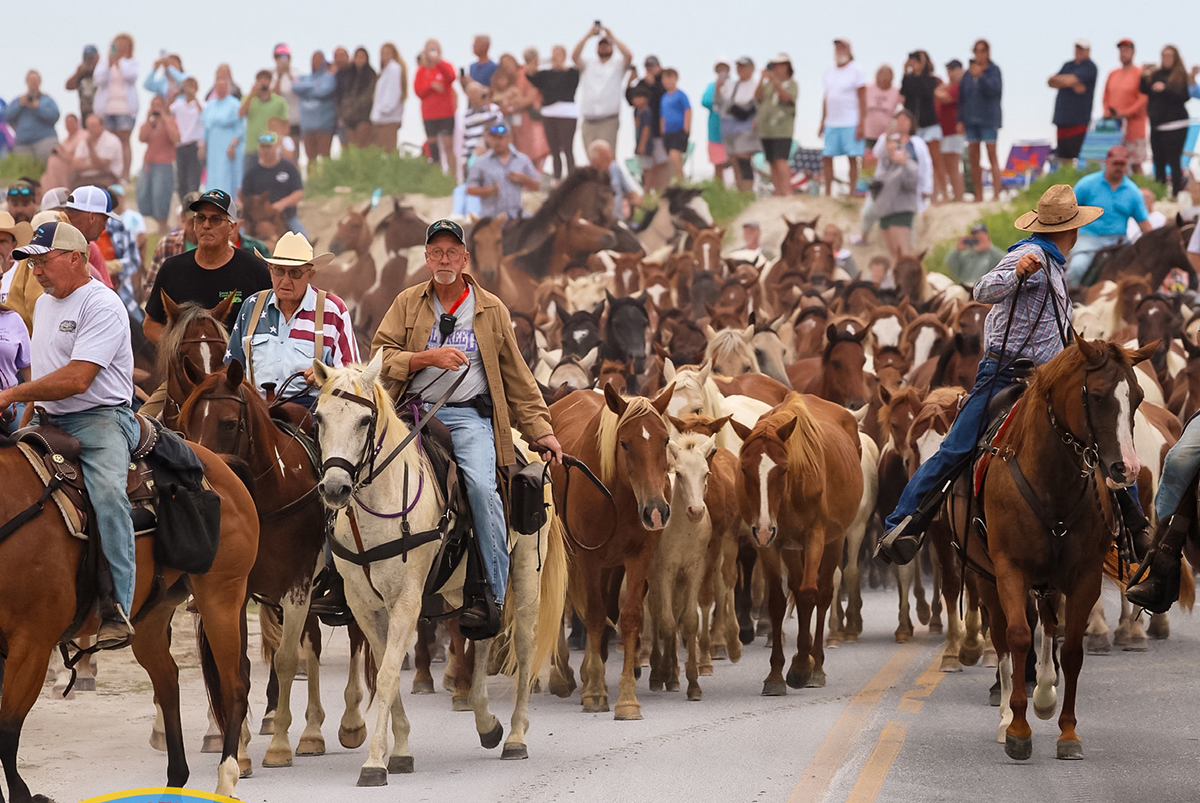
From 2010 through 2019, reported sales averaged about $157,000 annually. In 2025, the centennial auction surpassed $1 million for the first time, while the 2026 event generated $635,600. The fire company retains an average of six or seven foals each year as “buybacks,” selecting animals it wants to return to the Virginia herd after the auction.
Public information officer and Saltwater Cowboy Hunter Leonard told Coastal Review the unique program is one of its most important conservation tools – helping maintain the herd’s health and longevity while promoting genetic diversity. Buyback purchasers receive naming rights, giving them a personal stake in the herd’s future even though the foals remain on the island. On Friday, the remaining ponies swim back across the channel to their permanent home on Assateague.
Home, however, looks different on each island. While these five herds share a historic legacy, each population’s geography, local priorities, and individual pressures produced a unique answer to the same question: How do you preserve an equine lineage on islands that refuse to stand still?
The sand shifts, the channels move, and the forage comes and goes with the tide. An act of Congress, nonprofit stewardship, a fenced pasture, fertility control with minimal intervention, an annual roundup and auction; each offers a solution to the same changing landscape.
What varies is what each island demands — of horses and humans alike. And different as those demands may be, each reflects generations of people doing what they could, with what they had, to ensure these wild horses can continue doing the same.