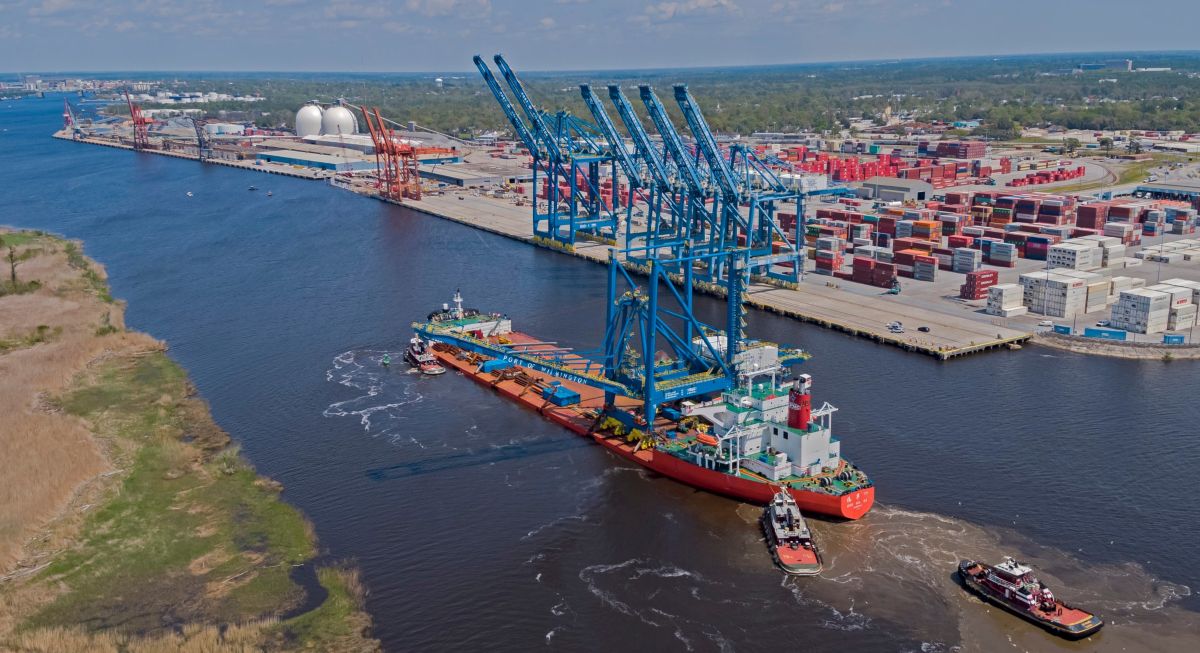
The North Carolina State Ports Authority has asked the federal government to suspend work on the Wilmington Harbor deepening proposal.
NCPA Executive Director Brian Clark, in a recent letter, formally asked the Army Corps of Engineers to halt “further consideration” of the proposed $1.3 billion harbor expansion project. In the Sept. 18 letter, Clark also specifically requested Assistant Secretary of the Army for Civil Works D. Lee Forgsren defer associated Wilmington Harbor 403 letter report activities and additional consideration of the federal agency’s pending record of decision, which was anticipated to be released this month.
Supporter Spotlight

“While we are certain the economic benefits from such a project could have lasting positive impacts on the entire State, what has become clear during this process is a need to pause and give adequate study and reflection to the potential environmental impacts of a project of this magnitude, including the potential impacts of per- and polyfluoroalkyl substances, commonly referred to as PFAS,” Clark wrote. “The questions raise by residents, researchers and other stakeholders regarding the potential effects of PFAS within the scope of this project are too important to be subject to a systematic timeline.”
The ports authority’s request comes about three months after the Corps released its final Wilmington Harbor 403 environmental impact statement, or EIS. That study targets a plan to extend the entrance of the federal navigation channel by about 9 miles, deepen the channel from 42 to 47 feet and widen parts of it from the mouth of the Cape Fear River about 28 miles to the Wilmington port.
The federal government has spent about $4.15 million of the federal portion of the Wilmington Harbor 403 cost-share agreement on the proposed project, along with more than $150,000 in federal funding for an independent external peer review, Jed Cayton, public affairs specialist with the Corps’ Wilmington District, said in an email responding to questions Monday morning.
Cayton said that the Office of the Assistant Secretary of the Army for Civil Works and Congress will decide any future actions or next steps.
The State Ports Authority has for years considered the possibility of expanding the harbor to accommodate larger, deep-draft container vessels at the Wilmington port in U.S. East Coast-Asia trade. Authority officials have argued that deepening the shipping channel will attract more import and export business and boost job growth in the state.
Supporter Spotlight

But such a proposal has faced widespread criticism from residents, environmental organizations and local governments concerned about the project’s impacts to historic and cultural resources and erosion and flooding along the lower Cape Fear River, habitat destruction, and potential disbursement of contaminants in the riverbed’s sediment into marshes and onto public beaches.
Looking back: Corps presses toward fall decision on $1.3 billion harbor plan
The North Carolina Department of Environmental Quality’s Division of Coastal Management also raised objections earlier this year about the proposed project. Division officials argued that the Corps’ draft EIS failed to adequately assess cumulative flooding impacts or thoroughly detail areas where dredged material would be placed, did not sufficiently account for potential effects on fisheries habitat, freshwater wetlands, shorelines, or state, historic and other sites along the river, and did not evaluate PFAS in the lower Cape Fear River sediment.
The river, which is the drinking water source for tens of thousands of North Carolinians, has for decades been polluted by upstream dischargers that use human-made chemical compounds commonly referred to as “forever chemicals” because of their resistance to breaking down in the environment. PFAS are used to manufacture a host of consumer goods, including food packaging, stain resistant carpet, and nonstick cookware.
“The last thing that this river and the wildlife and the communities around it needed was a costly project that would have exacerbated these threats,” Southern Environmental Law Center Staff Attorney Hannah Nelson said in a telephone interview Monday. “We applaud the State Ports Authority for setting this expansion aside and I hope that state officials can now prioritize action that protects the Cape Fear River and the hundreds of thousands of people who rely on it each and every day.”
DEQ had not responded to Coastal Review’s requests for comment at the time this report was published.
In his letter, Clark said the State Ports Authority is “embarking on our new strategic plan, which calls for an overall increase in tonnage traversing the Wilmington Harbor.”
An authority spokesperson confirmed the Ports Authority’s request to suspend the project, but did not respond to specific questions by the time of this publication.
“There are already ways to reach the economic goals in the area using our existing channel,” Nelson said. “We don’t need to be deepening just for the sake of deepening so I’m glad to see that they’re planning to utilize what they already have and hoping that any future development comes with rigorous analysis and a resilience approach.”
Nelson said the process under the National Environmental Policy Act played out as designed.
“This is how NEPA is supposed to work and it highlights the importance of having NEPA and having a strong federal review process because, without it, we’ll have folks making uninformed decisions and we could have dealt with a loss of a really important resource without this review,” she said.
North Carolina Coastal Federation Coastal Management Program Director Kerri Allen said in an email Monday that the organization appreciates the State Ports Authority’s decision to pause consideration of the proposed project. The Coastal Federation publishes Coastal Review.
“This is an important step that gives us the opportunity to take a thoughtful, science-backed look at the potential environmental impacts of a project of this scale,” she said. “For years, partners, along with residents, researchers and others, have raised questions about those impacts, including the potential risks associated with PFAS. Those questions deserve careful study, and we’re encouraged that the Port recognizes they shouldn’t be constrained by a predetermined timeline. We look forward to continuing to engage constructively as this work moves forward and making sure future decisions are grounded in sound science and protect the long-term health of the Cape Fear River and our coastal communities.”