Third in a series
Another year brought another wave of arguments over shellfish leases in North Carolina coastal waters.
Supporter Spotlight
Before summer officially began, legislators added language to a bill that would temporarily ban new leases in the waters behind Topsail Island. This provision was tacked onto legislation originally written to extend New Hanover County’s shellfish lease moratorium another five years, through to 2031.
This was the second consecutive year that representatives from Topsail Island’s three towns attempted to pause new leases in Stump and Topsail sounds.
House Bill 1113, sponsored by Rep. Ted Davis, R-New Hanover, also included a provision to extend a moratorium on new shellfish leases in Carteret County’s Bogue Sound until July 1, 2028. The bill was withdrawn from the legislative calendar and sent to the House rules committee on June 18. It hasn’t moved since.
New Hanover County’s request to continue blocking new leases from its waters was tucked into the state budget Gov. Josh Stein signed July 7. The law grants the county a two-year extension, not the five years originally sought.
That’s two more years that prospective shellfish farmers or those looking to expand their business will remain shut out of the waters in North Carolina’s two southernmost coastal counties. Brunswick County has had a shellfish lease moratorium in place since Harry S. Truman was in the White House.
Supporter Spotlight

Lease moratoria and poor water quality have resulted in areas closed to shellfish harvesting farther north, effectively bottlenecking growers into waterways that are still open, including those around Topsail Island in Onslow and Pender counties.
Clashes over shared public waters are not likely to ebb with the tide as North Carolina’s aquaculture or mariculture industry expands.
The North Carolina Division of Marine Fisheries received by its Aug. 1 deadline 49 shellfish lease applications for six counties: Carteret, Dare, Hyde, Onslow, Pamlico and Pender, according to information provided by the division.
New lease applications cover a combined 55 acres of bottom and water columns. That includes 15.75 acres in Bogue Sound, where what turned out to be a seven-year moratorium expired on July 1.
In total, six lease applications were submitted for Onslow and Pender counties – four for Onslow and two for Pender.
“We have heard from some private residents and also some fishing guides and some commercial interests about their concerns about, in particular, column leases,” said William Snyder, chair of the Topsail Island Shoreline Protection Commission. “We know that those concerns are still out there. I think that you could say that there’s some disappointment that we were not able to get the moratorium first and then get a study to confirm or deny the concerns that we have.”
Balancing act
On a positive note, he said, two studies on shellfish leasing — one commissioned by the General Assembly and one lead by North Carolina Sea Grant in partnership with the Coastal Federation — are examining how to balance future shellfish lease site selections, help shape future policy to protect the industry, and ease user conflicts.
“We’ve got to hang our hats on how these studies play out and listen to see what that tells us in terms of conflicting uses of our public trust waters,” Snyder said.
The North Carolina Collaboratory is expected to present an interim report on its study at year’s end.
Last week, Sea Grant and the Coastal Federation, which publishes Coastal Review, launched an online survey asking oysters growers in Pender and Onslow counties to share their experiences and perspectives on the use of public trust waters.
The organizations are hosting a meeting next month for shellfish growers.
Back in April, local elected officials, private property owners and recreational water users were invited a public meeting with Sea Grant and Coastal Federation representatives to discuss their concerns about leases in Stump and Topsail sounds.
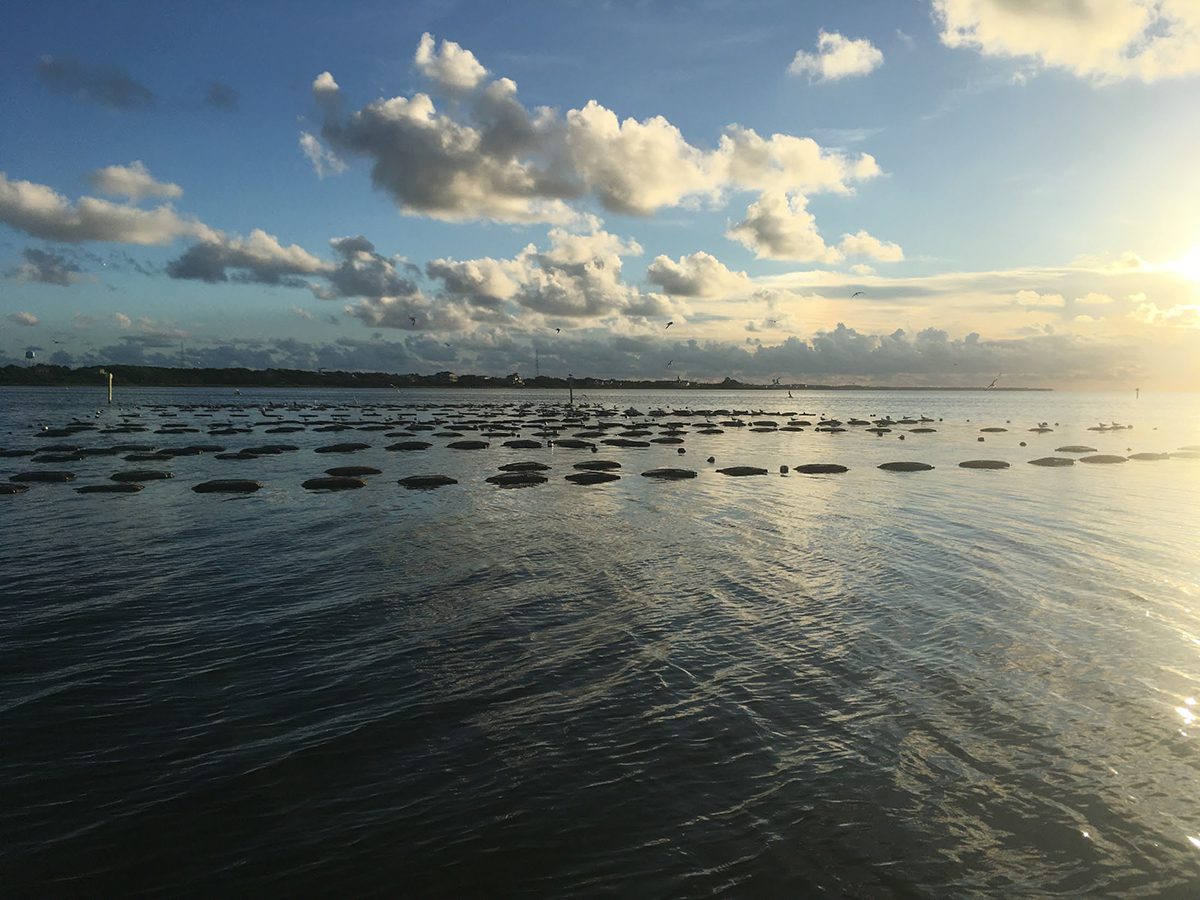
People at that meeting overwhelmingly expressed worries about water column leases, or those where shellfish growers use floating gear to grow oysters at the water’s surface. Floating cages, they argued, impede boating and kayaking access, infringe on popular fishing spots, and impact waterfront viewsheds.
Recommendations shared with Sea Grant and Coastal Federation staff will help shape updates to the North Carolina Strategic Plan for Shellfish Mariculture, a plan commissioned by the General Assembly in 2017. This document is effectively the state’s roadmap for a sustainable shellfish industry.
The organizations also anticipate publishing next year a Geographic Information System, or GIS, database pinpointing areas where leases may or may not be suitable in the waterways behind Topsail Island.
“It’s important to acknowledge that many residents have some concerns about navigation and access and those are important to take into consideration as part of the conversation, just as the benefits of shellfish aquaculture,” Coastal Federation Chief Program Officer Ana Živanović-Nenadović told Coastal Review last month. “But ideally, those conservations should happen without having to close water bodies to new leases.”
Days after Bogue Sound’s shellfish lease moratorium expired, Carteret County Commissioner Marianne Waldroup and Rep. Celeste Cairns, R-Carteret, held a meeting with state fisheries officials, aquaculture specialists, marine scientists, the N.C. Fisheries Association and other stakeholders to discuss ways to minimize potential user conflicts in the sound.
Carteret Community College Aquaculture Department Chair David Cerino attended that meeting.
Cerino, who also grows shellfish, explained that there aren’t that many sites ideal for shellfish aquaculture in Bogue Sound. Areas dense with submerged aquatic vegetation, or plants that grow under water, portions of the waterway permanently closed around the Morehead City port, and areas closed to unexploded military ordnance, cut down lease space, he said.
“I think once it was shared that there wouldn’t be leases everywhere because they can’t site them there, most of the town representatives were less opposed to it being open for leases,” Cerino said.
The group agreed to hold future talks about identifying low-conflict spots in Bogue Sound and potential buffer zones from the land.
A history of public opposition
About 34% of the state’s coastal waters are permanently closed to shellfish harvest because of pollution and lack of monitoring capacity, according to the 2021-25 Oyster Restoration and Protection Plan for North Carolina.
Today, 6% of coastal waters remain closed to new shellfish leases, according to the Division of Marine Fisheries.
New shellfish enterprises have been blocked from waters in Brunswick County since 1949. Farther north, new leases have not been permitted in Core Sound since the mid-1990s. In 1996, legislators approved a permanent ban on new leases in the sound.
Those moratoria were implemented because of public backlash that leases violate the public trust, according to an April 2020 division report.
“Historically, public opposition to shellfish leases resulting from user conflicts has been a major concern,” states the report. “Shellfish moratorium have been imposed in recent years in areas where user conflict issues have been especially acute.”
Cerino called moratoria a “knee-jerk reaction” and a “nuclear option of just eliminating something because you’re maybe worried about a specific circumstance.”
“What that does is it funnels people to the areas that are still open because a lot of people are wanting to get into this business,” he continued. “I would like to see a moratorium on moratoriums, but I’m biased. They basically take away the opportunity to establish sustainable businesses that have positive environmental impacts and employment opportunities and increase our seafood production and improve local economies and water quality. There are definitely areas where we shouldn’t have shellfish leases, but they are not entire sounds, entire waterbodies that should be closed off.”
The rise in user conflicts has driven up the numbers of legal challenges against the Division of Marine Fisheries, according to the report.
But no growth goes without challenge, Živanović-Nenadović said.
“I think our waterfronts are consistently changing with our human activity. When you build a marina, you change the waterfront,” she said. “When the Coastal Federation builds a living shoreline, we change the waterfront. It’s important to always remember that those are valid and compatible uses of our public trust water bodies and have been deemed to have benefit to society, and that’s why they’re allowed and why we have a public permitting system in place for those uses.”
The challenge, she said, has been and continues to be bringing people together “to get to a point of shared values and understanding and accepting that these water bodies are for everybody to use.”
In 2019, the General Assembly charged the fisheries division with identifying potential shellfish aquaculture enterprise areas, or SEAs, in waters closed to new leases. SEAs are designed to speed up shellfish lease permitting and help reduce user conflicts by grouping leases in large pre-permitted areas.
The state had not established one of these areas at the time this story was published.