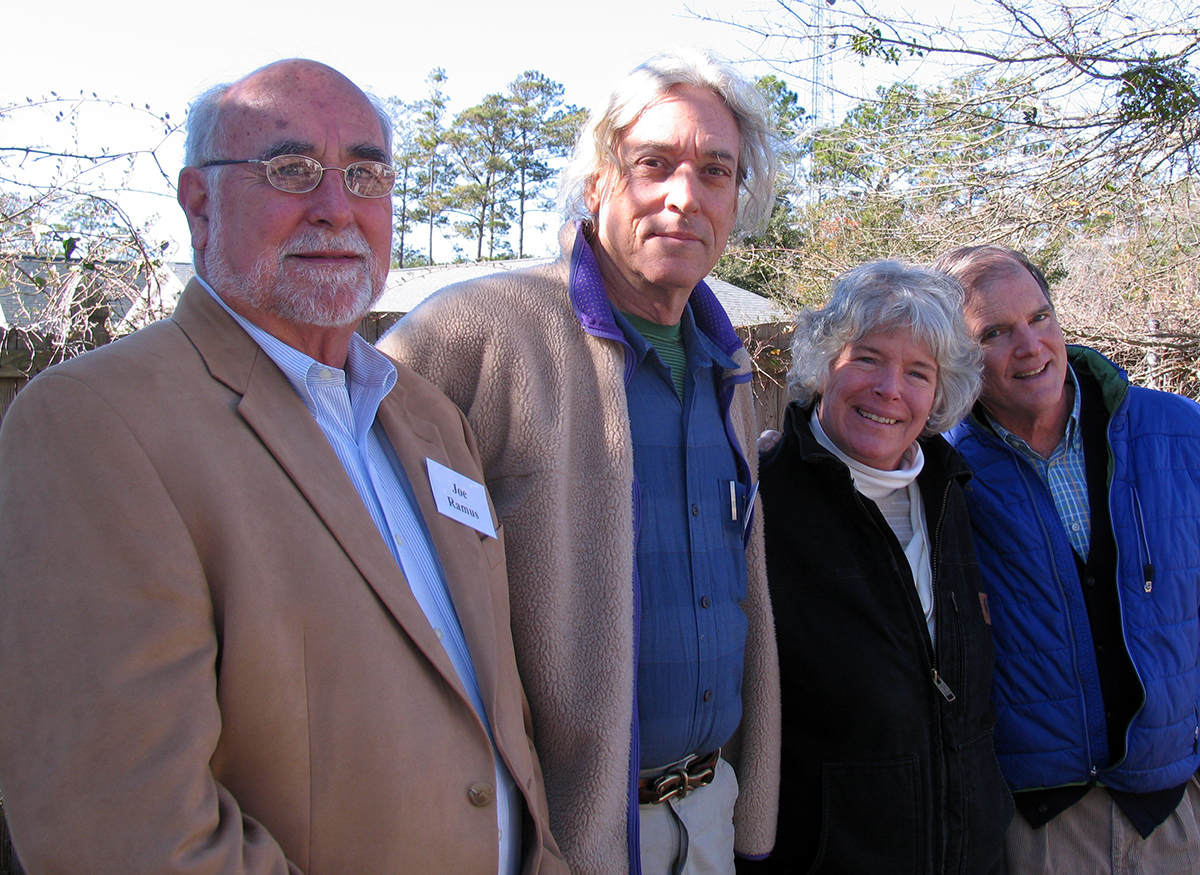
Dr. Joe Ramus was not the man with whom to debate science willy-nilly.
Ever the consummate critical thinker, Ramus was that person who knew that he knew the science upon which he built a storied career here on the North Carolina coast. Ramus, a professor, prolific researcher, former Duke University Marine Laboratory director, and past president of the North Carolina Coastal Federation’s Board of Directors, died Tuesday, Sept. 22.
Supporter Spotlight

As news of his death last week passed through the halls of the higher learning institutions and in the offices of the organizations to which Ramus devoted his time and talents, friends and former colleagues reflected on memories of the man known for his sharp, often dry wit who was passionate about understanding and protecting the coast.
“I considered Joe my older brother and Joe kind of treated me that way too,” Dr. Hans Paerl said with a chuckle during a Sept. 24 telephone interview.
That brotherly bond forged after Paerl, now a retired professor and researcher at the University of North Carolina Institute of Marine Sciences in Morehead City, landed a job exactly the same year and in exactly the same coastal North Carolina county as Ramus.
By that point in time in 1978, Ramus had been a teacher and researcher at Yale University for some 10 years.
Ramus explained in a 2014 interview with Coastal Review that he enjoyed teaching at the prestigious university, but that Yale lacked a marine lab.
Supporter Spotlight
“Yale had a field station on Long Island Sound, and I spent as much time there as I could, but it wasn’t enough,” he said.
Naturally, Ramus did not hesitate when he saw Duke University’s advertisement for an open position at its Beaufort-based marine lab.
“I had 10-year plans: Yale for 10, Duke for 10, then somewhere else,” Ramus said in 2014.
But life and its funny way of upending even the best laid plans spare few, including Ramus, who fell in love with Carteret County and Jackie, a local girl he later married. They were husband and wife until his death.
Paerl who, coincidently enough, lived across the San Fransico Bay from the Ramuses’ Walnut Creek, California, home after his family moved from the Netherlands when he was 10, also applied for the job at the Duke Marine Lab, as well as one at Carolina’s IMS.
“It turned out that it was kind of a preordained marriage because John Costlow, who was the director of the Duke Lab, and Dirk Frankenberg, who was the director of our lab at UNC, they actually got together and decided well, why don’t we just have Joe go to Duke and Hans go to UNC,” Paerl said. “That started our long research careers that complemented each other really well because we needed some plant people at the coast at that time. It was a strong emphasis on fisheries and larger animals and mammals, leaving a big research gap in the role of plants in the coastal environment.”
Ramus’ research focused on larger coastal plants like seagrasses and seaweed. Paerl studied algae.
Together, they mentored graduate students, co-supervised various committees and researched plants in the coastal zone.
They would eventually team up in 2000 to create the FerryMon project, which equips North Carolina Department of Transportation ferryboats with specialized sensors and automated water samplers to collect and monitor environmental data in real time.
“It’s been a very successful merger of scientific expertise and interests, and it’s served the state extremely well because there is nothing out there monitoring water quality in Pamlico Sound on a day-to-day basis,” Paerl said. “FerryMon really filled that void.”
He credits Ramus for securing funding for the project long after money granted through the N.C. Disaster Relief Fund dried up.
“He was a great salesman. He knew how to use the right words with politicians and with the decisionmakers and I just went along with it,” Paerl said.
“Once you got over the fact that he sort of had to pontificate every now and then it was actually a great relationship,” he continued. “He had an interesting way of lecturing where he would not talk down to you but had this kind of air of confidence when he got up there on the stage. And, you know, he had every reason to be confident because he was a very smart guy and 90% of the time, he was right. I let him know about the other 10%.”
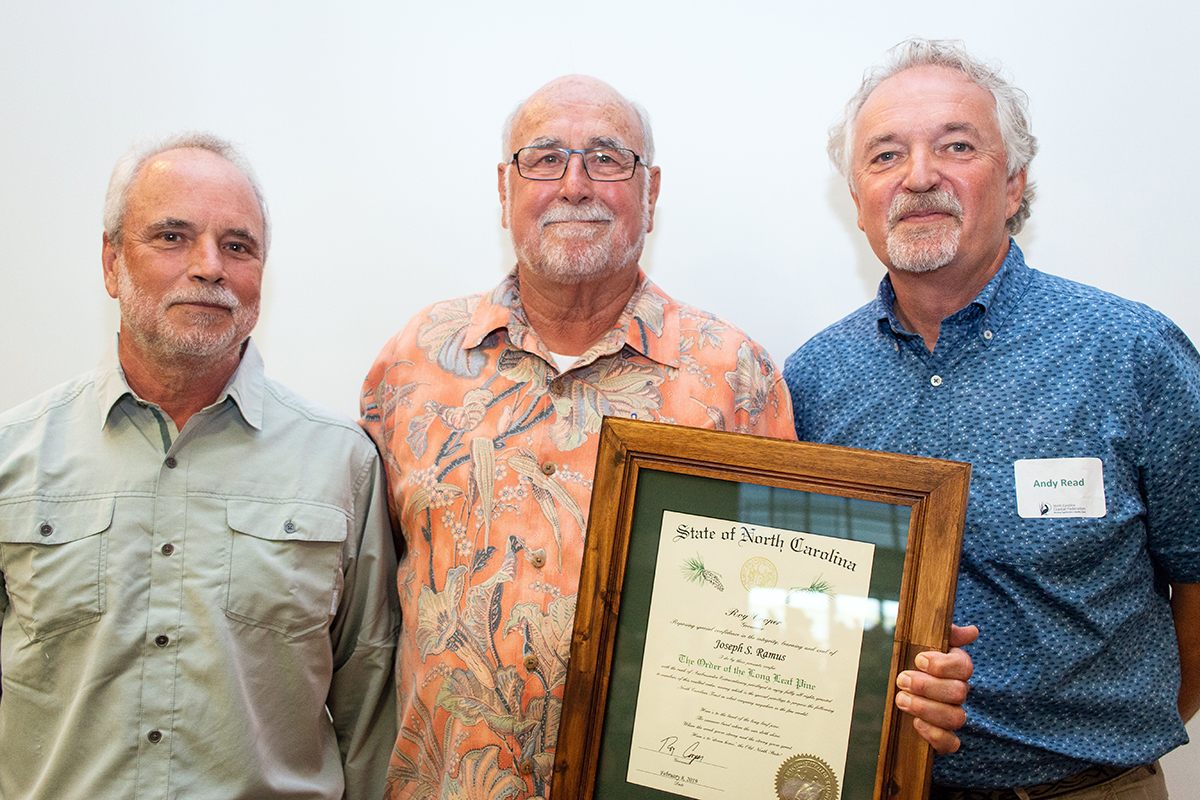
Ramus was awarded the Order of the Longleaf Pine, one of the highest civilian honors in the state, in 2019 for his contributions to science and education, and his environmental leadership as the Coastal Federation Board of Directors. The Coastal Federation publishes Coastal Review.
Even into retirement, their careers continued to parallel. Paerl was bestowed the same honor earlier this year.
Duke University marine biology professor and former lab director Dr. Andy Read explained in a telephone interview Ramus’ role in overseeing the integration of the marine lab into what is today the university’s Nicholas School of the Environment.
“Joe liked to say that that was a very critical time for the marine lab because it gave us an intellectual home. Until that time, the lab had been pretty separate, and I think a lot of people at Duke didn’t really know that we had a marine lab,” Read said.
Forming the school, “really gave us a sense of mission to understand environmental issues that affected our coastal waters,” he said. “That was what he was passionate about, particularly about Pamlico Sound, and understanding both the natural and the anthropogenic factors that kind of forced those systems that we rely on so much.”
Read shared how the two would refer to one another by their line in succession as directors of the lab.
“He used to refer to me as Number Seven because I was the seventh director for the Marine Lab, and he was Number Four. So, we referred to each other as Number Four and Number Seven, which is pretty typical of Joe’s dry sense of humor,” he said.
“He did not suffer fools gladly, I will say that,” Read continued. “There are times that Joe would look at you from behind those glasses of his and you got the sense that what you were saying was being very carefully evaluated. You better be right and you better have the facts supporting your argument because Joe would look very critically at things for sure. He had high standards for science. He expected the people around him to have equally high standards and I think he expected people in positions of authority to appreciate the value of the science and what it means in terms of making decisions that could affect the quality of our environment and the quality of people’s lives.”
Coastal Federation founder Todd Miller remembers his first encounters with Ramus in the 1980s when the Coastal Federation was still a fledgling organization.
“He was a well-known scientist, and I would say intimidating in some respects before I got to know him well,” Miller said. “He just didn’t accept what you said. You had to present your case. I think he just didn’t take things on face value, so you had to be beyond your game if you were going to be convincing with him.”
Miller explained Ramus’ involvement with the Coastal Federation grew over time. And though the science was “always there, front and center in terms of his perspective on things,” Ramus was steeped in his community. He enjoyed spending time on his boat, fishing, and cycling.
“Joe’s legacy lives in the work he helped strengthen and in the people he encouraged to ask harder questions, listen more carefully and keep going,” Miller stated. “I will miss his counsel, his humor and his friendship.”