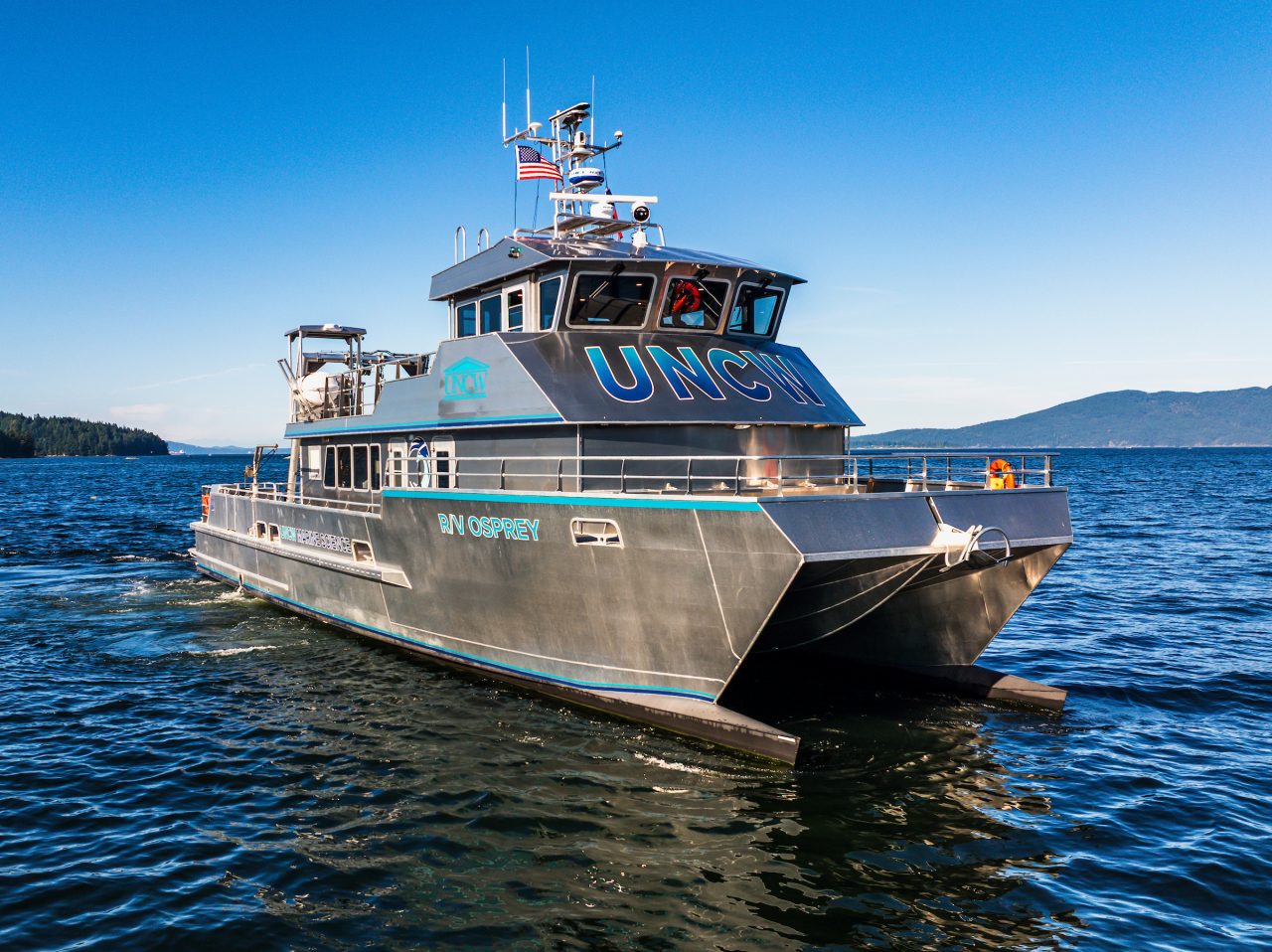
Marine scientists and others at the University of North Carolina Wilmington are waiting anxiously for the arrival of a new $7.5 million, state-funded research vessel that will greatly enhance research capabilities and learning opportunities for students.
While the school’s marine science students hail from far-flung locations, a substantial number are from the Wilmington area and as many as 400 are from in and around Carteret County.
Supporter Spotlight

That’s important to UNCW Director of Marine Operations Jay Styron of Cedar Island and Wilmington.
“I’m excited,” he said Monday afternoon.
“We’ve been pushing for this for 16 years. I can hardly believe we’re finally at this point. We are grateful for the state funding. Delivery is imminent.”
The R/V Osprey was built for the university in Bellingham, Washington. Styron went to the shipyard recently and took the 78-foot-long, 27-foot-wide aluminum catamaran out for sea tests and said Monday it handled the tests beautifully.
“It was great,” he said. “It’s everything we hoped for.”
Supporter Spotlight

Size alone will be a difference-maker.
The RV Osprey is 15 feet longer than the vessel it’s replacing and will be the largest marine research vessel in the region, Styron said.
“It’s even bigger than the research vessel at the Duke (University Marine) lab” on Pivers Island in Beaufort, he said.
Duke’s vessel is a 77-foot, hydrofoil-assisted, aluminum catamaran built by All American Marine and delivered in 2019.
The R/V Osprey is en route to Florida, where Styron will pick up and sail the vessel home to a berth on the Atlantic Intracoastal Waterway off campus.
UNCW’s Center for Marine Science has more than 100 affiliated faculty representing all UNCW colleges. It features offices and laboratories for more than 40 researchers and scientists, 65 students and more than 60 staff members.
Styron said one of the major improvements the Osprey will offer UNCW and the region is enhanced geophysical work, especially in identifying locations of offshore sand.
“Sand is gold now,” he said, because local governments along the coast are constantly looking for sand to nourish beaches that are eroding because of sea level rise and the impacts of hurricanes and nor’easters.
In addition, Styron said, the vessel will enhance research into and monitoring of PFAS.
These compounds, per- and polyfluoroalkyl substances, are manufactured chemicals used since the 1950s to make consumer products resistant to water, grease and heat.
Because of their persistence, they are often called “forever chemicals.”
They don’t break down easily in nature or in humans and are believed to cause high cholesterol levels, liver and immune system damage, low birth weights, some cancers and hormone disruptions.
In Wilmington, problems stem from decades of discharges into the Cape Fear River from the Chemours chemical plant upstream in Fayetteville.
But PFAS also have been found in other locations where water has been tested.
Styron said another use for the vessel will be retrieval of weather buoys associated with the Coastal Ocean Research Monitoring Program, or CORMP.
Styron said the university will seek donors to help cover operational costs for R/V Osprey, with a particular eye on the many wealthy people who have flocked to the North Carolina coast in recent years.
Ultimately, he said, he’d like to see an endowment, such as the one for marine science at Duke University, to cover all costs.
Styron added that the new vessel will enable increased collaboration with the many marine science and fisheries facilities in Carteret County and elsewhere.
Design characteristics
A press release from UNCW states that the vessel design will allow researchers to adapt to a variety of projects, providing dependable access to nearshore environments to make North Carolina an exceptional living laboratory.
“As the state’s coastal university, the (UNCW) Center for Marine Science serves as a hub for research that addresses regional, national and global environmental challenges.
“The R/V Osprey enhances the center’s capacity to support projects focused on coastal resilience, ecosystem health, fisheries, water quality and marine technology”
The custom-designed catamaran hull with hydrofoil allows for increased stability and maneuverability in choppy coastal waters.
The hull design, combined with the energy-rated engines and 6-foot draft, provides fuel- efficient performance on a stable platform.
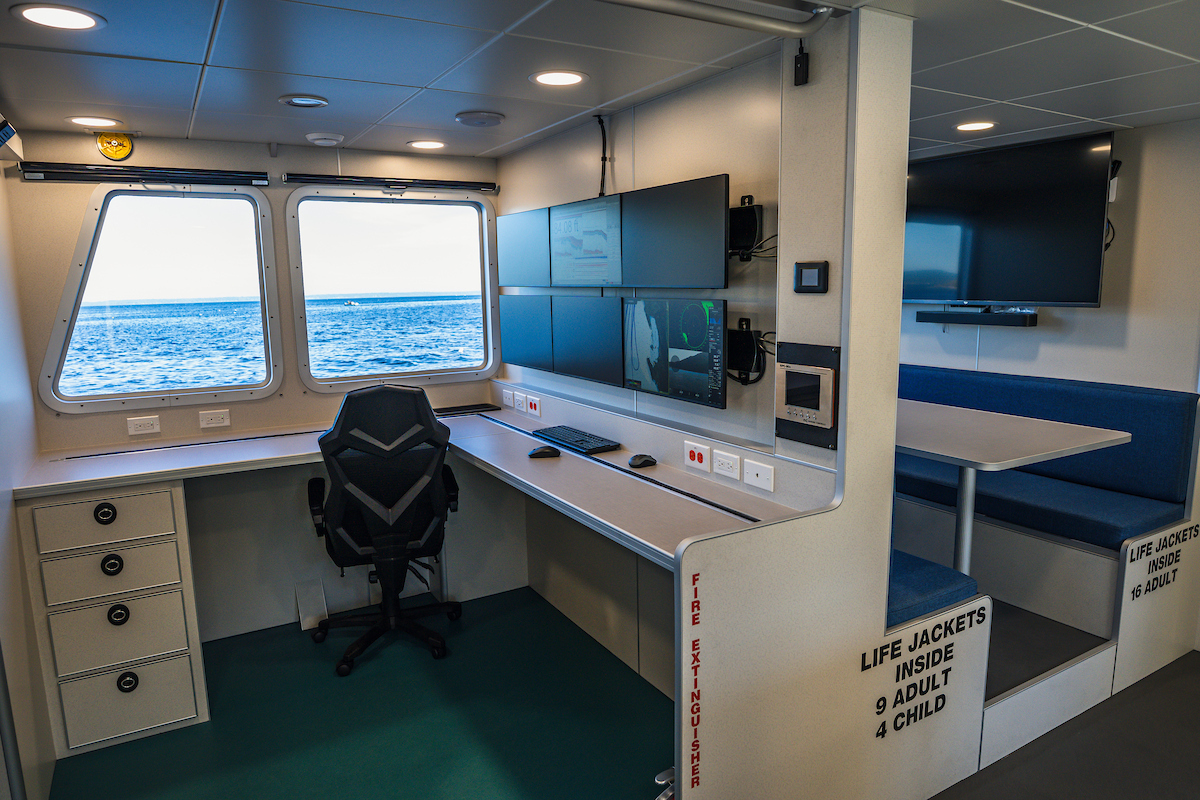
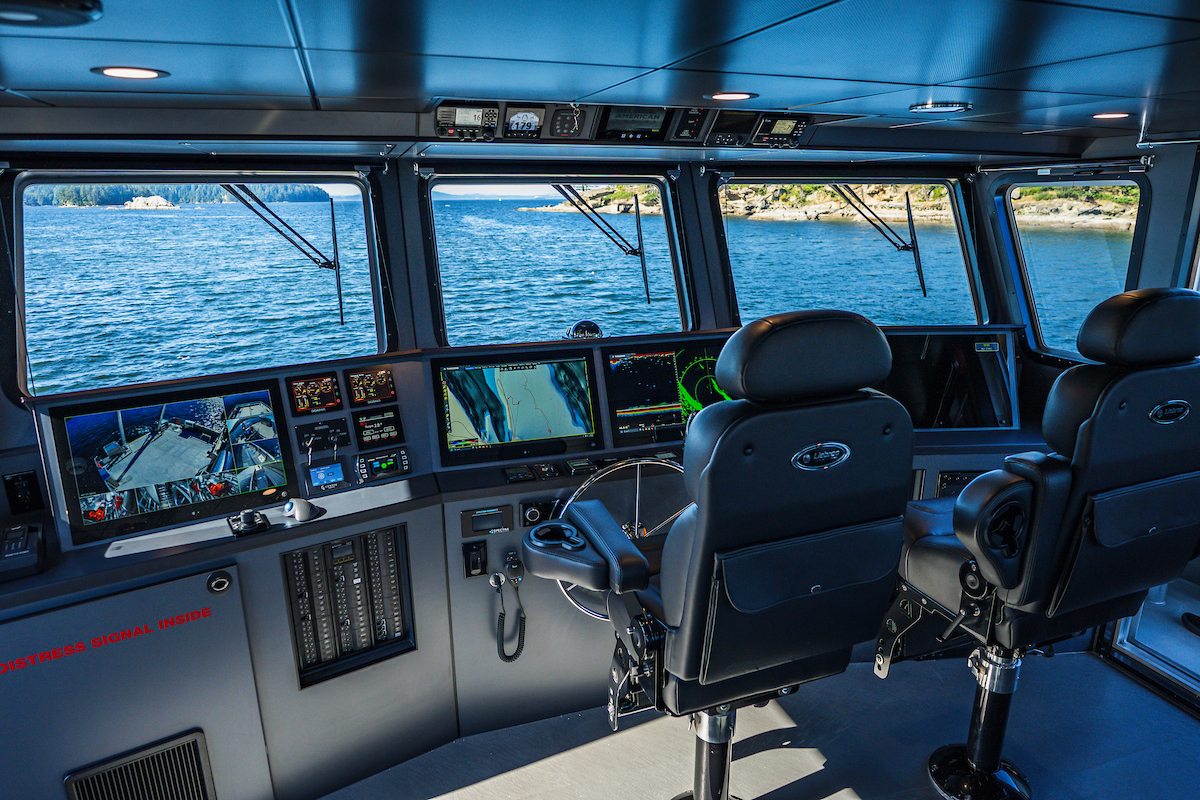
It has an advanced navigation system to fully integrate with instruments and scientists during a cruise.
It includes radar, single-beam sonar, a multibeam sonar, an automatic identification system, or AIS, VHF radio, an an electronic amplification system, or hailer, and a forward-looking infrared, or FLIR, thermal and low-light camera system.
There are berthing spaces for up to 10 crew and researchers with quiet, comfortable rest areas during multiday sea operations, essential for safety and effective operational and scientific work.
Lab space is a climate-controlled environment for processing freshly collected samples, with running seawater, freshwater refrigeration, deep-freeze storage, chemical storage and microscopes. Dry lab space is used for computing and analyzing data collected during cruises. It allows active monitoring of built-in and overboard systems such as acoustic doppler current profiler, or ADCP, to study the water column, a WASSP multibeam sonar system, analytical processes running on scientific computer servers, Wi-Fi, monitors and connection points for geophysical survey equipment.
The 27-foot-wide aft deck is designed to maximize space.