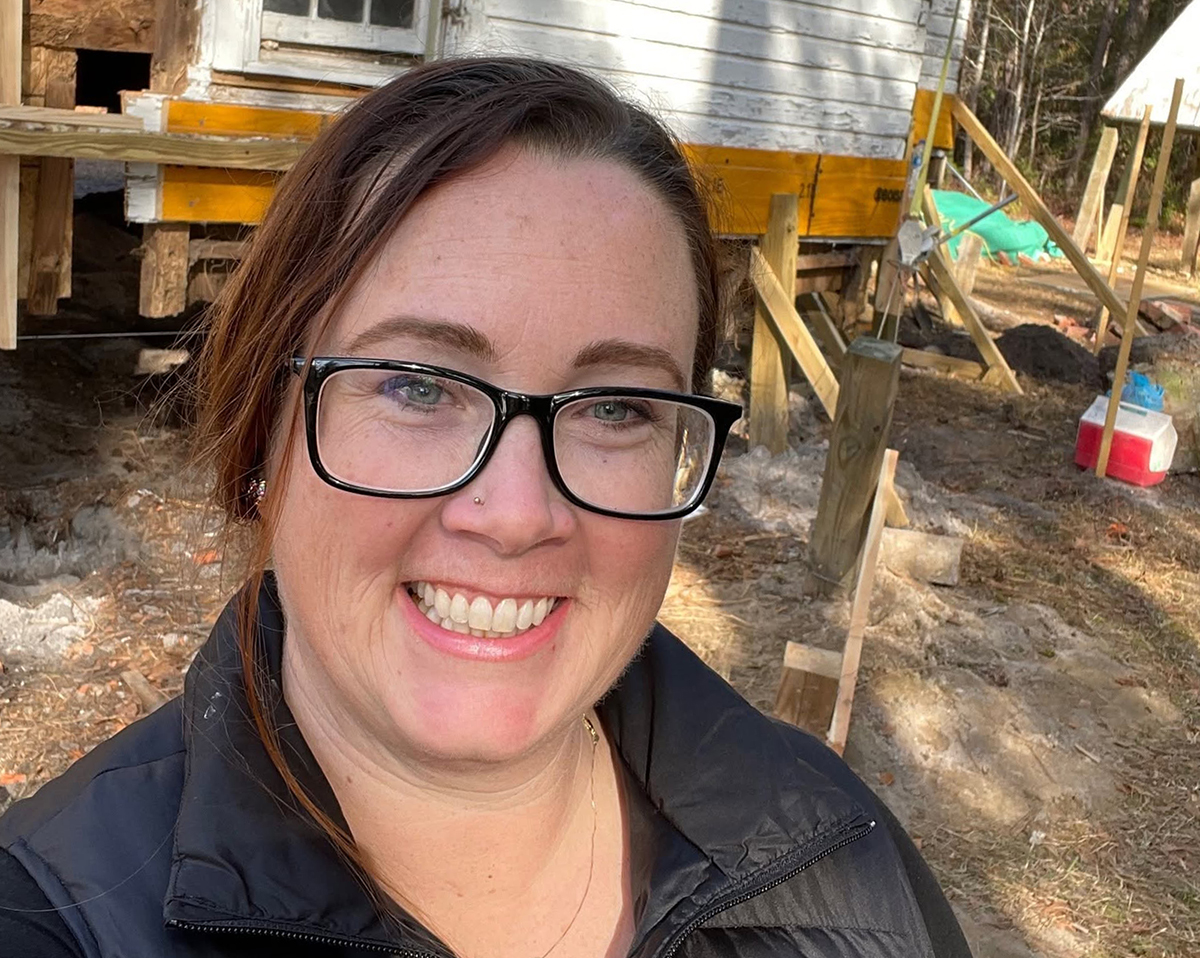
When Jesica Blake accepted a temporary position with the North Carolina Coastal Land Trust in 2002, she was motivated more by a desire to be near family than by the job itself.
Her twin daughters were approaching that bittersweet transition to kindergarten. By that time, she was living in Vermont, far from her native Jacksonville, which she’d left behind for college and adulthood.
Supporter Spotlight

“I really hadn’t thought about my career at that point,” Blake said in a recent telephone interview.
Over the course of three short summer months, the land trust’s Founder Camilla Herlevich and former Director of Land Protection Janice Allen figured out how to make Blake’s staff position permanent. Blake would become the nonprofit’s first dedicated stewardship staff member.
What has followed since those early years is one woman’s story of growth in both profession and passion for the places and people with and for whom she works.
Blake officially took the helm of the land trust as its executive director on Oct. 1. She replaces Harrison Marks, who is now senior adviser.
Though she’s far from new to the inner workings of a nonprofit that has played a pivotal role in shaping conservation efforts in North Carolina, the move from assistant director to director is still a transition, Blake said.
Supporter Spotlight

“One of the great things about being here for 24 years is that I am aware there are going to be some challenges, but I also feel like I have a thorough understanding of what’s under the hood,” she said. “I know what the challenges are and I am planning on being very deliberate in how to increase some systems to address some of those challenges and also allow for creativity from this very talented, professional staff that we’ve built to help address those challenges.”
Recruiting the land trust’s new director of stewardship and special projects, Carlos Torres Báez, was interesting, Blake said, because that was her first experience hiring someone to replace the role she filled for more than 20 years.
“I’m very cognizant about making sure that my way isn’t the only way in that department and I’m excited for the expertise that Carlos brings because I think he can improve on the stuff that I’ve done and I’m really excited for that for him,” she said.
Blake holds a deep attachment to that particular job because it was the spark that launched a career she had not anticipated when she moved to Wilmington in 2002.
“The more I did, the more I loved. I was just really honored and privileged to work with people like Camilla Herlevich and Janice Allen. The depth of knowledge, their skill sets, were amazing. When you stay somewhere that you love and are trained by the best, you have the opportunity to continue to grow your responsibilities and they made that possible,” she said.
Since its founding in 1992, the Coastal Land Trust has been instrumental in forging relationships with property owners and communities resulting in the conservation of more than 91,000 acres in eastern North Carolina.
Of the successes the organization has celebrated over the years, the project that is perhaps the dearest to Blake is the restoration of Reaves Chapel, a historic African American church off the banks of the Northeast Cape Fear River in Navassa.
This was her “heart project,” she said, one different than any other she’d worked on before. Blake refers to 2015, the year she started working with the Brunswick County town, a “great marker” in her career path.
The chapel was built between 1860 and 1880 by formerly enslaved people known as the Gullah Geechee. The building is one of the oldest African American structures in Southeastern North Carolina.
“What was really different about Reaves Chapel was the immersion into a community, being welcomed in and building trust, and have it be because of my authentic devotion and admiration and want to be able to support, that I would say probably gave me a lot of confidence in some of the things that I just took for granted as part of my job,” she said. “Reaves Chapel was where community met. It’s where they learned, they celebrated births and mourned deaths. It’s where they were able to meet in a world that didn’t accept African Americans having other places to go, so it expanded my view of what conservation can be.”
The restoration and conservation of the little chapel, a wood framed church marked with colored windows and topped with a steeple, took 10 years to complete.
The project taught Blake patience and how to pivot when the unexpected happens, whether it be a pandemic or hurricanes or, in this case, a combination thereof.
“I spent many times before meetings, getting [to the chapel] and hour early and laying on the floor just kind of to clear my head and think about all the possibilities. What are we missing? Who needs to be included? How does that look?,” she said. “That project kind of reinvested my questions about conservation and what it means to people and making sure that we always ask, does it need to be us, is there someone better suited for this? And, in that particular case, there was not.”
Another pivotal project in Blake’s career goes back to her earlier days with the land trust.
Springer’s Point Preserve, one of the last remaining undeveloped areas on Ocracoke Island, was the first preserve in which Blake had start-to-finish involvement. Trail design was not a skill set Blake had at that time in the early 2000s, but that project gave her the opportunity to learn, she said.
Today the preserve spans more than 132 acres where guests can hike winding trails through maritime forest, along salt marsh and wet grasslands to the beach.
The twins Blake reared along with their younger brother are now young adults forging their own career paths. Gone are the days of Blake’s time as the dedicated minivan-driving mom shuttling her children to soccer, hockey and lacrosse games.
This was her time to step up into the role of the land trust’s executive director.
As far as she’s concerned, she’ll be a “ticket junkie” for the foreseeable future.
“Regardless of it being a movie or a concert or plane tickets, in my rule book you can’t turn those tickets in without having another pair on deck. I populate my calendar with work responsibilities because I am really hoping to get out and sit down with a lot of people that have supported us for a while to hear what they think and have them have some one-on-one time and feedback time as I take over. But there will still be time for tickets. There’s always time for tickets,” she said.
Looking back, Blake said opportunities for other jobs routinely knocked at the door.
“But at the end of the day the people, not just the people that work here, but the people of eastern North Carolina, the landowners, the general public, the communities like Navassa and the biological beauty of this place – that’s what’s kept me here,” she said. “I love the swamps and I love our landowners. If there was one thing that I want people to know is the reason that I’m taking this position is not to be an executive director of a land trust, it is to be the executive director of a land trust that protects and does conservation in eastern North Carolina for the people of North Carolina.”