Jamie and Paul Lane had expected to spend their week before Christmas fishing for perch in the Albemarle Sound. Instead, restrictions on gillnet use led to them losing an important part of their season.
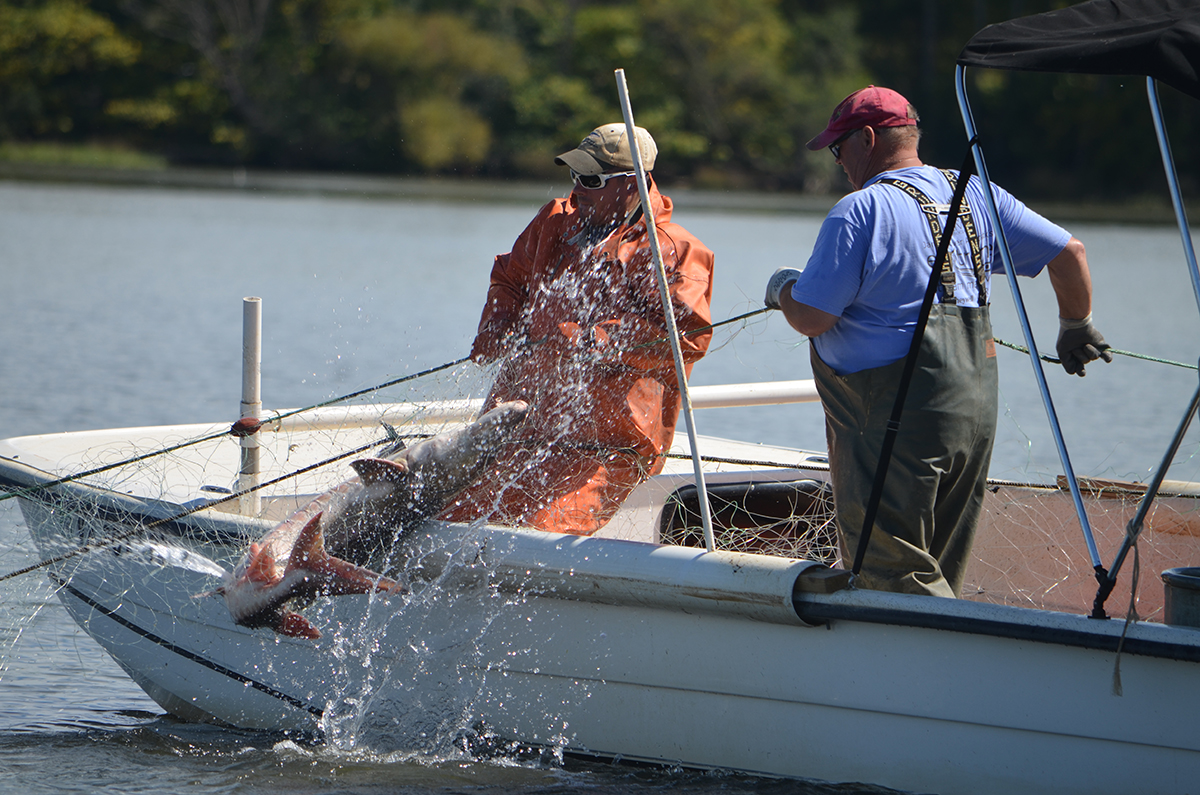
A Dec. 17, 2025, proclamation from the North Carolina Division of Marine Fisheries restricted gillnets across Management Unit A under the state’s federal permit for protecting endangered Atlantic sturgeon and sea turtles. Jamie Lane said four observed sturgeon interactions in a small-mesh fishery were extrapolated to nearly 85 estimated takes, threatening to shut the fishery down.
Supporter Spotlight

“Right there, a week before Christmas, there’s not a lot of other options at that time of year,” Jamie Lane said. “That’s very detrimental to your livelihood.”
This closure is part of a broader dispute over whether North Carolina’s Atlantic sturgeon population has recovered enough to call for less restrictive protections. The Lanes are part of a group of commercial fishermen asking the National Oceanic and Atmospheric Administration to reclassify the Carolina population from endangered to threatened, arguing that sturgeon are more abundant, mortality is low and current regulations have reduced the risk from gillnets. Scientists and federal officials, however, say the population is depleted compared to historical levels, and that increases in juvenile fish or sightings by fishermen do not necessarily show that adult sturgeon have recovered.
Paul Lane, who has been commercial fishing for more than 40 years, said that sturgeon catches were once “talked about almost like a Bigfoot sighting,” and now, fishers cannot seem to stop accidentally catching them.
In their petition to NOAA, the fishermen point to the Atlantic States Marine Fisheries Commission’s 2024 stock assessment as evidence of recovery in the Carolina distinct population segment (DPS). They argue the assessment raises questions about how the population can be labeled depleted while its abundance has increased since 1998.
“They themselves, the ASMFC, noted their own self that there was a 100% probability that coastwide abundance has increased since 1998,” Jamie Lane said. “So even while they wrote it was depleted, they admitted the abundance had increased, and of all the different distinct population segments, the Carolina DPS was the number one in the recovery.”
Supporter Spotlight

The federal permit allows North Carolina’s gillnet fishery to continue, but it sets limits on interactions with sturgeon and sea turtles. Observers monitor 7-10% of large-mesh trips and 1-2% of small-mesh trips, and fishermen are required to report sturgeon interactions within 24 hours. Those observations are then used to estimate the number of takes across the fishery. If estimated or observed takes approach the permit’s limits, the state can enact additional restrictions or close fisheries.
The regulatory system has developed since the Carolina DPS was listed as endangered in 2012, with the state receiving its first sturgeon-specific permit in 2014 and replacing it with the current combined permit in 2024. Under the new permit, a “take” does not necessarily mean a sturgeon dies. Live, released fish can still count toward estimated takes, which the fishermen say is posing the most significant issue, as most sturgeon they catch are released alive.
The fishermen repeatedly use the 2024 stock assessment as evidence of recovery. But James Boyle, an ASMFC fishery management plan and an author of the assessment, said the figures are being misinterpreted. The assessment found a 77% probability that the Carolina DPS’s abundance index was higher at the end of its survey period than its reference point. That was the highest probability among all DPSs, but Boyle said the figures cannot be used to rank DPSs by recovery.
“It’s really hard to compare those across DPSs to say in that 77%, you’re comparing Carolina to Carolina from 1998,” Boyle said. “So that doesn’t mean that it’s recovered or that there are more fish there than in the Gulf of Maine, which has 45%.”
Coastwide, the assessment found a 100% probability that abundance was higher than in 1998. The assessment finds it likely the coastwide population has increased but is still depleted relative to its much larger historical population.
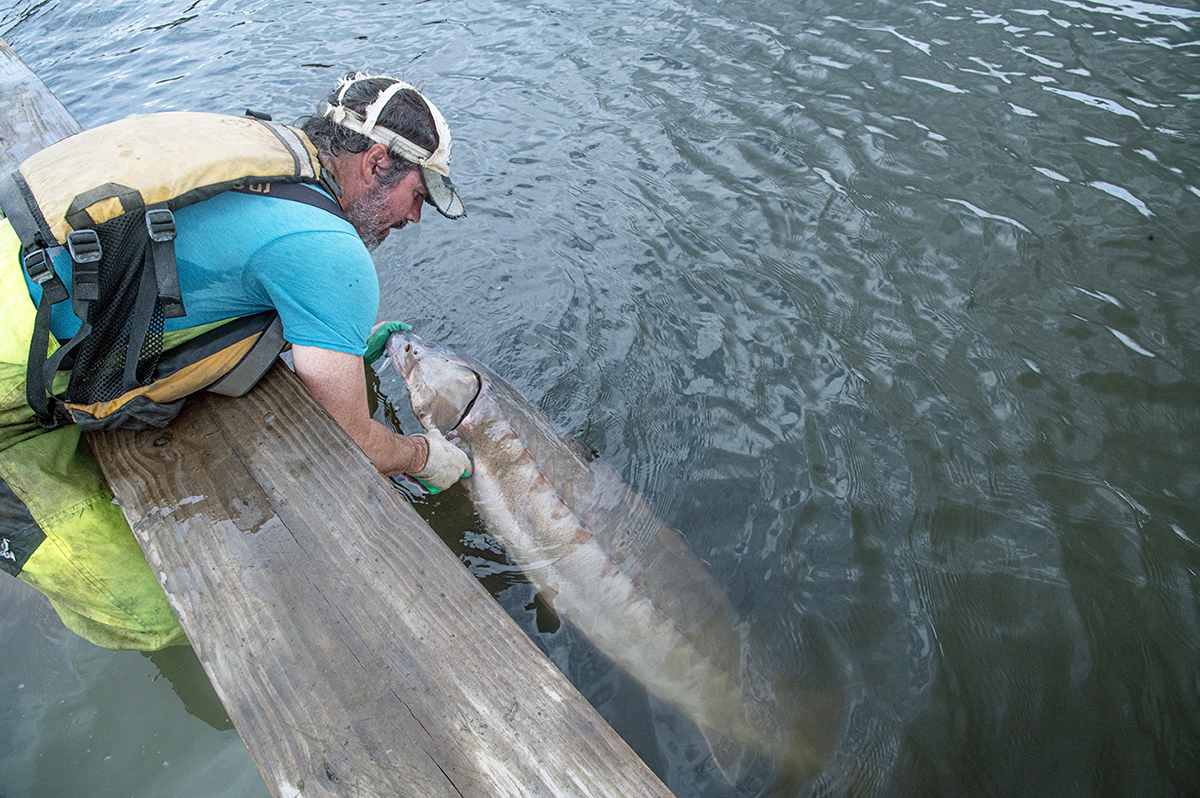
The fishermen also point to broader signs of improvement in the population, including the range of sturgeon sizes found in the assessment, from 5 to 72 inches, as evidence of smaller, younger fish indicating a healthy and growing population. But Dave Kazyak, a U.S. Geological Survey research biologist who studies Atlantic sturgeon, said the North Carolina surveys used in the assessment focus largely on young-of-year and juvenile fish. An increase in those fish can be encouraging, he said, but it does not necessarily represent the status of the adult population.
Kazyak said that distinction is especially important for species like the Atlantic sturgeon, which live up to 60 years. Most juveniles remain in their natal rivers for several years before moving to the ocean. Changes in the number of young fish may take years to translate into changes in the adult population.
There is another complication, in that fish found in North Carolina do not always respect state boundaries. Kazyak said sturgeon from different populations can overlap, meaning a survey can capture a mixture of fish whose populations may be changing in different directions.
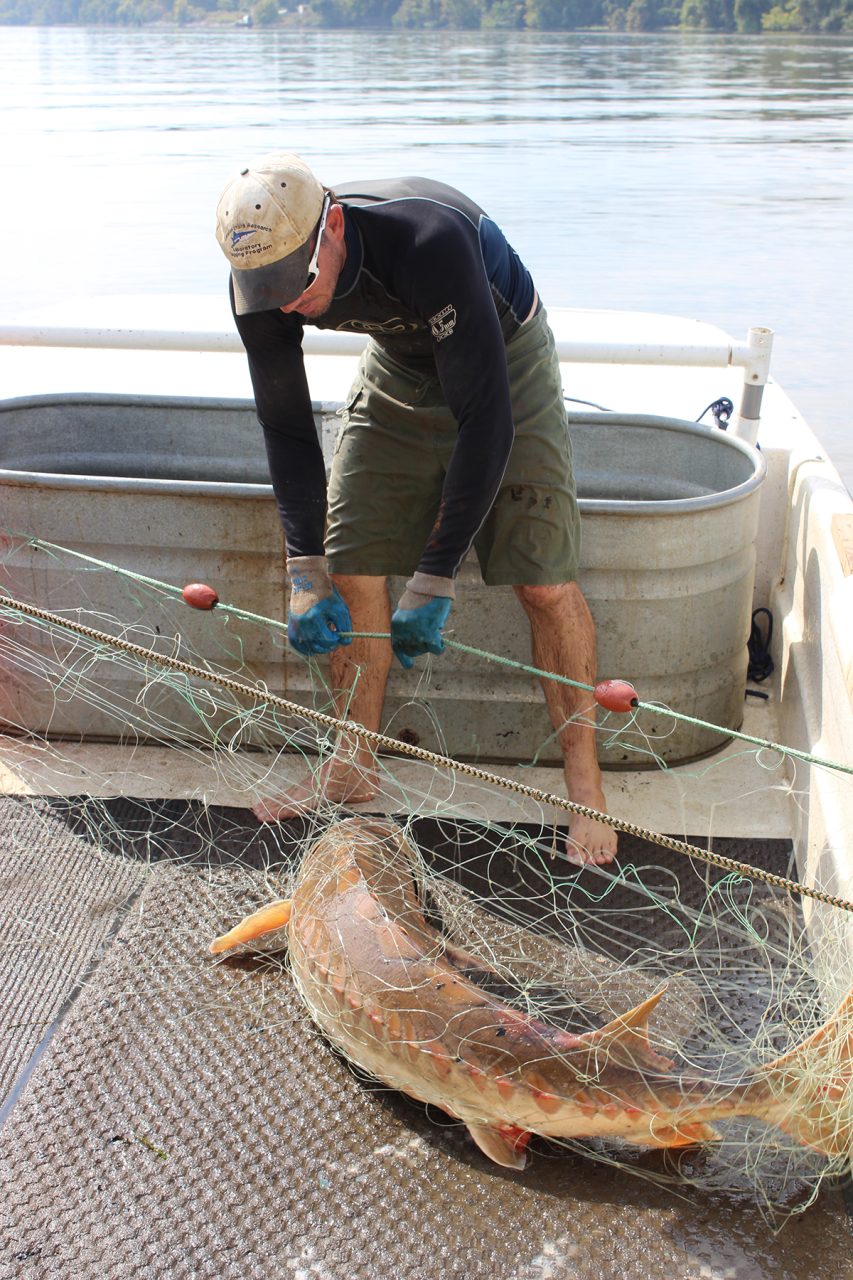
“If you’re just naively tracking abundance over time, you’re kind of getting a composite signal on how different populations are doing, and they may not all be going in the same direction,” Kazyak said.
Scientists also lack a direct estimate of the total number of sturgeon in the Carolina DPS. Instead, they use surveys to track if the population is changing over time. That makes it difficult to estimate exactly how many adult fish remain in the DPS.
That uncertainty extends beyond what happens after a sturgeon is released. Sturgeon are particularly susceptible to gill nets because their bony scutes can become trapped in the mesh. Kazyak said the amount of time a fish remains entangled can affect whether it survives in the long term or if it is able to continue breeding, meaning a live release does not necessarily tell researchers everything about the impact of the interaction.
“Because they live a long time, have a low rate of natural mortality and they don’t mature until they’re relatively old, it doesn’t take a lot of additional mortality from people to change the population trajectory,” Kazyak said.
Since the petition’s filing in January, the Lanes said their concerns have been met with deaf ears. They said they initially filed a 30-day notice of intent to submit the petition in December, then sent the downlisting petition to NOAA on Jan. 25. After receiving no response, they said they followed up in April, shortly before the 90-day deadline.
In May, Andrew Herndon, a NOAA Fisheries staff member handling the petition, told the Lanes that the agency had received their request and was working on it. By June, Herndon told them the review remained incomplete because of staffing shortages and competing priorities, according to the Lanes.
The Lanes later sent NOAA a 60-day notice of intent to sue over the delayed finding. Under the Endangered Species Act, NOAA is generally required to make a decision within 90 days on whether a petition provides enough scientific or commercial evidence to warrant further action, when practicable.
NOAA’s website currently lists the Carolina Atlantic sturgeon petition, received Jan. 28, as still awaiting its 90-day finding.
In an email, Herndon told Coastal Review that the petition is still under review, and he could not provide a timeline for completion. He said that after his assessment is finished, the petition will undergo internal review, which he has no control over.
The Lanes said, ultimately, their push for a downlisting is not an effort to weaken protections for sturgeon but to recognize what they see as a recovering population.
“We want to work. We don’t want to mess with the sturgeon,” Jamie Lane said. “We want their population to recover.”