Founder’s commentary
The North Carolina Coastal Federation publishes Coastal Review.
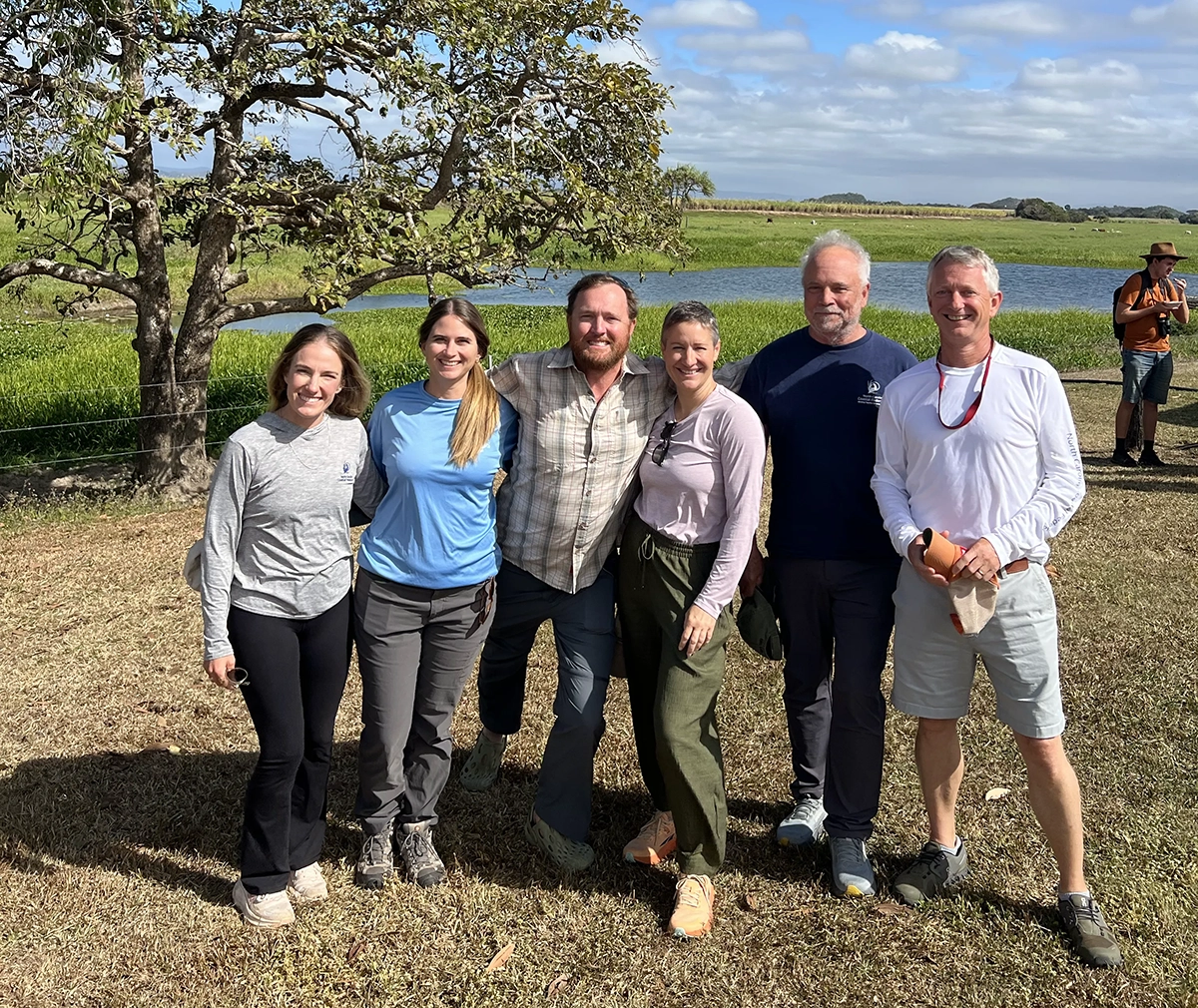
In July, nearly 50 scientists, restoration practitioners, community leaders, government officials, and conservationists from Australia, the United States, and the United Kingdom gathered at James Cook University in Townsville, Australia, around a deceptively simple question: What will it take to make our coasts more resilient for people and nature — and restore coastal habitats at the scale and speed now required?
Supporter Spotlight

After three days of discussion, one conclusion stood out:
We increasingly know how to restore coastal ecosystems. Our greatest challenge is creating the partnerships, financing, science, policies, and community capacity needed to put that knowledge to work at a much larger scale.
When many of us began this work decades ago, coastal restoration was largely experimental. Today, projects around the world demonstrate that wetlands, oyster reefs, mangroves, seagrasses, rivers, floodplains, and coastal forests can be restored to improve water quality, support fisheries, reduce flooding, store carbon, provide habitat, and protect communities.
The Need for Scale
Restoration has matured from a collection of individual projects into an international movement. Our ambitions must mature with it.
Too often, we still proceed one project, one permit, and one grant at a time. Meanwhile, sea level rise, storms, declining water quality, habitat loss, and a warming climate operate across entire landscapes. We need sustained efforts encompassing whole rivers, estuaries, and coastlines — not scattered projects lasting only a few years.
Supporter Spotlight
Scientist Kevin Kroeger introduced us to the concept of LUNEs — Large Unreplicated Natural Experiments. At the scale at which restoration increasingly must occur, we cannot always wait for small, replicated experiments to answer every question before acting. Large restoration projects can themselves become carefully monitored experiments where scientists, practitioners, landowners, and communities learn together and adapt as conditions change.
The Cost of Moving Too Slowly
Events in Nepal provide a terrible reminder that the question of scale is not academic. A massive glacier and ice-rock collapse high in the Himalayas unleashed an immense half-billion-ton avalanche, triggering catastrophic flooding through the valleys below. The unprecedented disaster has claimed nearly 1,000 lives, with more than 4,000 locals and tourists still reported missing.
Scientists will need time to determine precisely how climate change contributed to this event. But it occurred against a clear backdrop of climate-driven change. Warming temperatures are melting glaciers and thawing permafrost, destabilizing high-mountain landscapes and increasing risks to communities below.
Nepal is thousands of miles from the coastlines we discussed in Townsville, but the lesson is painfully relevant. We experienced our own warning in North Carolina when Hurricane Helene brought catastrophic flooding to mountain communities in and around Asheville — far from the coast where we have traditionally focused much of our climate resilience work.
These events remind us that climate change does not respect boundaries between mountains, rivers, estuaries, and oceans. Places once considered relatively safe are increasingly vulnerable to impacts that can cascade across entire landscapes. They should not come as surprises, but as stark warnings that nowhere is immune—and that incremental responses will not be sufficient for changes occurring at this scale.
Adaptation — restoring wetlands, protecting floodplains, improving early-warning systems, and making communities more resilient — is essential. But adaptation alone cannot be our strategy. Unless the world also reduces emissions and ultimately removes some of the carbon already accumulating in the atmosphere, we will continually be adapting to a climate that becomes more difficult, expensive and dangerous to live with.
That is why one of the most provocative discussions in Townsville was also one of the biggest.
Scale in the Ocean
Kroeger challenged us to think at an almost unimaginable scale.
Beneath many coastal regions lie enormous deposits of limestone and other alkaline minerals. If we can learn to use these materials safely and efficiently to increase ocean alkalinity, we may be able to enhance natural processes through which the ocean absorbs carbon dioxide from the atmosphere and stores it in stable dissolved forms. Such action is likely necessary to remediate ongoing acidification of the oceans, since ceasing emissions will not be enough to restore healthy ocean acidity levels. Adding alkalinity to the oceans can be viewed as ecosystem restoration on the grandest scale.
The quantities involved would be enormous. Removing a billion tons of carbon dioxide annually through some mineral-based approaches could require processing and moving well over a billion tons of mineral material each year—approaching the scale of major global mining, shipping, and energy industries.
But perhaps that is Kroeger’s larger point.
For two centuries, humanity has constructed an extraordinary global infrastructure to extract fossil carbon from underground and transfer it into the atmosphere. Addressing that legacy may ultimately require comparable ambition to harness natural minerals, ocean chemistry, and other processes capable of moving some of that carbon back out.
Even a regional effort illustrates the challenge. If the Southeast U.S. Atlantic coast someday sought to remove 100 million tons of carbon dioxide annually through mineral-enhanced ocean alkalinity, deployment would have to occur on an enormous scale. The precise amount of mineral required would depend on its composition and how quickly and efficiently it reacts, but a mature program could require placement of 100 million tons or more each year, sustained for decades. Achieving that scale would require a major industrial system of mines, processing facilities, railroads, barges, ports, energy infrastructure, and extensive environmental monitoring.
Carbon removal at meaningful scale begins to look less like a conventional restoration project and more like building an entirely new industrial infrastructure.
The science is not ready for that scale today. Ordinary limestone cannot simply be spread into seawater and expected to solve the problem. We need to determine how minerals can be processed and dissolved efficiently, understand ecological effects and energy requirements, reliably measure actual carbon removal, and demonstrate that benefits substantially exceed impacts.
But that was precisely one lesson from Townsville: We need to begin testing solutions capable of eventually operating at scales commensurate with the problems we have created.
Scale on Land
Thinking big does not apply only to the ocean.
Coastal farms, forests, and other undeveloped working lands may become some of our most important restoration opportunities in coming decades. A farm or managed forest can potentially become tomorrow’s wetland, floodplain, or marsh migration corridor. Once that same land is covered with roads and buildings, those opportunities may disappear permanently.
That means partnering with willing farmers, foresters, and other landowners now — not necessarily to remove land from productive use, but to help keep working lands economically viable and undeveloped while preserving future restoration options.
Don’t Just Preserve — Restore
We also need to change how the world thinks about landscapes that have already been damaged.
Conservation has understandably emphasized protecting the best natural places that remain. But achieving coastal resilience will also require reclaiming wetlands and other habitats that previous generations drained, ditched, cleared, or otherwise degraded.
In coastal North Carolina, we intend to pursue international recognition under the Ramsar Convention on Wetlands for a major restored wetland landscape. The point is not simply another designation. We want to demonstrate that internationally significant wetlands do not have to be places that escaped human alteration. They can also be landscapes that people had the vision and persistence to bring back.
Recognizing outstanding restored wetlands alongside pristine ones would send a powerful message: Restoration can recover some of what we have lost.
We hope our partners in Australia, the United Kingdom, and elsewhere will identify exemplary restored landscapes of their own so we can learn from one another.
Communities Must Own the Effort
Perhaps the most important lesson from Townsville is that restoration cannot succeed as something done to communities — or even simply for them. It must be done with them and ultimately become something communities see as their own.
For people who live and work along the coast, restoration is not primarily about acres of wetlands or miles of shoreline. It is about whether homes are safer from flooding and storms; whether pollution threatens fisheries, tourism, aquaculture, and recreation; and whether communities can withstand events capable of undermining economies built over generations.
Residents, landowners, businesses, fishers, farmers, Indigenous communities, local governments, and other interest holders also possess knowledge that can make projects better. Their participation builds the trust and long-term commitment needed to sustain restoration long after an individual grant ends.
When healthier wetlands, rivers, reefs, forests, and estuaries also mean cleaner water, stronger fisheries, reduced flood risks, economic opportunity, and safer communities, restoration stops being someone else’s environmental project.
It becomes a community investment worth protecting.
Regulation Must Catch Up
Restoration projects need strong environmental safeguards. But regulatory systems should evaluate restoration differently from projects that primarily cause environmental harm. Rather than focusing only on potential risks, regulatory decisions should weigh those risks against the environmental benefits of restoration—and the consequences of doing nothing. The goal should be rigorous review that protects the environment while enabling projects designed to restore it.
We need faster permitting pathways for proven restoration practices, coordinated agency reviews, science-based performance standards, and where appropriate, pre-approved categories of restoration projects.
Practitioners have responsibilities, too. Better permitting requires complete plans, sound science, and meaningful interest holder engagement. Reform should mean making good restoration easier — not lowering environmental standards.
Invest Like It Matters
Finally, none of this happens without sustained investment.
Government grants alone cannot meet the need. Wetlands, reefs, floodplains, forests, and other natural systems should increasingly be viewed as essential infrastructure — worthy of investment because they protect communities, improve water quality, sustain fisheries, conserve biodiversity, store carbon, and reduce future risks.
If we are serious about restoring entire coastal landscapes rather than isolated projects, our financing systems must become capable of supporting that ambition.
The Path Forward
The Townsville Summit did not produce one new solution. It produced something potentially more important: recognition that we must match the scale of our solutions to the scale of our problems.
Participants challenged the international community to at least double the pace and scale of coastal restoration, protection, and resilience investment by 2035.
That is ambitious.
It needs to be.
The encouraging lesson from Townsville was that people separated by thousands of miles are wrestling with remarkably similar problems — and developing solutions that can help one another.
The knowledge exists. The partnerships are growing. The consequences of moving too slowly are becoming increasingly visible.
Now we must make our coasts more resilient for people and nature, restore what we have lost, and begin confronting the forces driving these changes — at the speed of need.
Todd Miller helped organize the international Townsville Coastal Restoration Summit with Nathan Waltham of James Cook University and Roger Proudfoot and Eve Leegwater of the UK Environment Agency. The summit brought together scientists, restoration practitioners, community leaders, government officials, and conservationists from Australia, the United Kingdom, and the United States to explore how coastal restoration can be advanced at the scale and speed now required.