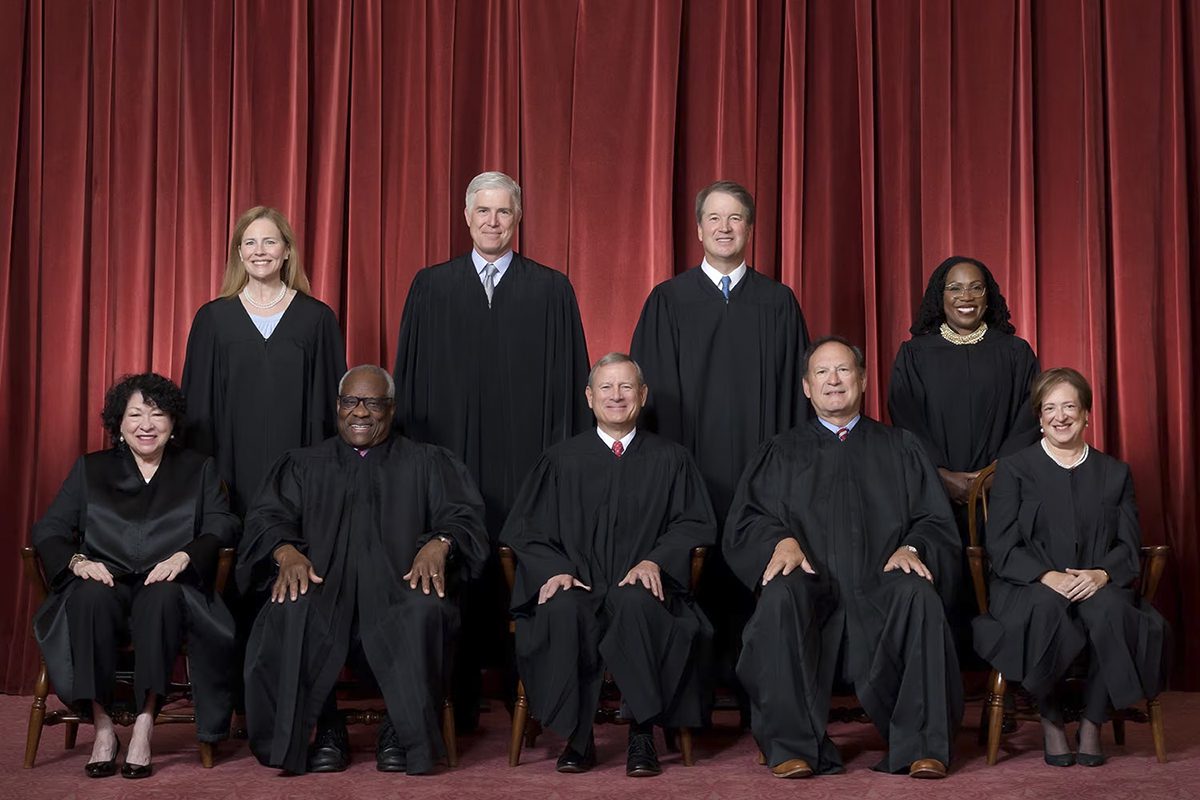
The maker of weed killer Roundup, with a supporting amicus brief from the Trump administration, has won a Supreme Court case that shields the corporation from liability from users who alleged the company failed to warn consumers that it could cause cancer.
The case involved a Missouri man named John Durnell who in 2019 sued Monsanto, which is now owned by Bayer, in state court, alleging his use of Roundup, a glyphosate-based herbicide, over about 20 years caused his non-Hodgkin’s lymphoma. Durnell asserted that Monsanto should have included a cancer warning on the Roundup label.
Supporter Spotlight

A jury awarded Durnell $1 million, and he won on appeal, but the U.S. Supreme Court reversed the decision, with Justice Brett Kavenaugh writing for the majority, Justice Clarence Thomas filing a concurring opinion and Justice Ketanji Brown Jackson writing the dissent, which Justice Neil Gorsuch joined. The majority held that the Environmental Protection Agency’s approval of the product label meant that Roundup could only be sold with the label exactly as the EPA approved it. The opinion held that, “if third parties (like Durnell) want to bring new information to EPA’s attention or if they believe that EPA has failed to consider relevant information, those third parties are free to petition EPA to modify, suspend, or cancel a pesticide’s registration.”
“Because EPA has repeatedly concluded that glyphosate is not likely to cause cancer, the agency has not required a cancer warning on Roundup’s label,” Kavanaugh wrote. “Importantly, EPA’s regulations require a pesticide manufacturer such as Monsanto to use the EPA-approved pesticide label—here, the Roundup label without a cancer warning—unless and until EPA approves or requires a different label.”
Monsanto had argued, and the majority agreed, that a provision of the Federal Insecticide, Fungicide, and Rodenticide Act, or FIFRA, “expressly preempts Durnell’s failure-to-warn claim,” meaning that
The majority opinion “departs from the near-unanimous view of the many state and federal courts that have rejected this preemption argument,” Jackson wrote in her dissenting opinion.
“In my view, the majority should have joined that chorus,” Jackson wrote. “Durnell’s failure-to-warn claim is not “in addition to or different from” FIFRA’s mandates; it is equivalent to FIFRA’s key labeling requirement—the misbranding prohibition.”
Supporter Spotlight