Editor’s Note: After Sam Bland retired from his position as superintendent at Hammocks Beach State Park, he joined the staff of the North Carolina Coastal Federation. While a coastal specialist in the 2010s, he would periodically write about his time in the field for Coastal Review. Now traveling the country, Bland drops a line every once in a while to share a new adventure with his readers, such as the following:
Supporter Spotlight
Many years ago, as a teenager, I was driving through Marine Corps Base Camp Lejeune in Onslow County. This was pre-9/11 when civilians could take the shortcut through the base to bypass the heavier Jacksonville traffic.
On one of the lonely roads that travels through the lofty pines and scattered wetlands, I was well away from the main base area. I came upon a traffic jam of cars parked helter-skelter on and off the road. It looked like an apocalypse, or maybe the rapture had just happened.
People were abandoning their vehicles and gathering down the road.
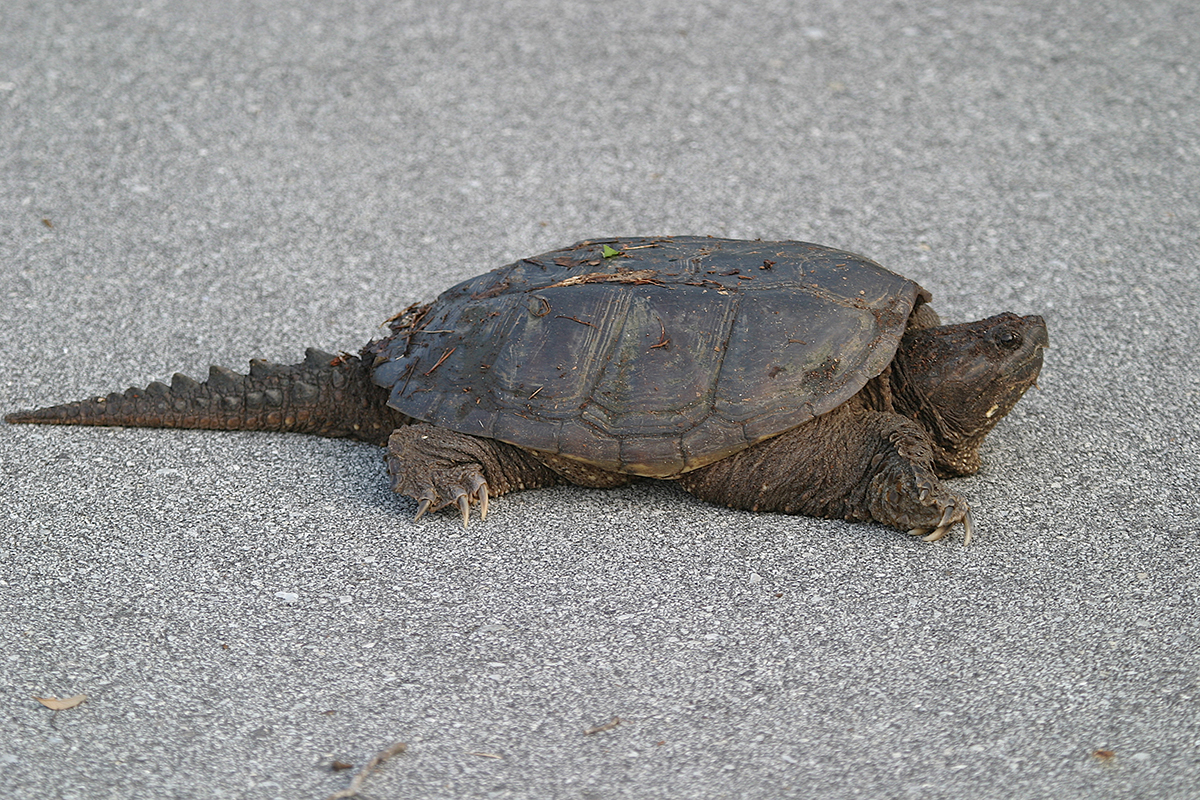
Thinking it was some type of car wreck, I parked and trotted up the road to see if I could help. There, in the middle of the road, was a gargantuan snapping turtle holding the road hostage. With its long neck extended and snarling mouth agape, it defiantly stopped traffic. It could have easily been mistaken for a low coffee table that had fallen out of the bed of a pickup truck.
An early summer downpour had put this snapper on the move, seeking new habitat. Or maybe it was a female looking for a nesting site. Thinking that I could easily save the day and get traffic rolling, I cautiously approached the island-sized turtle. With its belly on the pavement, it slowly rose up on its tippy toes with the poise of a ballerina. Standing tall on its feet, it turned its colossal shell in my direction and established a fighting posture. I was now put on notice.
Supporter Spotlight

Sneaking up behind the impressive snapper, I tried to grab the back of the shell with my bare hands. Its thick, meaty tail slapped my arm forward toward the head of the turtle. I released the shell just a whisper before its long neck, tipped with a razor-sharp beak, whipped around, snapping at my fingers. The gathering crowd roared with laughter, cheering on the turtle.
The horde, now standing with their arms crossed, waited for the trainwreck to leave the station. Undaunted, I taunted the beast into biting onto a small tree branch. With the branch now clinched between its jaws, I tried to drag it off the road. The snapper then snapped the branch as if it were a No. 2 pencil.
Throwing me a lifeline, someone from the crowd tossed me a ratty old towel, saying “try this.”
Now, like a matador with a cape, I faced the monster. I dangled one end of the towel above the irritated reptile like a fishing lure. As it lunged after the bait-like rag, it moved closer to the edge of the road. Continuing to tease the snapper, it had soon moved itself onto the grassy shoulder of the road. It then latched onto the towel and was sort of hooked like a fish.
At this point, I was able to drag the turtle off the road and down into a low, wet, marshy area. As I walked up the slope and back onto the road, the crowd greeted me with a round of polite applause. I headed to my car, fingers intact.
Prehistoric beasts
Surfacing amid the Cretaceous Period, these prehistoric-looking beasts have been around for 90 million years. Hearty as can be, they even outlasted the dinosaurs, avoiding all the mass extinction and destruction caused by that devastating asteroid. Like the horseshoe crab, they too are called “living fossils.” Their physical makeup has been expertly designed for their habitats and has changed very little from ancient times.
Known scientifically as “Chelydra serpentine,” the common snapper is found in the shallow, mucky substrate of ponds, lakes, creeks, canals and freshwater wetlands. With their long snake-like neck and tail, the scientific name accurately describes their serpentine features.
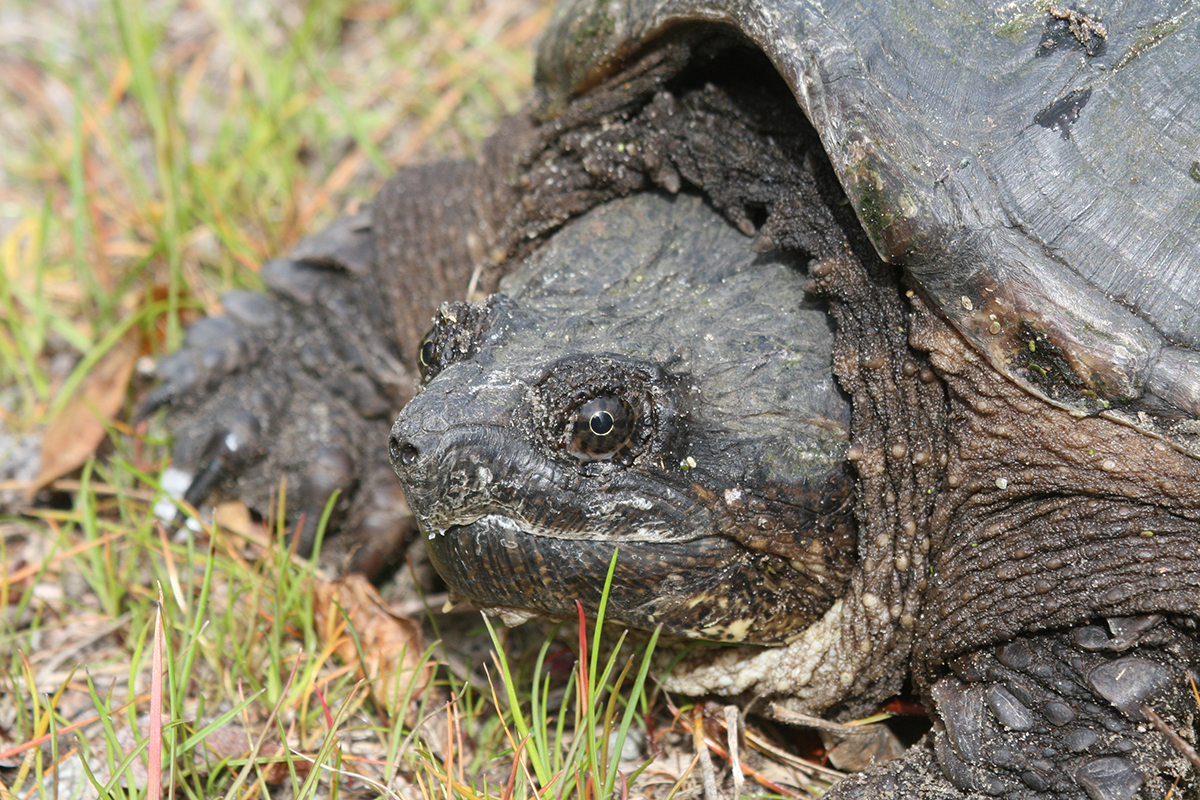
These aquatic reptiles are quite content to spend their days saturated in their watery home in search of food. Digging into the mud, with only their eyes and snout exposed, they will patiently wait to ambush prey. With algae often growing on their shell, they blend in, looking like a submerged log.
Like nature’s version of DoorDash, they stealthily wait for a fish, water snake or frog to drift within striking distance. With speed much faster than the blink of an eye, their long neck and head launch as if spring loaded at close to 170 mph. Violently powerful jaws that some have described as “Vice-Grip pliers with razor blades” and their hooked beak secure the prey. They will also eat plenty of aquatic vegetation, algae and scavenge on dead animals.
After heavy rains, I once waded into an ephemeral wetland to rescue a fledgling blue jay. The bird had been feeding on water insects from a branch floating on the surface. Frantically calling and flapping its wings, I thought its foot was caught in the tangle of branches. When I reached down to pull up the jay, I saw that a small 4-inch snapper had chomped down on its foot. As I pulled them both out of the water, the turtle dropped away and the bird took flight in a splash and dash. This is when I learned that snappers like to eat birds as well.
A moment of paralyzing panic
As a young teenager growing up in rural Beaufort County, many scorching August afternoons were spent cooling off in the slow-moving tributaries of the Pamlico River. Tagging along with my older brothers and their friends, we would launch from the bridges that spanned the creeks along dusty country roads. One after another, we exploded into the water, expertly demonstrating the cannonball dive. Someone usually brought along a few pilfered field-fresh watermelons that were plunked into the water to cool down. The sweet red flesh that had been roasting in the hot summer sun would be perfectly chilled for a refreshing post-swim treat. We had to keep tabs on the melons and push them back and forth to make sure they didn’t drift away with the current.
I know that every kid splashing in that tea-colored creek had their own life issues, perhaps even demons, that they were dealing with. But this was a moment of all-is-forgotten, dog-paddling, carefree freedom. An idyllic, Southern, coming-of-age scene. Reflecting on it now, it reminds me of the Jimmy Buffett song, “Life is Just a Tire Swing.” That is until the snapping turtle showed up.
Under the golden glow of the sun low on the horizon, our blissfully innocent summer swim was suddenly interrupted with a blood-curdling cry, “Snapperrrr!” A moment of paralyzing panic seized each swimmer. With just our heads bobbing above water like the watermelons, we stared at each other in silence. And then mayhem ran rampant. Flailing at the water, we all made a desperate dash to the lone makeshift ladder of two-by-fours nailed onto a support piling of the bridge. The ladder was clogged with kids scrambling up and over each other before tumbling off the bridge railing and back onto the blacktop. There I was, frantically dog paddling, the last one still in the water, waiting to go up the ladder. Curling my toes, I could feel the snapper closing in.
Despite their reputation, snappers are quite meek and easygoing while in the water, rarely aggressive toward humans. Out of the water, however, these relics have the looks of a scoundrel itching for a fight. On land, these anciently handsome creatures can become quite defensive if they feel threatened. Feeling vulnerable, because they are unable to fully retract their head, legs and tail into their shell, they become fighters.
Extending their legs, they will jack up their shell high into the air, looking like a sturdy workbench. With this stance making them appear bigger, they are now emboldened enough to gape open their flesh-shredding beak and let out a startling hiss. Come too close and the neck will launch towards you at an inescapable velocity. Those untrained in handling a snapper will soon learn that their neck can reach half the length of their body.
A persistent mother
When I lived in Emerald Isle, my property had two small, marshy, organic wetlands within the surrounding maritime forest. Every spring, during April, the same female snapping turtle emerged from the muck to lay eggs in the backyard. In the loose, sandy soil of an ancient sand dune she would dig a shallow pit and deposit close to 30 eggs.
During my first year on the property, I didn’t see her nesting, but I discovered the aftermath of a marauding raccoon: Leathery eggshell casings littered the ground, ripped open by a hungry bandit devouring the yolks.
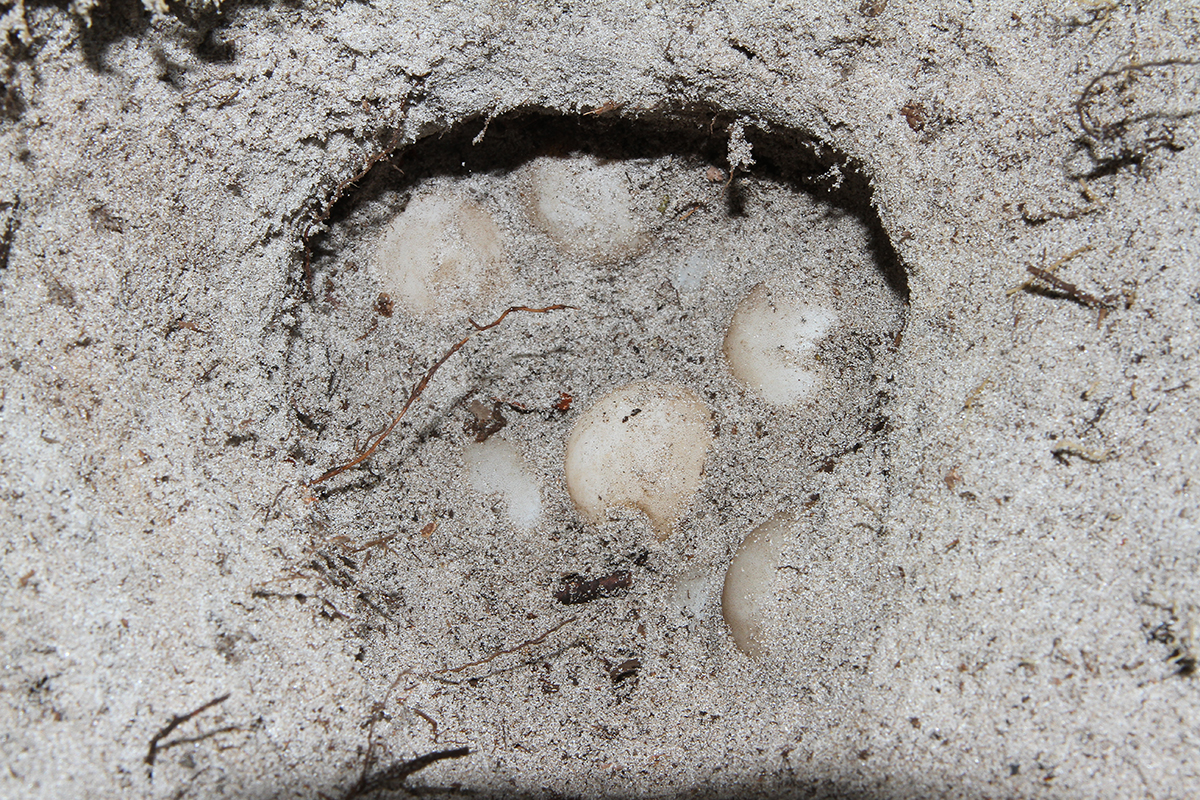
The following spring, my wife, Bright, saw the turtle heading to the backyard with the weight of the world on her back. When the turtle had crawled out of the wetland, she carried with her a big hunk of mud complete with dead leaves and vegetation on top of the shell. Looking like a moving atoll, perhaps this is what inspired the Native American legend of Turtle Island.
We watched as she peppered the yard with false nests to frustrate and discourage predators. Then, she finally dug a proper pit and dropped around 20 eggs. Sand was flying everywhere as she meticulously covered the nest. Her head was coated in a sand mask with her eyes barely poking through.
To protect the nest from gray foxes or raccoons, I anchored a four-foot wire mesh over the nesting area. I removed the mesh after a few weeks and once the scent of the nest had evaporated. About 70 days later we found baby snappers searching for the marshy bog.
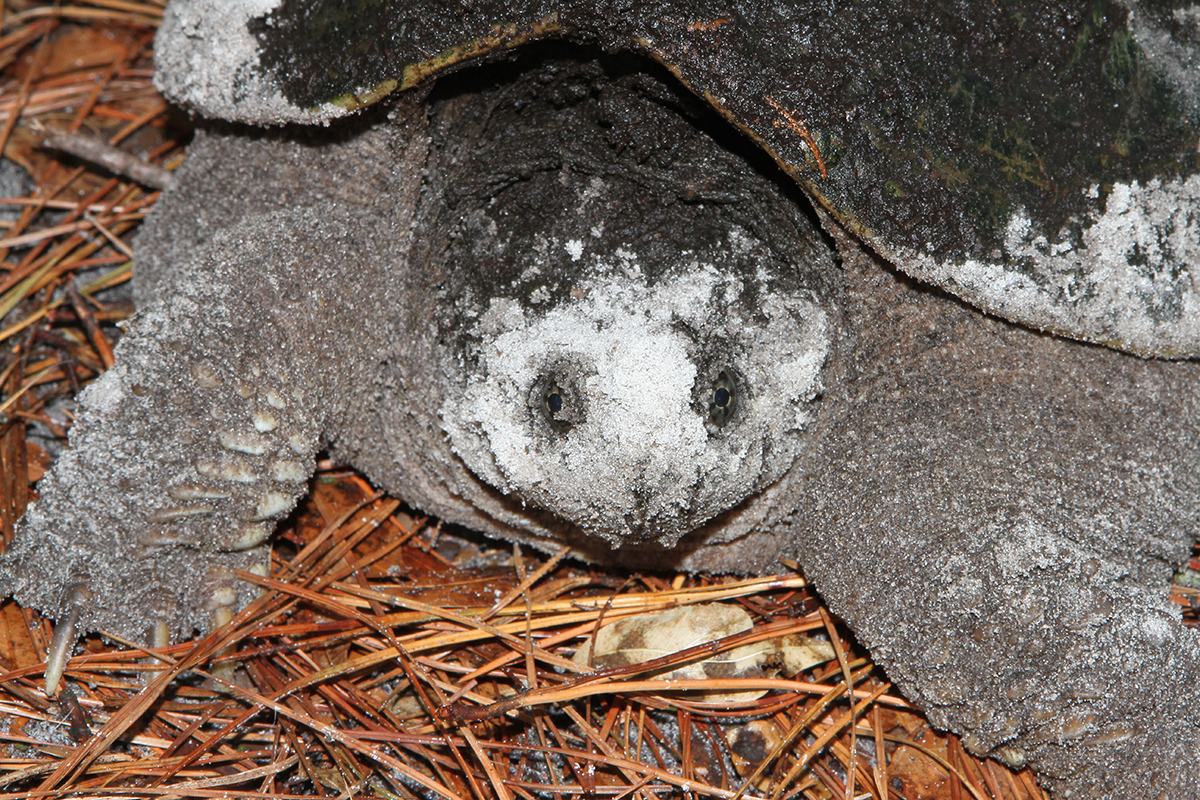
Each spring, almost to the day, she would return to nest in our backyard.
Even through an adult snapper can occasionally fall victim to an alligator or river otter, these ruggedly armored reptiles have little to fear. Young snapping turtles don’t fare as well. They must face a gauntlet of predators such as raccoons, foxes, herons, minks and even owls. Since they aren’t physically able to defend themselves yet, they deploy a chemical weapon.
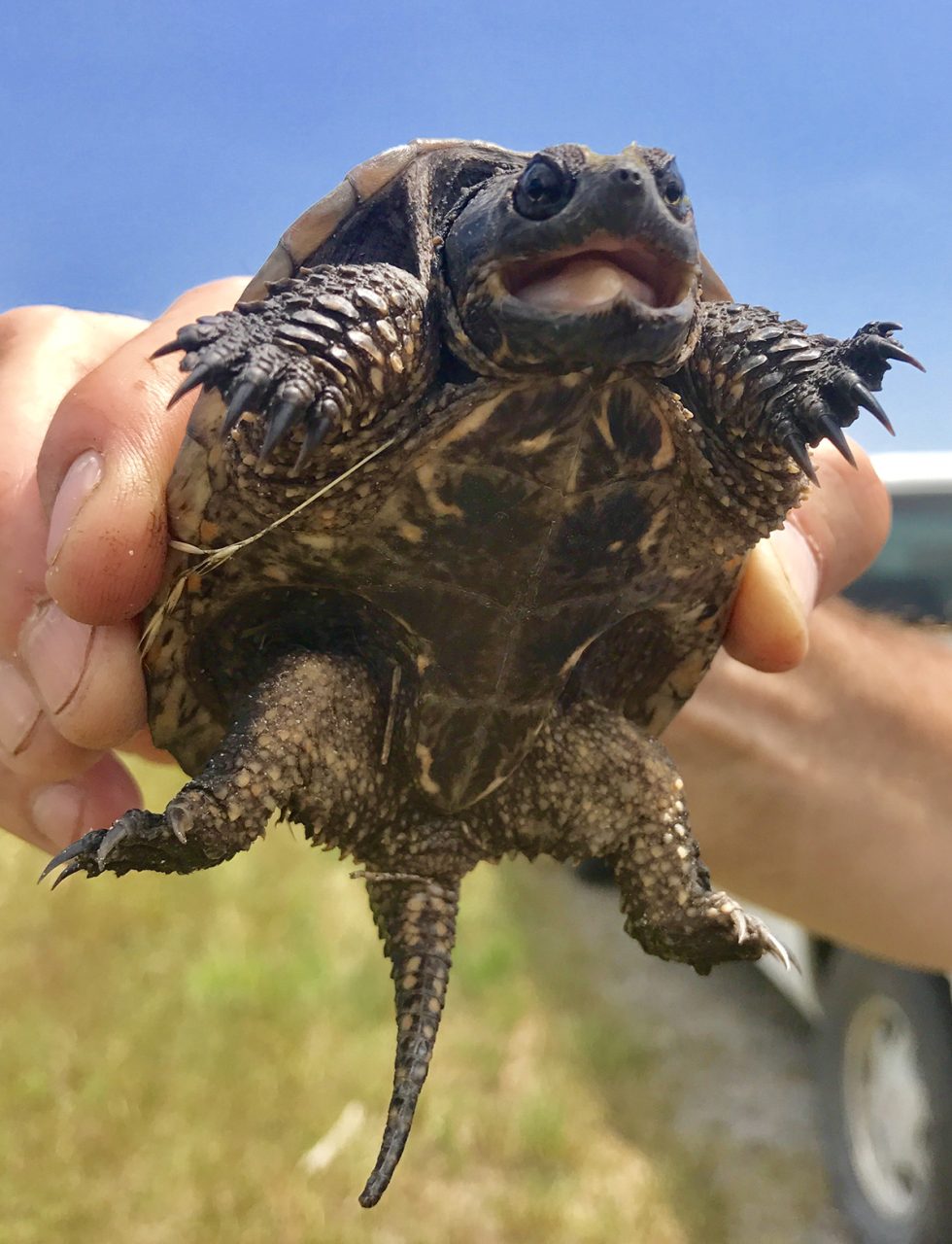
When threatened, they will emit a most putrid musk to repel any predator intent on causing harm. I learned this lesson the hard way when I rescued a small snapper off a busy roadway. It thanked me by releasing the gag-inducing musk that would quickly ensure its freedom from my hands.
Folklore, mystique
For some reason, snapping turtles have often appeared during my life. Throughout time, cultures around the world view animals as signs, messages, symbols and even omens. The coyote is known as a trickster and can be viewed as a warning, the eagle is seen as power and the wolf signals loyalty. The snapping turtle carries with it, patience, tenacity, survival, perseverance and integrity.
Along the way, this ancient relic has developed a larger-than-life mystique. For generations their reputation has steeped and marinated in the hypoxic waters where they live. Folklore, myths, legends and outright lies have been dredged up from the muddy wetland bottoms.
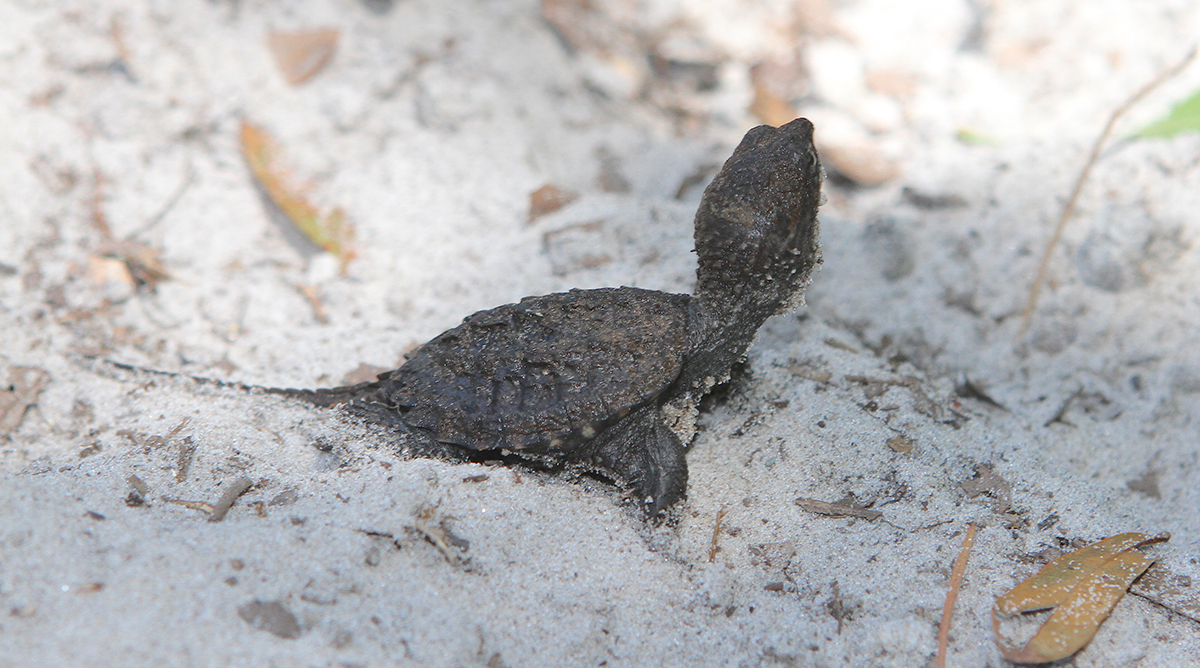
One of my favorite myths is that if a snapping turtle bites you, it will not let go until it hears thunder. As a child running barefoot and feral through the swamps, I was often cautioned by the old-timers. With a wag of a finger, they would lecture, “Beware the snapper, its bite will linger until the sound of thunder.” I guess they thought it was an effective strategy to keep kids from wandering into and getting lost in the marshy woodlands. I thought it was a bunch of crap. Yet, this country folklore persists today.
While the origin of this legend can be debated, it appears to have solid standing in Native American storytelling. Two publications, “Kickapoo Tales” (1915) and Ojibwa Texts (1917-19), tell the story of an otter that gets bitten by a snapping turtle. This Algonquian folklore saga has been titled, “When Snapping Turtle Went to War,” or “Snapping Turtle on the Warpath. Told by the Ojibwe storyteller, Glistening Footprint, the story was documented by the Native anthropologist William Jones around 1905.
In the story, otter was sent to kill snapping turtle. But the snapper was on the otter’s plan and hid to ambush otter. Snapping turtle chomped down onto the otter’s private parts. The pain was unbearable and the otter begged to be released.
Recounted in different Native variations of the story, the snapper replied:
- “When the Thunder-god has come back, I will let you go.”
- “Not till the Thunderers come resounding will I release you from my mouth.”
- “I won’t let go till the thunderbirds come.”
- “Verily when the Thunderers cry then will I let thee go.”
- Or, “Not until a great thunderstorm will I release him from my mouth.”
The Thunderers, thunderbirds and Thunder-Gods all represented the storm spirits that had the power to conjure up thunder, lightening and rain. Otter implored snapper to be liberated from its steely grip. Then, the story continues: “Sure enough, the Thunderers began to cry. Then indeed was the Otter let go.”
After jumping off that bridge, I was now the otter, a frantic kid with a snapper bearing down. Was the myth true? I didn’t want to take any chances and get into a delicate predicament like that of the otter. Without a thunderhead in sight, I leapt out of the water and onto a bridge piling as if a frog being chased by a largemouth bass. Free from being mauled by the snapper, I bear-hugged the creosote-soaked pole with my legs and arms. I slowly shimmied my way up the timber for the final push onto the road.
Gripping with all the strength my lean 12-year-old body could muster, I pushed upward. Immediately, pain literally sliced through my fingers. The cap of the piling was covered with thin sheets of tin to prevent water from seeping into the timber. Years in the elements had caused the edges of the tin to curl up creating a sharp blade perfect for gashing open flesh.
Red ran thick down my forearm as I kept my right hand above my heart to slow the bleeding. My left hand was somehow unscathed. The swim party was now over and I needed to go get stitches in my ring and middle fingers. In a borrowed car, my older brother peeled out with barking tires as we raced off to a clinic.
As we crossed the bridge, I glanced over the railing, looking for the predacious snapping turtle in the waters below. The only thing I saw was the watermelons as they made their leisurely escape down the stream. Like the popular song at the time, this was my “Bridge Over Troubled Waters.”
Sitting in the exam room, clothed only in my dripping wet cutoff blue jeans, I could smell the oily creosote that now stained my shorts, arms, legs and chest. Taking pity on me, the kind doctor stitched me up and sent me on my way without charging me a dime.
The beak of a snapper didn’t injure me that day, but the fear of a powerful myth did. Time has absorbed and faded the scars from my fingers, but I can still feel the thickened skin from the cuts. Whenever I rub my fingers over the old wounds, the memory returns as vivid as if it was yesterday. I think of that phantom snapping turtle from time to time and I can’t help but smile knowing that the experience has made my life richer.