MANNS HARBOR – Just weeks after the first community meeting was held here to discuss an upcoming project to construct long-sought wildlife crossings under a section of U.S. Highway 64 by the Alligator River National Wildlife Refuge, the North Carolina General Assembly passed its budget that included — much to the surprise of some — millions in recurring funds statewide for wildlife crossings and habitat connectivity.
For conservationists who have for years advocated for the passages as necessary safety measures for human and animal alike, it was fantastic news.
Supporter Spotlight
“We’re extremely excited about the $10.2 million in the state budget for wildlife crossings!” Ron Sutherland, chief scientist at the nonprofit Wildlands Network, said in an email.
“We knew there was bipartisan support for the measure, but it has been so hard to predict anything coming out of the state legislature for so long.
“From what we can tell, this is now the largest commitment by any state on a recurring basis for wildlife crossings,” he added, “so we’re grateful for the leadership on this issue.”
Recently, Sutherland, among others, had worked to help raise $6.25 million in matching funds toward the U.S. 64 project that included an anonymous donation and contributions from Wildlands Network, the Center for Biological Diversity, and the North Carolina Department of Natural and Cultural Resources. Last year, the North Carolina Department of Transportation was awarded a $25 million grant from the Wildlife Crossings Pilot Program established by the 2021 $1 trillion federal infrastructure law.
According to the department, the proposed $31.25 million project would construct 11 wildlife passages of various sizes, with corresponding fencing along 2.5 miles of U.S. 64 from the east end of East Lake on the Dare County mainland to west of Robertson Landing Road. The preliminary design and environmental review process is targeted for completion in 2027. The project, which is included in the State Transportation Improvement Program, or STIP, is slated to begin in 2028 and be completed in 2031.
Supporter Spotlight

At the public meeting on June 23 in Manns Harbor — a small community near East Lake — Matt Seymour, NCDOT’s project manager, explained that most of the project, built on swampy land and much of it adjacent to canals, would involve construction of underpasses, which would require elevating the road. Some crossings would provide small wooden bridges and little tunnels for animals. Fences along the road, fronted with vegetation, would serve as guides to lead the animals to the passages.
“Planning and design will also consider construction access, maintaining traffic flow on this critical route, and minimizing impacts to nearby canals and swamps, private property, utilities, wetlands, historic sites and community resources,” NCDOT said on its online project site.
Several residents in the audience expressed concerns about locating crossings too close to private property.
“The bigger ones, where we’re anticipating bear and wolf, they won’t be in residential areas,” Seymour responded. “We have to be sure we’re strategic with the fencing.”
Seymour said that NCDOT is working closely with staff from the North Carolina Wildlife Resources Commission and the U.S. Fish and Wildlife Service on designing the crossings, as well as listening to concerns and suggestions from residents who coexist with wildlife in the area.
“The Service is a project partner and collaborator on the wildlife crossing grant,” Rebekah Martin, manager of the Coastal North Carolina National Wildlife Refuge Complex, wrote in a later email. “We are particularly involved in planning, permitting coordination, and refuge-level decision-making to ensure the project meets refuge purpose and mission requirements while benefitting both public safety and wildlife.”
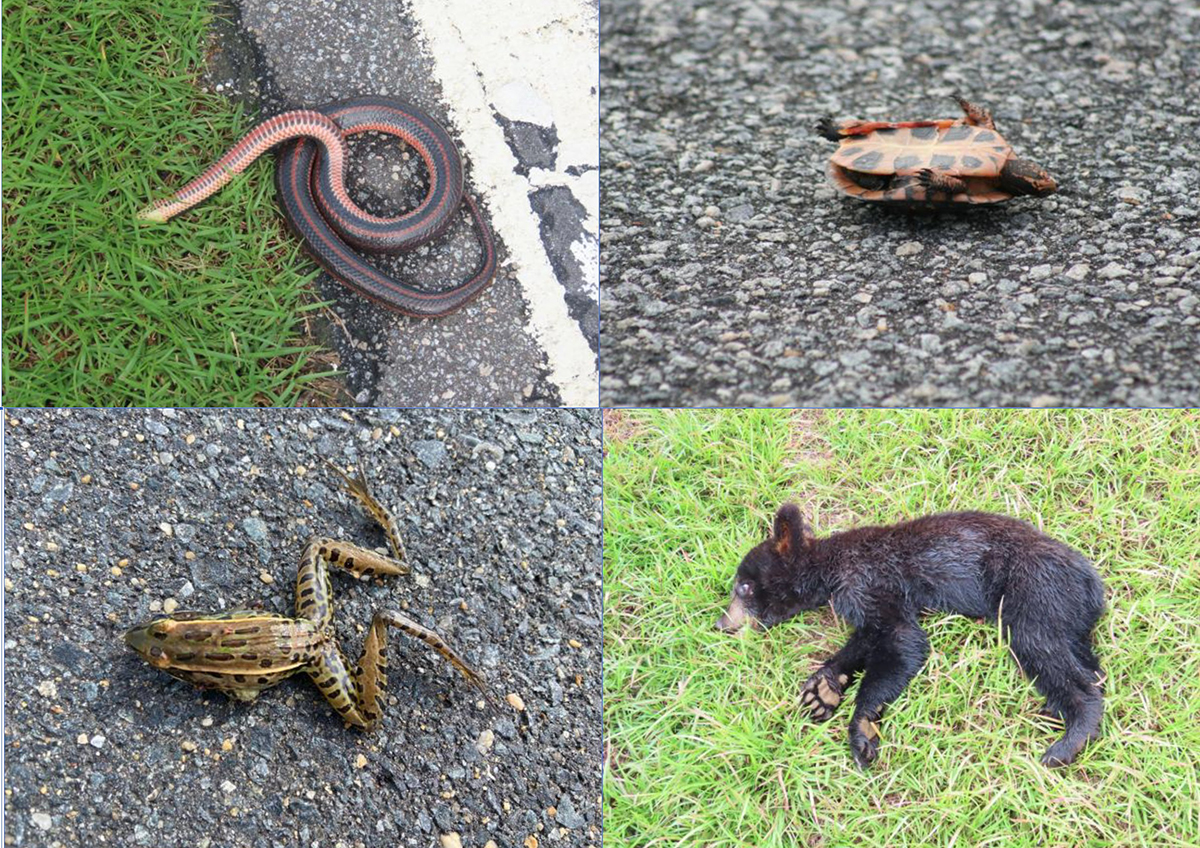
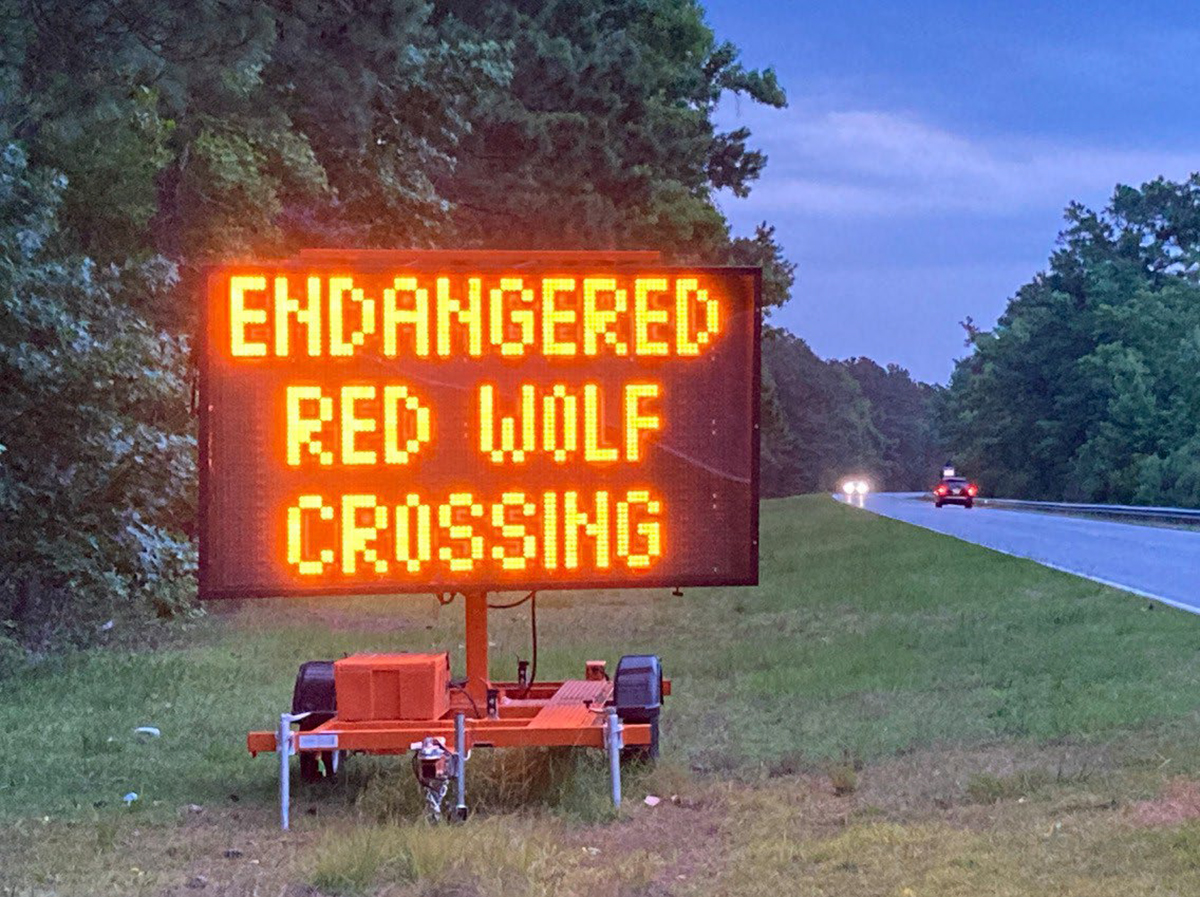
Notably, the Alligator River refuge is populated not only by thousands of wild animal species, ranging from tiny salamanders to massive black bears and — yes — alligators, it is the only habitat in the world with endangered wild red wolves. Many thousands of the refuge creatures, including numerous rare wolves, have been among the annual victims of vehicle traffic.
Swerving to avoid deer carcasses on the dark road, veering around huge alligators that emerge in headlights and bracing when an animal is accidentally hit have been regular survival tactics for local drivers on U.S. 64, which crisscrosses more than 158,000 acres of protected refuge lands. The highway also cuts through the 1.7 million-acre recovery area of private and public lands in Beaufort, Dare, Hyde, Tyrrell and Washington counties that have been intensively managed for the red wolves by the refuge since 1987.
But U.S. 64 in Dare County also serves as a major travel corridor back and forth to the popular Outer Banks beaches, as well as a critical hurricane evacuation route, with millions of vacationers driving through areas thick with animals moving through the landscape and dashing across roads.
Over the last decade, in fact, vehicle strikes are the leading cause of mortality in red wolves, according to the Red Wolf Essential Survival Crossings Under Evacuation Route (RESCUER) project report.
Although the latest population is not yet available, red wolves number about two dozen or more in the management area.
“Installing wildlife fencing to reduce (collisions) along with multiple wildlife underpass structures to provide habitat connectivity for species including the critically endangered Red Wolf, black bear, white-tailed deer, mesomammals, small mammals, and herpetofauna is an essential mitigation measure to address impacts from US 64 through Alligator River National Wildlife Refuge,” according to the report.
Numerous hot spots for wolf mortality that had been identified by recent research, according to the report, are targeted in the first phase of the proposed wildlife crossings project along U.S. 64.
Looking back: Conservation group’s US 64 study finds ‘remarkable carnage’
Looking ahead to the additional wildlife crossings made possible by the recurring state funding, Sutherland said that the money will be spent statewide, including in Western North Carolina, and likely on the highest-priority projects for protecting both wildlife and human safety.
“It is too soon to know if new crossings for US 64 will be in the mix or if the state is going to focus on other regions given the existing $31 million project for 64,” Sutherland said in an email, responding to questions from Coastal Review. “I suspect there may be some enthusiasm for repairing the existing three crossings further west on 64 between Plymouth and Roper — the crossings are fine but the fencing is buried in the tree line and apparently full of holes for wildlife to sneak through.”