

Dozens of people from across the country warned at a public hearing that the U.S. Environmental Protection Agency’s proposal to repeal federal drinking water limits for “forever chemicals” erodes public trust and endangers millions of Americans.
Those who spoke Tuesday during the online hearing the EPA hosted that lasted more than seven hours resoundingly opposed the agency’s plans to strike down enforceable standards for four per- and polyfluoroalkyl substances, or PFAS, and push the deadline in which water utilities must comply with limits for related compounds PFOA and PFOS by two years.
Supporter Spotlight

“These are dangerous to our health and incredibly persistent in the environment,” said Kathy Westman, a registered nurse and member of the Alliance for Nurses for Healthy Environments, a global nursing organization. “Nurses witness firsthand the health impacts and harms. PFAS can increase risk of certain cancers, alter endocrine responses and impact pregnancy outcomes as you all know. You can’t make America healthy while allowing toxic chemicals to flow. Please protect our citizens.”
Westman was among a host of healthcare professionals, researchers, waterkeepers, lawyers, environmental advocates, retirees, high school and college students, and private citizens who urged the EPA against rescinding current federal standards for PFNA, PFHxS, PFBS, and HFPO-DA, commonly referred to as GenX. They spoke from their offices and homes from the Carolinas to California, Maine to Florida, and Texas to Illinois.
They concurred that extending the deadline for water utilities to comply with enforceable standards for PFOA and PFOS from 2029 to 2031 would only further delay drinking water safeguards for Americans.
The Trump administration argues that giving drinking water systems the flexibility to opt in for the two-year extension would give them more time to sample source water for contaminants, test new controls, and train their workforce to manage those controls. And, the argument continues, rescinding current federal standards for PFNA, PFHxS, PFBS and GenX is necessary to comply with the Safe Drinking Water Act.
Under the proposal, the EPA would provide nearly $1 billion in new funding to states to address PFAS in drinking water and another $1 billion through the Emerging Contaminants in Small or Disadvantaged Communities program.
Supporter Spotlight

Opponents of the proposal argue that it is contrary to the message the EPA is trying to send by providing that funding.
Madhvi Chittoor, a 15-year-old climate activist and United Nations child adviser from Colorado, said rolling back PFAS protections “sends us in the wrong direction.”
“The hazard index is important because people are exposed to complex, multiple PFAS mixtures and removing it ignores the cumulative risk that families,” she said. “Weakening these protections shifts the burden from polluters to families and local water utilities, while disproportionately impacting low-income communities. That is not environmental justice.”
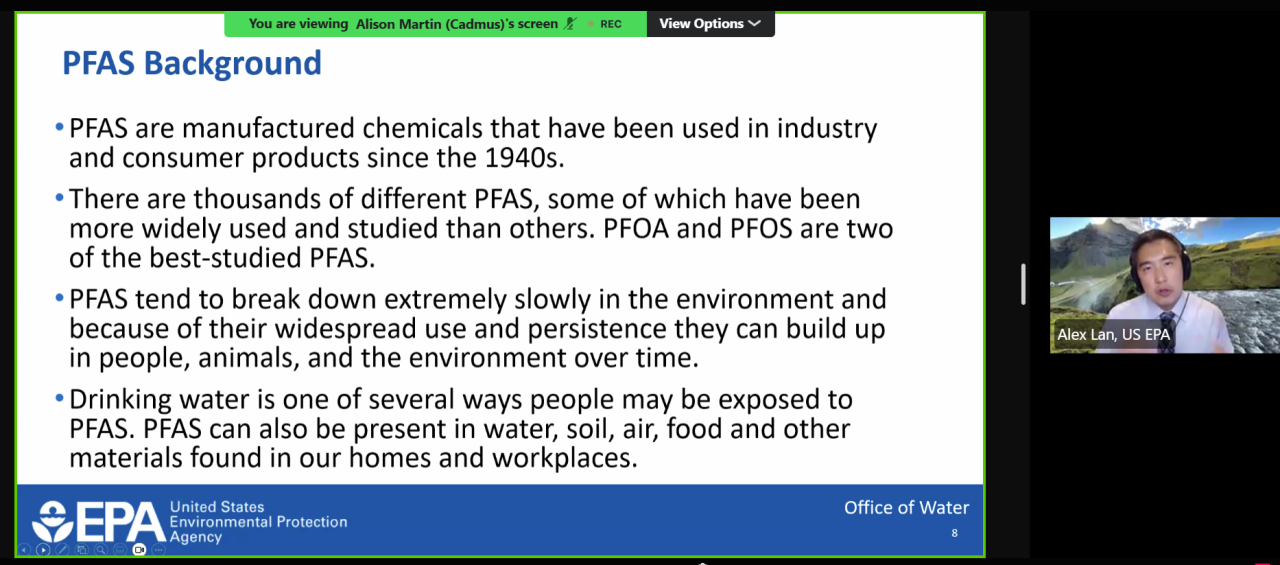
The EPA now categorizes nearly 15,000 different PFAS.
PFAS are used for the ability to repel water, stains and grease to produce a host of consumer goods, including food containers, waterproof gear, stain-resistant carpet and makeup.
They are often called “forever chemicals” because they do not naturally break down in the environment.
Some of the known human health effects of exposure to PFAS include weakened immunity, low birth weight in newborns, thyroid disease, and certain types of cancer.
Dr. Jamie DeWitt, a former associate professor at East Carolina University and now professor at Oregon State University, was a member of the EPA’s PFAS science advisory board that reviewed the science behind the maximum contaminant levels, or MCLs, for PFAS established under the current rule.
“I can say with confidence that the rules for these four PFAS were based on the best available science,” she said. “The only guarantee the public has of being protected from these PFAS in their drinking water, including communities impacted by high levels of these chemicals and populations especially vulnerable to these chemicals, is to let the rules stand. The agency has an obligation to protect the public’s health from hazardous contaminants in drinking water, and rescinding the rule is really the unlawful thing to do. Let this rule stand to ensure that the public is protected.”
For more than two decades, DeWitt has been studying the toxicity of various PFAS, including those found in the Cape Fear River.
Chemours, a DuPont spinoff, directly discharged PFAS, including GenX, from its Fayetteville Works facility in Bladen County for some four decades.
Just last month, the U.S. Justice Department announced a proposed $450 million, multistate settlement agreement with Chemours over PFAS pollution.
Critics argue that, other than a $22.5 million civil penalty to be paid over three years to the EPA and West Virginia Department of Environmental Protection, the settlement terms fail to directly put money toward reducing PFAS discharges.
Gov. Josh Stein said that he expects the settlement will have little, if any, meaningful impact in North Carolina, where state-led sampling found that in 2024 more than 300 public water systems serving more than 3 million residents contained PFAS levels above the EPA-established maximum levels.
Stein recently signed a $34.4 billion state budget that boosts funding for PFAS-related initiatives through the Department of Environmental Quality. This includes $45 million for PFAS water infrastructure projects, $10.2 million for the Bernard Allen Emergency Drinking Water Fund to sample private wells and supply alternative water, and $3 million for DEQ staffing, water testing and sampling.
Dr. Micah Nishigaki, a family medicine physician in Texas, said the current federal drinking water standards for PFAS are critical to public health.
“We’ve known for decades now how PFAS are linked to liver diseases, low birth weights, certain cancers, damage to the nervous immune systems, and higher cholesterol levels,” she said. “These pollutants lurk in our water, which millions of us drink and use for our daily needs. The 2024 PFAS ruling estimated that with these current regulations we can prevent tens of thousands of illnesses and thousands of deaths. That means less people needing to be hospitalized, less chronic illnesses worsened by these toxins, reduced strain our overburdened health care system, and fewer death certificates of loved ones who suffered from the effects of these pollutants that we would have to sign. Weakening these regulations wouldn’t do anyone’s health good.”
Marc Boom, senior director of public affairs with the Environmental Protection Network, a nonprofit organization made up of more than 750 former EPA staff and political appointees, said the EPA should be moving faster to protect people from PFAS, not weaken standards, “before communities ever receive the benefits.”
“Families across the country have already waited years for protections against these forever chemicals,” he said. “This proposal would make them wait even longer. The central problem is that the EPA is not following the science. EPA is not saying these PFAS are safe. They are not showing that the health risks have gone away.”
Trevor Hickman, an environmental and process engineer from New Jersey, asked the EPA to stick by its current regulation to make water utilities comply with enforceable standards for PFOA and PFOS by 2029.
“I think it all just boils down to the fact that it’s much easier to remove these chemicals at the source in the drinking water rather than deal with the ramifications down the line,” he said. “We’re talking about spending 10, 20, 100 times as much money in the coming years instead of dealing with the problem now. And putting it off two additional years is putting two more years of chemicals into our water, into our land and cleaning them up once they’re there is so much more difficult. To everyone in the EPA, I think you know what the right thing to do is, and I think that when you go to sleep at night, if you make the right decision, you’ll rest easy.”