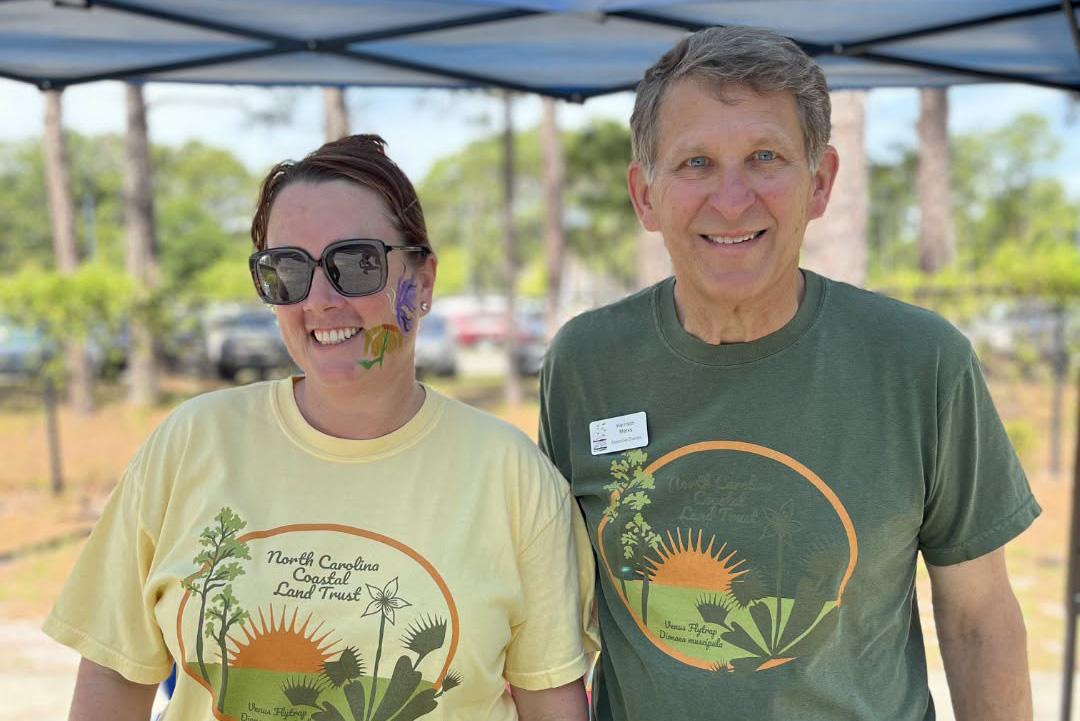
Harrison Marks remembers looking past his father’s shoulder at the excitement unfolding on stage.
Marks can only assume he was scooped up and out of The Waterside Theatre on Roanoke Island because “The Lost Colony” performance was “more than he could stand” at the tender age of 3 or 4.
Supporter Spotlight

That’s one of his earliest memories in the upper Outer Banks, the seaside destination his father sought in lieu of Virginia Beach, a resort city the family patriarch believed to be too developed by the 1950s.
“I really have to check myself to not be completely like him in terms of lamenting,” Marks said.
The outgoing executive director of the North Carolina Coastal Land Trust has nothing to gain by dwelling on the days when the Outer Banks and wider coastline were scattered with little more than fishing hamlets.
“We are an attractive place to live,” Marks said. “Unfortunately, what that means is, just like I was attracted to be here, many other people are attracted to be here, so I’m very conscious of the fact that we have to prepare for growth and accommodate growth in a smart way. But, if we want to maintain the character of eastern North Carolina, I think it’s really important to set aside some space and that’s what this job has allowed me to help do.”
This fall, he will officially step down as the nonprofit’s executive director to assume the role of senior adviser.
Supporter Spotlight

Associate Director Jesica Blake, a keystone employee of the organization for more than 20 years, will take over as executive director on Oct. 1.
“I am deeply honored to be entrusted with this role,” Blake stated in a July 1 release announcing her promotion. “The Coastal Land Trust has been my professional home for more than two decades, and I understand its mission, its people, and its potential at every level. I look forward to building on the extraordinary foundation Harrison and his team have created, and to doing whatever it takes to protect the lands and waters of coastal North Carolina for generations to come.”
Marks isn’t keen on accepting the praise directed his way since the announcement.
“One of the things that’s bother me a little bit is I’m getting credit for every good thing that’s happened in four years. Most of those things were in motion and I was lucky enough to be here as they happened. Jesica’s just so ready to do this and to the degree I helped in that happening at all, I’m really, really pleased about that,” he said.
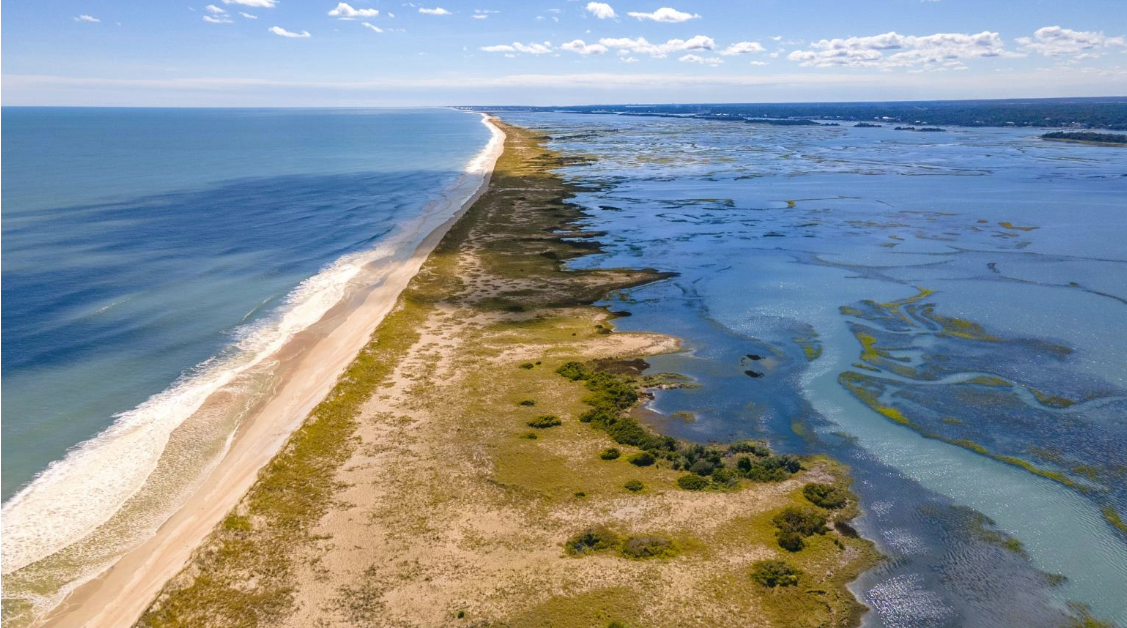
He’s proud of the organization’s accomplishments during his time as executive director, notably the Coastal Land Trust’s April 2025 acquisition of land on the southern tip of Topsail Island known as “The Point,” one of the last remaining privately owned, undeveloped tracts on the state’s barrier islands. Earlier this year, the land was transferred to the state, which will maintain and protect the property.
The organization is scheduled to close on the third phase of its conservation partnership on the Newport River with the North Carolina Coastal Federation and Marine Corps Air Station Cherry Point in Havelock. The Coastal Federation publishes Coastal Review.
That project entails the protection and restoration of more than 2,000 acres of land along the river.
And the organization most recently announced it had reached an agreement with a developer to permanently protect more than 3,200 acres of Sledge Forest, a sprawling tract of land in northern New Hanover County that features ancient forests, vast wetlands, and riverine habitat.
When Marks became the interim executive director a few years back, he figured he’d only be in the job for six months, tops.
By then, the Richmond, Virginia, native had pivoted careers from the banking industry to the great outdoors.
Marks was on his way to earning a degree in biogeography at Dartmouth College when, while conducting research in New Hampshire’s White Mountains, he discovered that fieldwork was not for him.
“I thought if I do something like this, I’m going to end up hating the outdoors,” he said.
After graduation, he landed a job at Wachovia National Bank, which was headquartered in Winston-Salem at that time.
He may have spent his successful executive years indoors rather than in nature, but the work still provided him with a profound sense of purpose.
“I felt like it was a little bit of a calling,” Marks said. “Historically, if you worked at Wachovia, you didn’t make as much money as you would if you were willing to work at some other places, but you stayed because it felt like it mattered you were there.”
He no longer had that feeling when Wachovia merged with First Union in 2001. He retired from banking in the early 2000s at the age of 55.
Less than a decade later, Marks, after returning to his environmental roots, would oversee the 2015 merger of two of the state’s oldest grassroots conservation organizations, the Pamlico-Tar River Foundation and Neuse River Foundation.
Marks was Sound Rivers executive director for four years before retiring a second time in 2017.
He and his wife, Suzie, sailed the east coast and the Bahamas for the next couple of years. He’d been an active member of the Coastal Land Trust’s finance committee by the time he joined the organization’s board of directors in 2021.
He thought the couple had made their last move, from New Bern back to Winston-Salem, when he stepped in as the Coastal Land Trust’s interim executive director in September 2022.
They were on the road from their Winston-Salem home to Wilmington when his wife opened with the ultimate ominous conversation starter: “We need to talk.”
She pointed out how he was really enjoying the work he was doing with the Coastal Land Trust. She would support him staying on as executive director if that’s what he would like to do.
“That really opened the door,” Marks said. “The board was starting its search for a permanent executive director and I went back to the board and said, ‘I’d be willing to stay on if you want me.’”
The board did.
Marks and his wife purchased a home in Wilmington a couple of years ago on a plot of land on the banks of a small cypress pond, a sanctuary for Anhinga, egrets, mallards and geese.
“I don’t think you could blast us out of here,” Marks said. “Winston-Salem is a wonderful place to live. It’s close to the mountains, which is nice, but we really are fundamentally water people. We’d much rather be here near the water, so we’re here for good.”