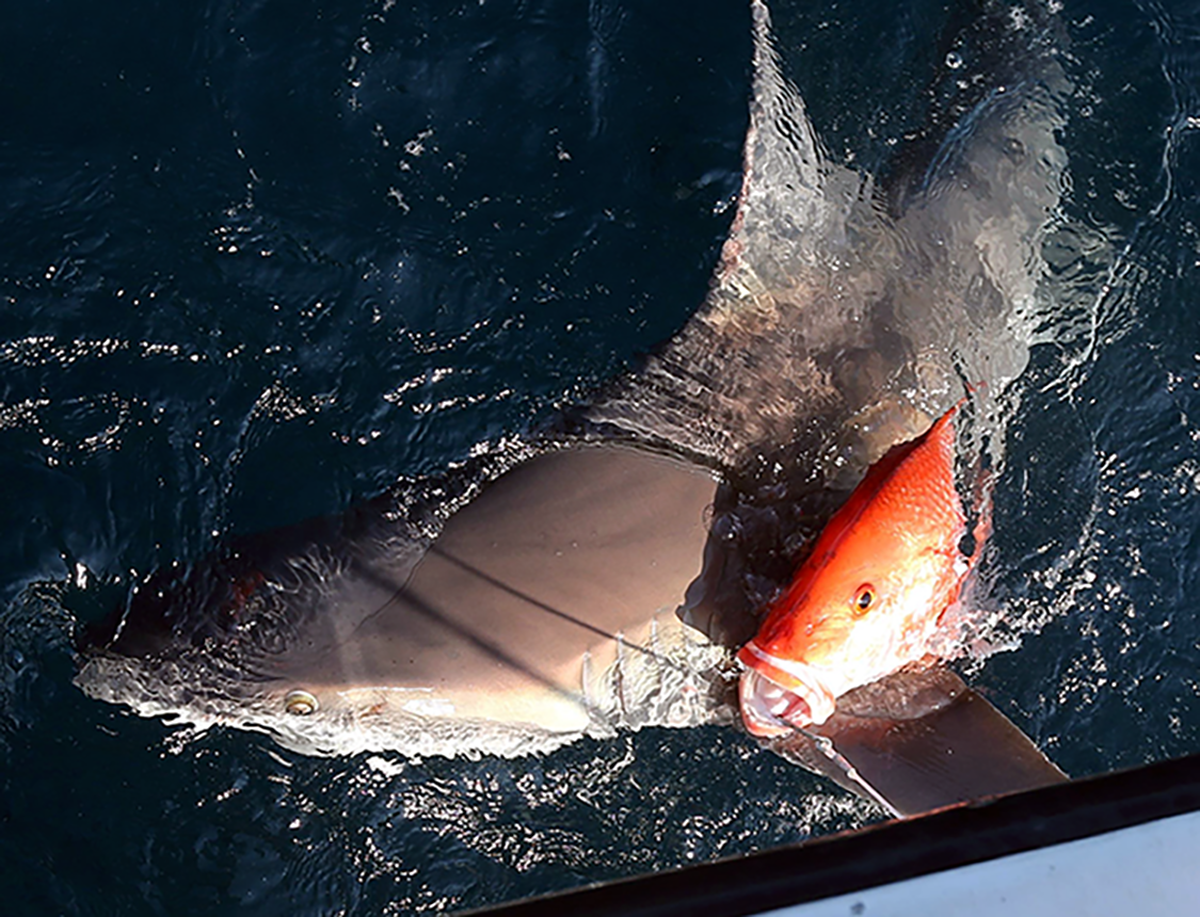
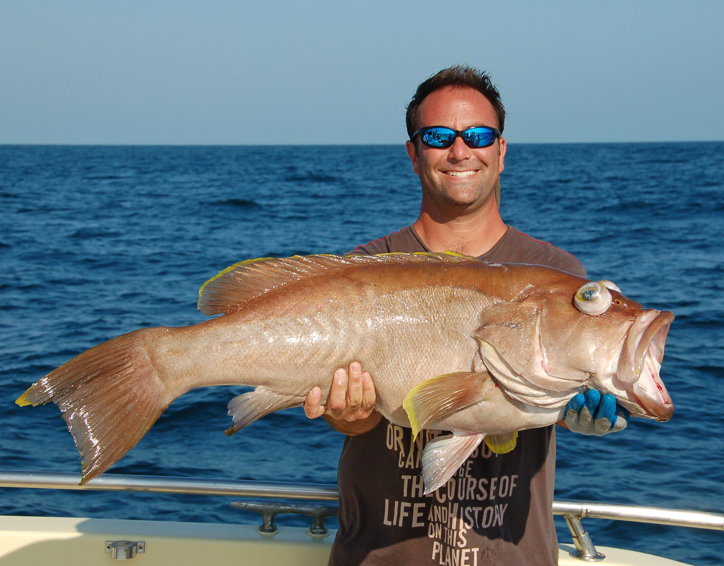
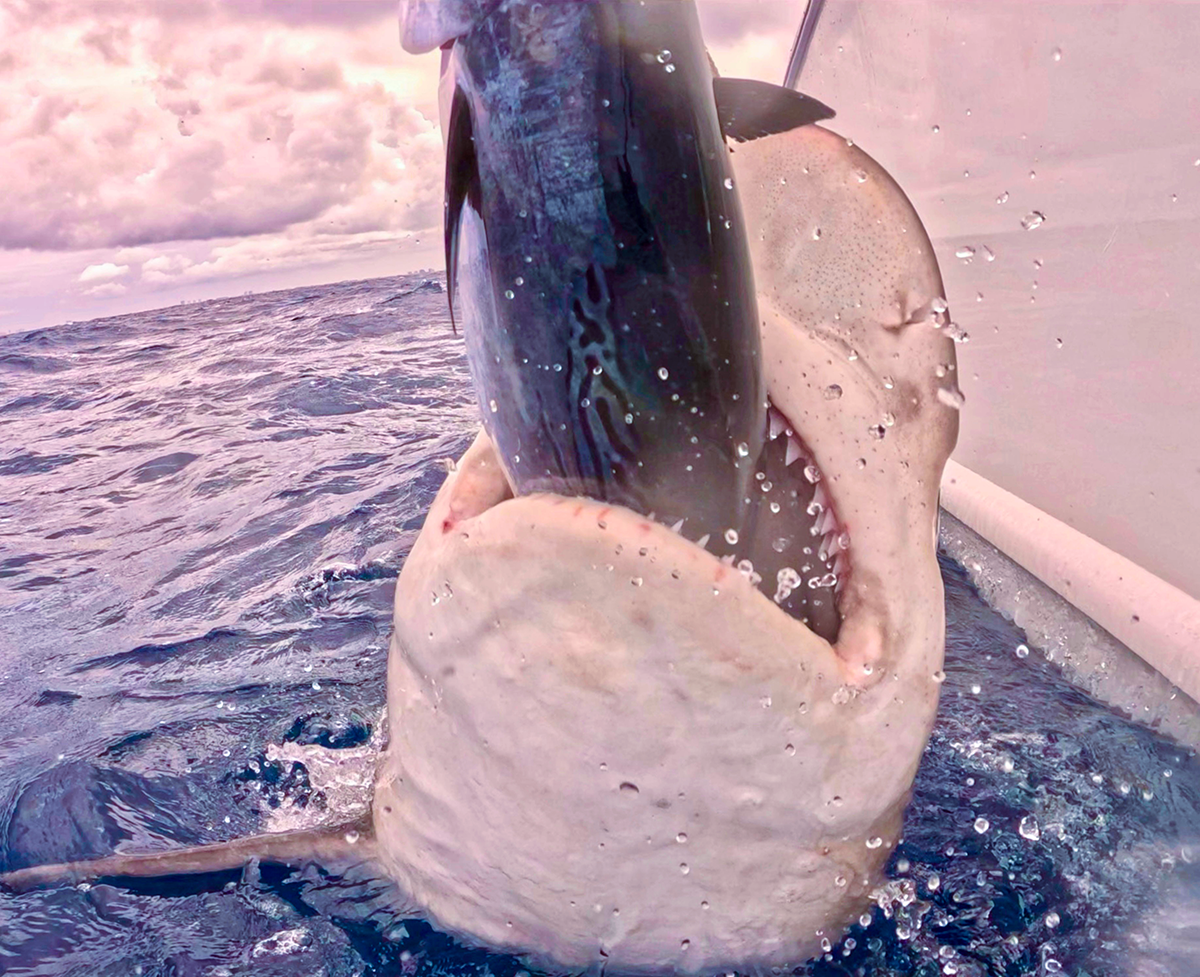
Few things infuriate fishermen more than reeling in a hard-fought saltwater fish only to find it half eaten by a shark.
The phenomenon known as shark depredation has for decades vexed recreational anglers and commercial fishermen.
Supporter Spotlight

More than three-quarters of a century have passed since Ernest Hemingway masterfully captured the heartbreak of shark depredation in his Pulitzer Prize-winning novella “The Old Man and the Sea,” a tale about an aging Cuban fisherman’s dayslong battle to reel in a giant marlin only to have it devoured by sharks.
Yet, in recent years, this conflict has seized the spotlight as a modern-day challenge.
A team of researchers took a deep dive into the history of shark depredation, pooling their knowledge and data spanning the course of the last 100 years. Their recently published study in the ICES Journal of Marine Science examined shark depredation across Atlantic recreational fisheries from the waters in Maine to Texas and the U.S. Caribbean.
Researchers focused on three groups: recreational anglers, target fisheries and sharks.
What they found is that, while there is a perception that getting sharked is an emerging issue, the reality is that anglers, the fish they target, and the sharks that target those fish are crossing paths more than ever.
Supporter Spotlight

“It appears to be more of an urgent and more of an immediate problem now, not necessarily because shark populations have exploded, but because of this combination of all sorts of factors,” said Dr. Marcus Drymon, a lead author of the study.
Drymon, an associate extension professor at Mississippi State University and marine fisheries specialist with Mississippi-Alabama Sea Grant, explained that, yes, shark populations have increased over the past quarter-century, “but it’s just much more complicated than that.”
To understand just how complicated, researchers traced back to some of the earliest instances of documented shark depredation chronicled by none other than Hemingway himself.
Hemingway had already proved himself a literary powerhouse when, in the early 1930s, he sought to become the first angler to reel in an intact bluefin tuna from the vibrant turquoise and electric blue Caribbean waters off the Bimini coast in the Bahamas.
“And, consistently, when he would hook up to one of these big fish, they would get torn apart by sharks before he could land the fish,” Drymon said. “That happened for a few years and then those experiences led him to develop different techniques.”
Hemingway modified his fishing gear to make it stronger, and he switched up his angling tactics.
“When Hemingway did that around 1935, it led him to becoming the first person in recorded history to land an intact bluefin tuna in the Bahamas, and it just shows that this conflict has been around for a long time. It’s just that back in Hemingway’s day, there were very, very few other boats on the water trying to do what he was doing and shark populations, at least in the Northern Hemisphere, were in a relatively pristine state,” Drymon said.
That changed in the 1940s with the onset of World War II. The United States, cut off from shipments of cod liver oil from Norway and Iceland, was in desperate need for a cod liver oil substitute.
The high demand for vitamins contained in cod liver oil, including vitamins A and D, led to the nation’s first shark processing plant in Port Salerno, Florida. The plant closed in July 1950. By that time, synthetically produced vitamins had swept the market, rendering the commercial shark fishery in the country obsolete.
At the same time, recreational fishing was on the rise. Post-war Americans had more leisure time, and a new generation of boatbuilders were turning a product that was lighter and powered by smarter engines.
The surge in recreational shark fishing drove the creation of the National Marine Fisheries Service Cooperative Shark Tagging Program in 1962.
Shark landings by recreational anglers remained low through the 1960s and into the early 1970s.
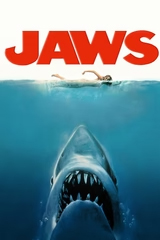
That would all change in the mid-1970s when (cue the theme music) “Jaws” was released in theaters across the country. The runaway blockbuster captured the imaginations of audiences the world over.
“It would be difficult to overstate the impact of ‘Jaws’ on the public’s perception of sharks, a concept coined ‘the Jaws Effect,’” the study states.
By the early 1990s, heavy exploitation of Atlantic shark populations led the National Oceanic and Atmospheric Administration National Marine Fisheries Service to introduce its first shark fisheries management plan.
By the early 1990s, shark populations in the Atlantic had been heavily exploited, prompting NOAA to implement the first fisheries management plan for sharks, he said. Shark populations that are overfished take a long time to recover because they are inherently slow growers, late to mature, and have relatively low reproductive output.
“We’ve now had 30 years of really successful efforts on the part of NOAA fisheries to rebuild and recover these shark populations and I would say that what we’re seeing today is a result of those management efforts,” he said. “But, there are downstream effects, because today there are so many more anglers on the water. The way they see it, there’s more sharks than they’ve ever seen. Sure, if they’ve only been fishing for the past 20 years, that is absolutely the case. But I would make the argument there’s nowhere near as many sharks now as there were in the 50s and 60s.”
The study notes that shark depredation is a widespread issue. There are at least 51 target species, notably red snappers and some groupers, vulnerable to predation by 22 species of sharks, according to the study.
Two of those species, the sandbar shark, which is federally protected, and the bull shark, are the worst offenders.
To lessen the impacts of those and other depredators, researchers suggest anglers take a page from Hemingway’s book, figuratively, or course.
“Our specific recommendations in terms of behavior change are relatively simple,” Drymon said. “The first one is, if and when you get depredated by a shark, move spots. I don’t say that lightly. I realize that’s a frustrating thing to have to do, especially if your spot’s a long way out in the middle of nowhere. But that is a good practice to follow.”
Second, try to avoid highly fished areas where there’s constant pressure on target species.
“Sharks are much more likely to habituate and hang out there and learn that depredation provides an easy meal for them,” Drymon said.
Third, be open to using deterrents Drymon and other researchers are currently testing.
“Our objective, our heart, is to give these deterrents to as many anglers as we possibly can, have them help us in the testing process with the hopes that those deterrents can let people fish at their favorite spots without being depredated as much as they normally would have,” he said. “As these deterrents continue to be developed, we’ll continue to try to test those and make our best recommendations to anglers and fishermen as to which ones are effective and which ones are not.”
Drymon said he’s also not opposed to the sustainable harvest of species of sharks that, like the bull shark, are not federally protected.
“If populations are not overfished and are not experiencing overfishing and there’s fishery management plans that allow for quota and harvest of those individuals, I think that’s a great, great option,” he said. “Just like any other fish in the ocean, I think that there is a time and a place for harvest of these animals provided that it can be done sustainably and provided that markets are in place for fishermen to profit from that harvest. I would be happy to help the establishment and the development of sustainable markets for shark products, particularly in the United States.”