New Bern’s colonial-era Tryon Palace is commemorating 250 years since the signing of the Declaration of Independence with a special Fourth of July celebration.
“Tryon Palace Glorious 4th: An A250 NC Event” is a family-friendly celebration taking place from 9 a.m. to noon Saturday, July 4.
Supporter Spotlight
“As our country commemorates the Semiquincentennial, Tryon Palace is proud to host our community for Glorious Fourth,” Executive Director Chrystal Regan said in a statement. “We welcome everyone to join us on Independence Day to celebrate the signing of the Declaration of Independence and honor all those who have worked for the 250 years since then to further the promises of Life, Liberty, and the pursuit of Happiness for all.”
Construction on the original Tryon Palace building, the Governor’s Palace, was completed in 1770 and served as North Carolina’s first colonial and first state capitol, which was moved to Raleigh in 1794. Philadelphia held the first commemoration of independence on July 4, 1777, while Congress was still occupied with the ongoing war. New Bern first celebrated Independence Day in 1778, according to the state.
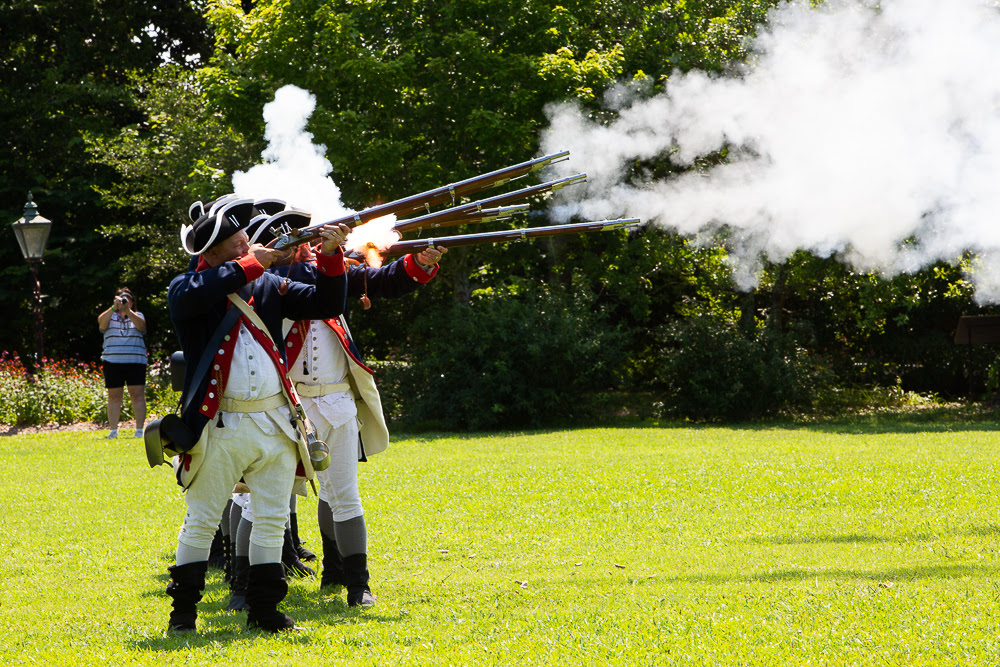
At 10 a.m., Maj. Seth Allen with the U.S. Marine Corps will read the Declaration of Independence just outside the Tryon Palace front gates. After the reading of the Declaration of Independence, the North Carolina Continental Line interpreters will fire a volley in celebration.
The Tryon Palace Fife and Drum Corps is to perform several songs before joining the New Bern Fourth of July parade along Pollock Street as it reaches Tryon Palace. The parade is scheduled to begin at 10:30 a.m. in the Fleet Street area and end on Craven Street.
After the parade, visitors can see a guided demonstration of a cannon firing on the South Lawn.
Supporter Spotlight

The grand opening of the site’s America 250 NC exhibit, “Freedom and Identity: Symbols of a New Nation” in the N.C. History Center is set for July 4 as well. The exhibit on display until Jan. 10, 2027, showcases the ways that style, craftsmanship and iconography were used in the earliest days of the United States to show patriotism.
The public can visit the palace grounds and gardens at no charge until noon that day.
A special tour of “Discovering Tryon Palace: Caswell’s Capital tour” is set for 3:30 p.m. July 4. Serving as a sequel to the regular Tryon Palace tour, visitors will be guided on a journey through North Carolina’s role in the days before and during the American Revolution, organizers said. Tickets, $20 for adults and $15 for ages 6 to 14, can be purchases online.
The standard 50-minute palace tours are offered Monday through Saturday at 10:30 a.m., 11:30 a.m., 1:30 p.m. and 2:30 p.m. and on Sunday at 12:30 p.m., 1:30 p.m. and 2:30 p.m. Tickets are on the website.
The existing structure is a replica of the 18th-century Georgian mansion. The original home of the colony’s British Royal Governor, William Tryon, was mostly destroyed during a 1798. In the 1930s, an effort was initiated to restore the palace, and the project was completed in 1959.
Now under the North Carolina Department of Natural and Cultural Resources, palace grounds includes historic buildings, gardens, and the North Carolina History Center, according to the nonprofit foundation that supports the state-managed historic site.
America 250 NC is the state’s official commemoration of the United States’ 250th anniversary, also under the natural and cultural resources department.