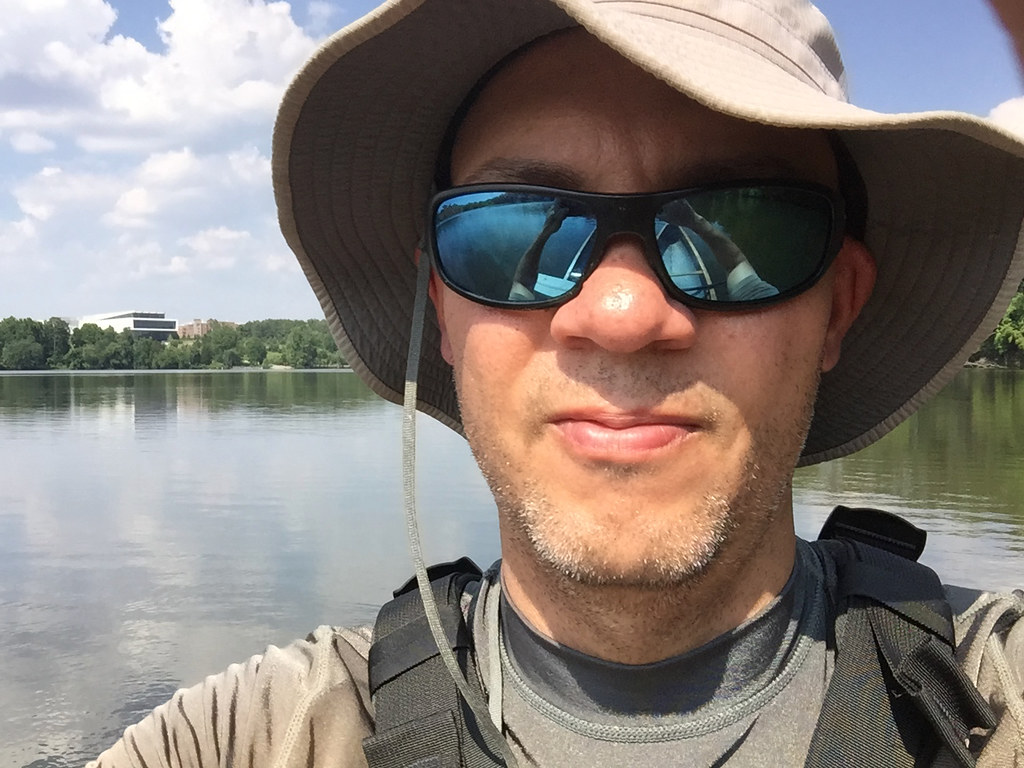
Dr. Ryan Emanuel said he has always been drawn to water, long before becoming a hydrologist.
“I grew up in and around water,” Emanuel recently told Coastal Review. “Even though my parents migrated from Robeson County to Charlotte and raised my brother and me there, we spent a whole lot of time in eastern North Carolina, down in Robeson County. And because Charlotte’s kind of centrally located, I also grew up spending a lot of time in the mountains.”
Supporter Spotlight
While in college, he would head to the coast to surf in his whitewater kayak as often as possible.
A Duke University professor since 2022 and member of the Lumbee Tribe, his research group, which is based in Duke’s Nicholas School of the Environment, “studies complex relationships across academic disciplines, including ecohydrology, watershed science, environmental justice, and Indigenous rights.”
“I am trained as a water scientist, a hydrologist, and I work kind of at the interface of water ecosystems and climate. That’s what I was trained professionally to do, and that’s what most of my work has revolved around for my career as a scientist,” Emanuel said. But about 12 years ago, he began “moving more intentionally into research that engaged with the kinds of questions that people are asking, and in my own community. I am a citizen of the Lumbee Tribe, and I also interact with folks from other tribal communities in North Carolina.”
Duke is also his alma mater, where he graduated in 1999 with his bachelor’s in geology. He then went on to earn his master’s and a doctorate at the University of Virginia. Before Duke, he instructed at North Carolina State and Appalachian State universities.
“I am just really, really drawn to water, and increasingly I’m interested in how Indigenous peoples in this part of the world relate to their culturally important waters. What does it look like to carry our connections forward into the 21st century?”
Supporter Spotlight

These questions began steering Emanuel’s approach to research, and ultimately, resulted in his 2024 book, “On the Swamp: Fighting for Indigenous Environmental Justice.”
Emanuel will be in Carteret County next week to talk about his book as guest speaker for a special program, “Where Water Holds Memory: Dr. Ryan Emanuel on Indigenous Environmental Justice in Eastern North Carolina.” Hosted by Coastal Carolina Riverwatch, the program is set to begin at 6 p.m. Thursday, July 23, at Promise Land Market in downtown Morehead City.
Tickets are $20, which goes to support the nonprofit organization’s work to protect Carteret County waters, the White Oak River and the New River. Reserve a ticket on the Riverwatch website. Books will be sold during the event, and guests are welcome to bring their own copy. Drinks and food will be available for purchase.
In his book, Emanuel “shares stories from North Carolina about Indigenous survival and resilience in the face of radical environmental changes,” according to its publisher, the University of North Carolina Press.
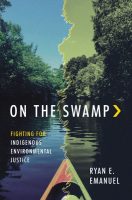
“Addressing issues from the loss of wetlands to the arrival of gas pipelines, these stories connect the dots between historic patterns of Indigenous oppression and present-day efforts to promote environmental justice and Indigenous rights on the swamp,” UNC Press continues. “Emanuel’s scientific insight and deeply personal connections to his home blend together in a book that is both a heartfelt and an analytical call to acknowledge and protect sacred places.”
Emanuel was invited by the North Carolina Commission of Indian Affairs, a state agency, in 2014 to join its then-newly formed environmental justice committee. Through the committee, he began to interact with members of tribes across the state and learn more about their concerns related to the environment.
Emanuel knew for a long time that there was a story to tell about Indigenous peoples and water, “and that story became clearer as I began to work more closely with my tribe and with other tribes throughout the state,” and what he thought was going to be a “feel-good story, for lack of a better phrase, became a more nuanced story that combined all of the rich positive cultural associations that we have with water, with some of the clear-eyed challenges that we face both today and as a result of historical occurrences around colonialism.”
He said he could not discuss what he had called “a love story of Eastern North Carolina,” a phrase he told Coastal Review he had used in one of his first interviews about the book, “without telling the good and the bad.”
Emanuel said he hopes that, with environmental justice as the “core intellectual framing” of the book, readers will come to understand that “environmental justice as a concept is based in policy, social movements and research, and not just a buzzword, or worse yet, a misrepresentation of the term.”
During the program, Emanuel said he plans to read excerpts from the book and then expound and explain the context of the vignettes.
One passage he was considering delving into is about collecting water samples in Sampson County after Hurricane Florence in 2018 with a team of Indigenous people, “who were basically guiding me through their homelands to show me places where they thought we needed to study water quality,” he said.

“That’s a particular memorable vignette from the book, because I think it was the first time in my life I ever actually been out to do field work in a group of all native people,” he said, calling it a “very different dynamic, because so often Native American scientists and scholars are isolated, we’re the only ones in the room.” While that doesn’t change the science, “it can change the social dynamics around the science, it is a different conversation that happens around the edges of the science.”
Emanuel said that he hopes to hear from people in the room during the evening program, be it thoughts on the book, questions on water pollution, climate change and development, discussing the historical connections to colonialism, or the legacy of Jim Crow segregation and Native Americans in Eastern North Carolina.
“I’m really excited to come down there and meet with people and talk about the book, because that general region, is one of the geographies that I cover and go into detail about in the book, and so it’s always special to be able to talk about parts of a book when you’re actually sitting in the place where these stories happen,” he said.
Riverwatch Executive Director Lisa Rider said that the nonprofit organization is honored to host Emanuel as part of its Indigenous Lecture Series.
“We are proud to bring this lecture to our community and hope it encourages meaningful dialogue about Indigenous environmental leadership, coastal resilience, and the future of water protection in North Carolina,” Rider said, adding that his talk “will help our community think more deeply about what it means to protect water, honor place, and ensure that those most connected to the land and water are part of the decisions that shape their future.”
Emanuel’s work brings together water science, Indigenous knowledge, and environmental justice in a way that is especially meaningful for eastern North Carolina, Rider added.
Through his book, Emanuel explores how Indigenous communities in eastern North Carolina have experienced, resisted, and adapted to major environmental changes, from wetland loss and climate impacts to pollution, development, and energy infrastructure.
“For Coastal Carolina Riverwatch, this conversation is deeply connected to our mission,” said Rider. “Protecting water quality is not only about science and policy; it is also about listening to the communities whose lives, cultures, and histories are tied to these waters.”
The book in brief
In the book, Emanuel explains that “that fossil fuel development, deforestation, wetland drainage, factory farming and other unsustainable practices are transforming Robeson County and other places throughout the Coastal Plain. The stench of industrial livestock waste hangs in the air. Rivers flow with nutrients and pathogens. Pipeline easements carve up the landscape. Climate change hangs over it all, threatening the Coastal Plain with intense floods, droughts and heat waves.”
He continues, “I set out to write a book that examined how Indigenous peoples preserve, steward and express sovereignty over their homelands when those places are threatened with degradation and destruction.”
Then Emanuel pointed to examples of “widespread disregard for Indigenous values and perspectives at the sharp end of environmental governance – the point where decisions are made,” particularly an industrial compound in Robeson County and the former Dakota Access Pipeline, which was in the news when he began writing this book in the mid-2010s but had been scrapped by 2020.
While the two issues differ, the “situations highlight points of connection between environmental justice and Indigenous Rights” and “Both cases also highlight the face of colonialism in the Twenty-first century, which is inextricably linked to the extraction and consumption of fossil fuels, and to the accompanying environmental degradation and climate change.”
Emanuel writes that the issues in the book are examined are through an Indigenous lens.
“To be clear. This book is one Indigenous lens – there is no singular Indigenous perspective. More specifically, the book is my lens. I am a Lumbee scientist, educator and advocate for Native peoples,” he wrote, adding that most of his daily work focuses on “my own community’s homelands in eastern North Carolina, and those are the stories that I am best qualified to tell.”
The “book’s structure is a collection of stories that reflects his desire to help guide and remind Native people about what matters. The stories also hold lessons for non-Native people, who all too often make decisions about tribal nations and our homelands without involving us or even contemplating the cost to future generations of Indigenous or non-Indigenous people.”