ROCKY POINT – New Hanover County residents and environmentalists continue their pushback against Martin Marietta’s plan to scale up Castle Hayne quarry mining operations, arguing that the company should further explore other expansion alternatives that would lessen the threat to vital wetlands and water quality.
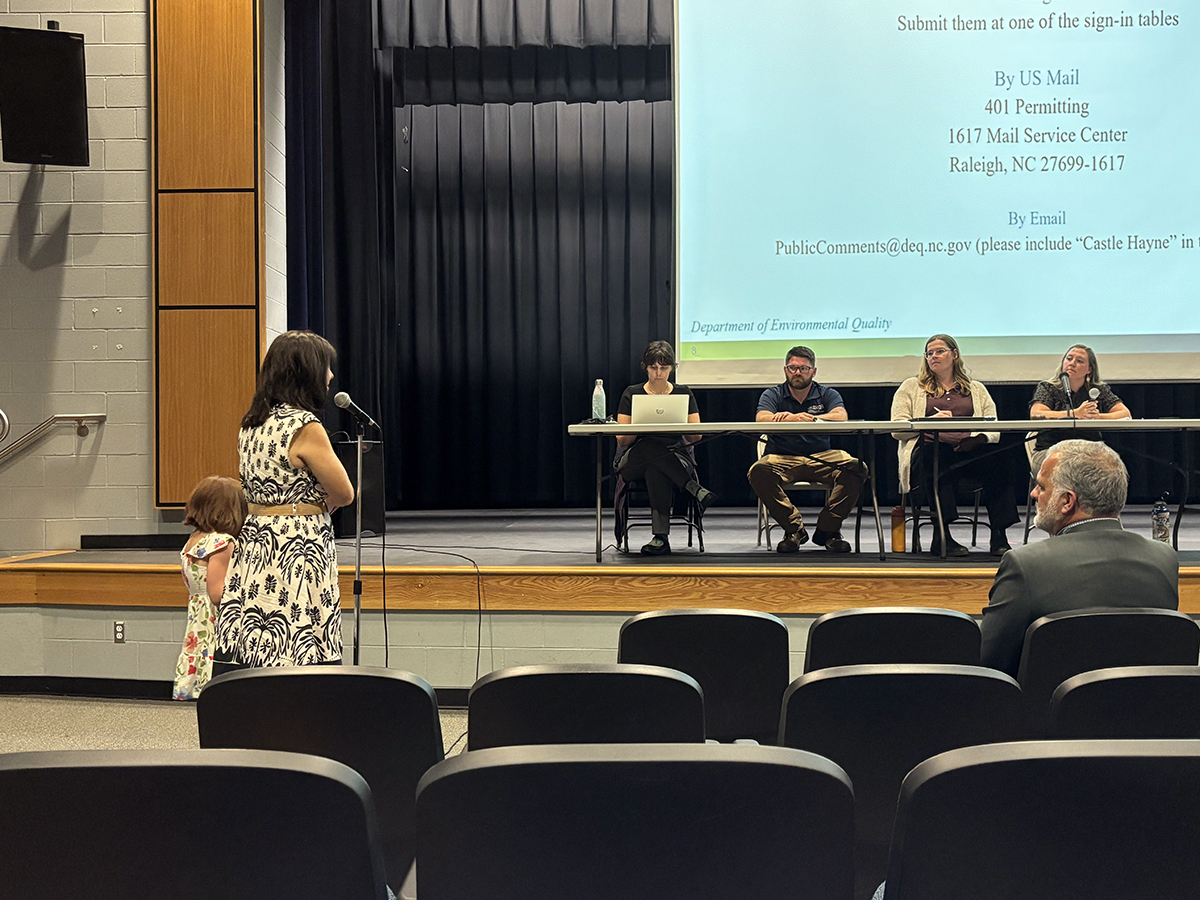
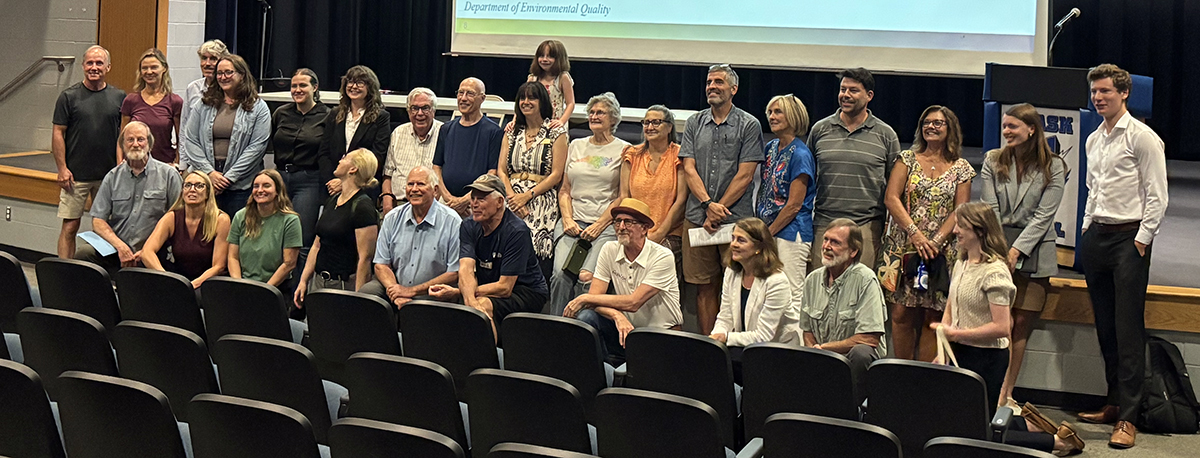
During a public hearing Tuesday night, more than a dozen speakers pressed the North Carolina Department of Environmental Quality’s Division of Water Resources to reject the construction supply company’s request for a Clean Water Act Section 401 water quality certificate to enlarge its Castle Hayne quarry by 358 acres.
Supporter Spotlight

“Let me first say that I understand the need for construction materials for a growing area but also know that we have significant natural areas that should and must be protected,” said Roger Shew, a coastal geologist at the University of North Carolina Wilmington and the first to step up to the mic in the hearing hosted at Heide Trask Senior High School in Rocky Point.
The Island Creek and Northeast Cape Fear River floodplain includes significant natural areas, where riverine swamp forests provide high levels of biodiversity, great habitat quality, nutrient absorption, carbon storage, sediment retention, and recreation, he said.
The company would mitigate wetland loss at a 2:1 ratio, either by purchasing riparian wetland credits or paying into the fund that buys wetland areas. Stormwater management measures would also be employed to minimize wetlands impacts and preserve water quality downstream. This would include a 50-foot minimum wooded buffer around wetlands.
Martin Marietta’s preferred plan to expand limestone mining operations would impact 143.46 acres of wetlands of medium and high quality, and 9.7 acres of open water that connect to those classified as primary nursery areas, strategic habitat areas, and essential fish habitat.
Shew said Tuesday that it is likely even more wetlands would be lost because mining requires pit dewatering, which “creates a cone of depression on lower water tables.”
Supporter Spotlight

“If mining is done in the lowermost floodplain area, flooding will be even more frequent, and of course sediment can be washed in the surrounding wetlands,” he said.
He and other opponents argue that the company could pursue alternatives that would better protect the environment and maintain profitable mining operations.
Shew suggested that mining operations occur largely outside of the floodplain and instead in upland areas of Castle Hayne and Rocky Point, which would conserve significant wetlands.
He also pointed to the company’s Rocky Point quarry, which sits about 3½ miles away from the Castle Hayne site. The Rocky Point quarry includes upland areas that are not directly connected with the significant riverine swamp forests along the Northeast Cape Fear River, Shew said.
He cautioned that if these areas are mined, land immediately adjacent to Interstate 40 must be designated as a buffer zone to avoid the risk of causing sinkholes.
“I hope you see there are options that may allow us to minimize costs of our significant natural areas, protect our waters, and provide the needed acreage for mines,” he said.
In order to obtain a 401 water quality certification, the Division of Water Resources requires that a project have no practical alternatives, that it minimizes adverse impacts to surface water and wetlands and avoids degrading ground or surface waters and causing indirect degradation that violates downstream water quality standards.
“Decades of industrialization and development of the Cape Fear River Basin limits the river’s ability to absorb the impacts of a quarry expansion in its direct floodplain,” said Page Turner, conservation biologist, chair the Cape Fear Audubon Society conservation committee and North Carolina Wildlife Federation conservation manager. “Loss of these wetlands and contamination of the waterway has a direct impact on the water quality of the Cape Fear River and should not be permitted.”
The Alliance for Cape Fear Trees Executive Director Isabelle Shepherd described the river as one that is “already carrying an enormous burden.”
“It receives runoff and pollution from the most densely populated parts of our state, from textile manufacturing, industrial discharge, wastewater treatment plants, concentrated animal feeding operations, and countless other upstream sources,” she said. “By the time that water reaches us, our wetlands and the trees within are among the last natural filters standing between those pollutants and our communities. When we remove wetlands, we remove one of nature’s most effective and irreplaceable water treatment systems. Once these wetlands are evacuated, they cannot simply be rebuilt elsewhere.”
Megan Teachey issued an ultimatum at the hearing, saying that she will pursue a court order known as a writ of mandamus against the Division of Water Resources to enforce its legal obligations if the division does not perform an independent aquifer impact study and verify state ownership of the affected submerged lands.
“The state does not own these waters,” she said. “It holds them in a strict fiduciary trust. Blasting, dredging and injection of industrial chemicals into our aquifer is happening without legal authority. This is a direct offense against the common people and the public trust that we are owed.”
New Hanover County resident Kelly McConnell expressed concerns that the proposed expansion of the Castle Hayne quarry would exacerbate flooding in the area.
“This area is already at high risk and this risk is increasing,” she said. “There are alternatives available that do not impact the wetlands as much and do not impact water quality. I appreciate the need for additional mining. Do it if truly needed, but with much less environmental impact.”
Fellow resident Margie Gewirtzman, her young daughter standing next to her side, said she is particularly concerned for the health of her daughter and other children who live in the area of the quarry.
“Everything that has been said here today sounds really dangerous for my daughter,” Gewirtzman said, adding that once wetlands are destroyed, they will not be the same.
“And it’s so perfect right now. How could we destroy it?” she asked.
The division is accepting written comments on Martin Marietta’s request for a 401 water quality certification through Aug. 13.
Comments may be submitted online. Refer to project No. 20260387, version 1, project name “Castle Hayne.”
Comments may also be submitted by mail to Stephanie Goss, 401 Permitting, 1617 Mail Service Center, Raleigh, NC 27699-1617.