The state’s long-term strategy to support coastal fisheries by improving and protecting habitat is currently undergoing the required five-year update.
With the Coastal Habitat Protection Plan, or CHPP, steering committee’s approval Wednesday during a web conference, North Carolina Department of Environmental Quality’s Division of Marine Fisheries staff are to present over the next few months the draft 2026 amendment to the Environmental Management, Marine Fisheries and Coastal Resources commissions.
Supporter Spotlight
The three state commissions that adopt rules for air and water quality, state fisheries, and coastal development, respectively, are to decide at their next meetings on sending the draft chapters out for public comment.
The commissions adopted the first CHPP in December 2004, a directive of the Fisheries Reform Act of 1997. The plan is to provide “information on the habitats’ distribution and abundance, ecological functions and importance to fish production, status and trends, threats to the habitats, and includes recommendations to address threats,” according to the division. The steering committee is made up of members of the three commissions.
Charlie Deaton, habitat protection supervisor with the Division of Marine Fisheries, explained to the steering committee that the four draft issue papers address ecosystem-based management, strategic habitat areas, planning for multi-decadal wetland change, and seagrass protection and restoration.
The 2016 CHPP serves as the base plan and was updated in 2021. The goal for the final adoption of the 2026 amendment is in November, he said.
Division of Marine Fisheries biologist Michelle Brodeur explained that the 2021 CHPP amendment established the foundation to improve monitoring coastal habitats.
Supporter Spotlight

Some progress has been made but the actions put forward were largely dependent on acquiring new, long-term funding and “that’s brought us in this cycle to look at alternative ways to incorporate our ecosystem data into our management decisions with the resources that we do have,” Brodeur said.
“In this issue paper, we discuss how DMF currently uses ecosystem data and management and then describe a framework moving forward for using what ecosystem data we do have to inform our decision-making,” she said. Some of the recommendations include determining management goals, determining ecosystem indicators and establishing appropriate thresholds. From there, work through the process of creating a progress report to fulfill “our 2021 CHPP action of providing a public-friendly ecosystem report card for our stakeholders.”
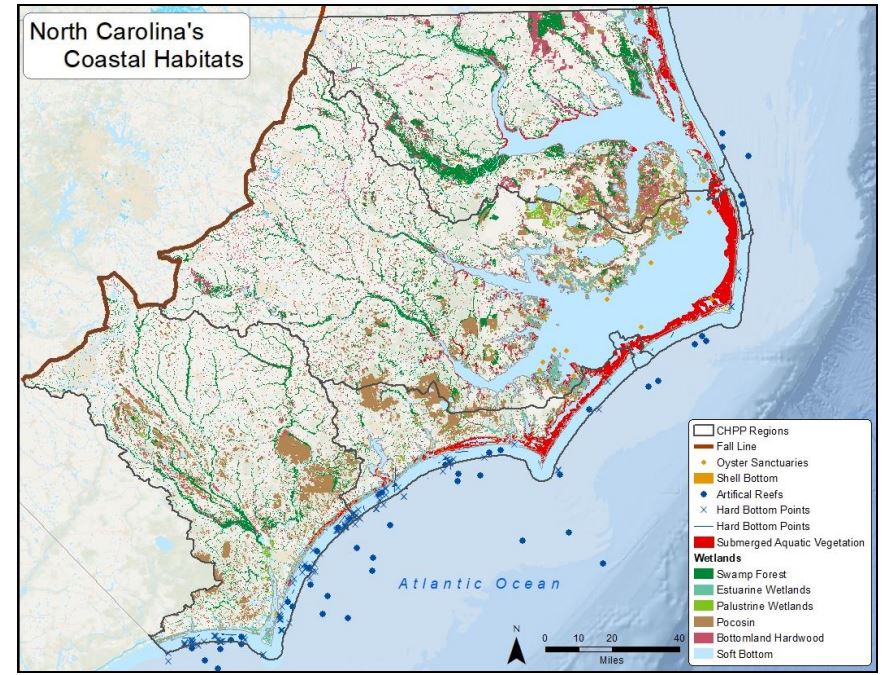
The draft paper on strategic habitat areas, Brodeur continued, looks at confirming that certain locations qualify as the locations described as having high-quality, connected habitats.
The process to identify these areas began in 2006 in order to “protect the biodiversity and ecological function of coastal habitats through non-regulatory approaches,” according to the presentation. Researchers and staff nominated locations from 2009 to 2018, and the sites recommended in the central and Cape Fear area, called regions 3 and 4 in the paper, were evaluated in a four-year study completed in 2021.
The study validates “our initial goals of identifying areas that provide exceptional habitat function by supporting a higher abundance and diverse fish populations,” Brodeur said. The results of the validation study, in combination with the findings that the strategic habitat areas had a more diverse estuary landscape, higher abundance of structured habitats, and less alteration in areas outside of the strategic habitat areas, lend further support for the designation of the nominated areas.
Due to the time and cost of the 2021 study, staff plan to explore the possibility of using existing independent sampling for proposed strategic habitat areas in the northern two regions, which are the Albemarle and Pamlico sounds, Brodeur said.
Fisheries Resource Specialist Derek Detweiler told the handful connected via the web conference that the chapter for planning for wetland change concentrates on thin-layer placement, or TLP, which is a “coastal wetland restoration or enhancement strategy whereby material (often dredged sediment) is intentionally placed on a wetland to increase its elevation while maintaining hydrology and inundation durations necessary for native (targeted) wetland vegetation to persist,” according to DEQ.
Detweiler said thin-layer placement was selected because of its potential to promote sediment accretion and restore impaired habitat by increasing marsh elevation and surface area through what is known as the beneficial use and placement of dredge material.
“For the purpose of this CHPP amendment, TLP is viewed strictly as a tool for the restoration and enhancement of existing wetlands, and not for the disposal of dredge material, not for the creation of new wetlands, or not for the mitigation of other wetland impacts,” he said.
The draft paper goes into extensive detail about the process Detweiler called “relatively unexplored” on a large scale in the state, highlights different case studies across the Eastern United States, includes site assessment and monitoring guidance the Division of Coastal Management developed in 2022, and regulation, policy and permitting aspects.
“We are interested in how TLP is viewed under the North Carolina Coastal Area Management Act and Dredge and Fill Law,” he said. The Coastal Resources Commission adopts rules for both CAMA and Dredge and Fill that are carried out by the state Division of Coastal Management, part of DEQ.
Any permit application for TLP would be denied under current regulations but could still be eligible for a variance from the Coastal Resources Commission, he said, adding that the growing interest in the process could lead to a need for rulemaking.
Detweiler noted that the projects in other states have varying degrees of success.
“The most important consideration with successful thin-layer placement is placement thickness relative to the local tidal frame,” he explained, “Ensuring that any elevation you raise within the existing marsh retains an elevation between sea level and mean high water to really promote native species growth within those marshes.” Those factors vary specific to location and the best past forward would be to evaluate projects in North Carolina on a specific case-by-case basis.
The goal for the paper, Detweiler said, is to highlight failures and successes. What they don’t want to do with this section is offer any endorsement of thin-layer placement or imply that the state must have a certain number of these projects completed within the next CHPP cycle.
“We just want to provide that information as an option moving forward because it has sparked interest in the state,” he said. “Commissioners and other stakeholders can use that information to kind of make that decision moving forward for each project.”
Marsh migration continues to be a priority for the CHPP, he added, and continued efforts will build on guidance from the 2021 CHPP, such as continuing to support and collaborate with the North Carolina Coastal Federation on marsh migration planning. The nonprofit Coastal Federation publishes Coastal Review
The draft submerged aquatic vegetation, or SAV, protection and restoration chapter considers the progressive loss of seagrasses in North Carolina waters and what can be done to slow the process.
The findings in the Albemarle Pamlico National Estuary Partnership’s recently updated report to a 2021 study on high salinity seagrass extent to “continued loss of high salinity seagrasses coastwide at a rate of a little over 1% per year, and we’ve lost 50% of our continuous meadows,” Deaton said about the report using data from aerial surveys conducted from 2006 to 2020.
Related: North Carolina’s seagrass habitat continues to decline: Study
“A lot of those are converting from continuous coverage to patchy coverage, and notable losses on the western, deeper side of the seagrass beds, particularly those that blanket the Outer Banks. So, in short, our seagrass beds are disappearing, and they’re becoming patchier over time. And this is a trend that’s been holding up for a while,” he said.
CHPP’s 2021 update proposes actions to protect seagrass, including proposed water quality standards. Researchers determined how clear the water needs to be for sunlight to reach the plants, a necessary part of the photosynthesis process. Getting the Environmental Management Commission to approve the standards is running behind though.
Deaton said the intent is for DEQ staff to continue facilitating “progress on the proposed water clarity standard to protect SAV, and we anticipate this coming back to the EMC sometime next year.”
The second part of the seagrass chapter, Marine Fisheries Habitat and Enhancement Section Chief Zach Harrison said, considers seagrass physical protection. The push to investigate what authority the Marine Fisheries Commission has to protect seagrass was spawned by a request in 2023 to look at trawling. The commission then in 2024 directed division staff to look at more comprehensive seagrass protections that the commission could mandate.
Staff found that the commission’s authority includes impacts to the entire ecology that supports marine and estuarine resources, and that most habitats addressed in the CHPP can be managed by the Marine Fisheries Commission.
Deaton said that the final section of the seagrass protection draft addresses proposed permitting for the growing interest in active seagrass restoration from the private sector.
“We’ve put together in this CHPP the pieces of what we think kind of the most common upcoming SAV restoration techniques might look like,” he said, and details a permitting framework.
“We’re going to call for a work group to continue to explore both some ecological concerns surrounding the practice and potential barriers and identify research needs,” he said. “One of the potential downsides that comes with sourcing from a broader area is increasing the likelihood of an incidental import of an invasive species. So, trying to manage some of those concerns with transplanting will be important moving forward. And additionally, coordinating with aquatic reed control treatments, because the last thing you want to do is restore your SAV bed in an area that might get sprayed for invasives.”