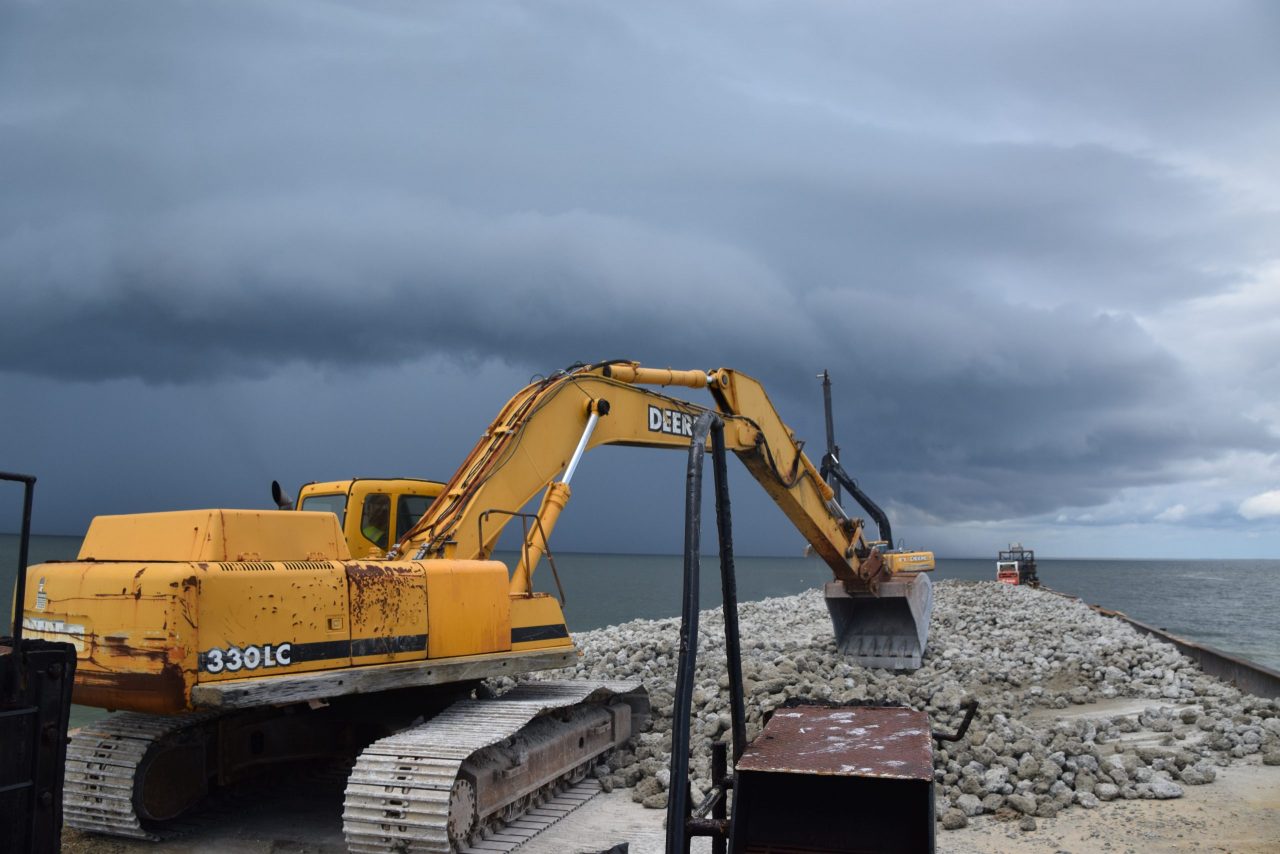
A significant milestone has been accomplished in the statewide effort to restore the oyster population in North Carolina waters. The goal to construct 500 acres of oyster sanctuary in the Pamlico Sound was reached in late August.
The North Carolina Division of Marine Fisheries began building oyster sanctuaries state waters in 1996 to restore the declining oyster population. The division began working with partners in 2003 to further the effort to build up oyster habitat, and then the 500-acre target was later established for what is now known as the Sen. Jean Preston Oyster Sanctuary Network, named for the late state legislator who lived in Emerald Isle.
Supporter Spotlight

Reaching the 500-acre goal was a “monumental effort,” the division’s Enhancement Programs Supervisor Bennett Paradis told Coastal Review in an email. “The scale of this project is truly an impressive accomplishment and a testament to the dedicated team of collaborators who have played a role in developing these oyster sanctuaries.”
The Coastal Federation announced during the first week of October the accomplishment, just as North Carolina Oyster Month was gearing up. This is the fourth year the state has set aside October to “shellebrate” the mighty mollusk, a partnership of the North Carolina Coastal Federation, North Carolina Sea Grant and NC Oyster Trail. Themed this year “Shellebrating Stewardship,” events are scheduled throughout the month at locations from Raleigh to the coast.
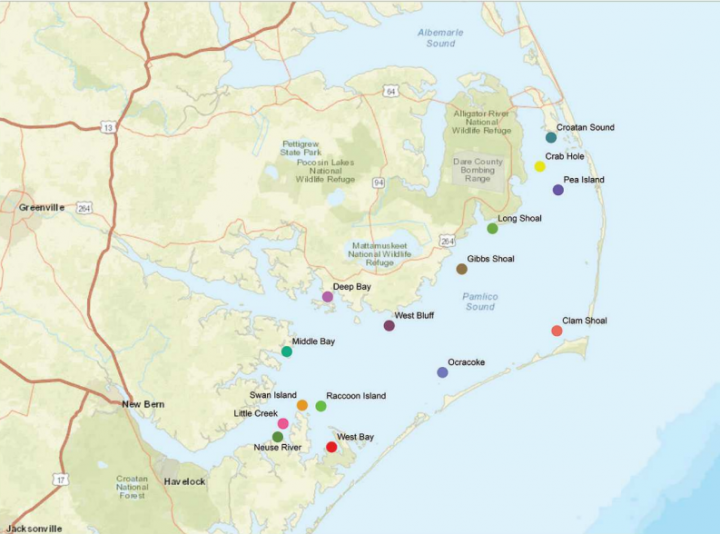
Paradis said that since the sanctuary program began 30 years ago, the division has worked with various partners including the North Carolina Coastal Federation, National Oceanic and Atmospheric Administration, The Nature Conservancy, Army Corps of Engineers and Albemarle-Pamlico National Estuary Partnership to realize the now 17 active oyster sanctuaries in Pamlico Sound. Harvesting is prohibited on protected reefs to allow oysters to grow and spawn year after year.
Coastal Federation Senior Adviser Todd Miller said that reaching 500 acres is a “major accomplishment, especially considering the decades of planning, construction and cooperation behind it.” Miller is the founder and former executive director of the Coastal Federation, which publishes Coastal Review.
“The Division of Marine Fisheries began building oyster sanctuaries in 1996. Beginning in 2003, the Coastal Federation brought fishermen, scientists, state agencies, conservation organizations and other partners together through the Oyster Restoration and Protection Blueprint to develop a shared plan for rebuilding North Carolina’s oyster resources. Expanding the sanctuary network has been a priority throughout successive five-year updates of that plan,” Miller said.
Supporter Spotlight

The first edition of the “Oyster Restoration and Protection Plan for North Carolina: A Blueprint for Action” was released in 2003, the second in 2008, the third in 2015, and the fourth edition in 2021.
The nonprofit’s role in the project has been to help sustain that partnership, build public and legislative support, secure funding, and bring private contractors and university researchers into the work alongside the division, Miller continued.
“Our direct construction partnership with DMF began in 2009. The 2015 Blueprint explicitly called for expanding the sanctuary network to 500 acres, and that year the General Assembly established the Senator Jean Preston Oyster Sanctuary Network,” Miller said.
The Republican senator who died in 2013 was an educator turned politician, who represented Carteret, Jones and Onslow counties in the House of Representatives for seven terms starting in 1992 and Carteret, Craven and Pamlico counties from 2007 to 2012 in the Senate.
“This milestone reflects more than two decades of partners sticking with a shared plan and turning it into something lasting for our coast,” Miller said, adding that most people never see these reefs, so it’s easy to miss the scale of what has been accomplished.
“Imagine restoring an area the size of a 500-acre farm but doing the construction underwater. Ecologically, these sanctuaries are much like a network of pollinator gardens: they provide protected places for life to thrive, with benefits that reach well beyond their boundaries,” Miller continued in his email response. “Oysters grow and reproduce on these reefs, and their young help replenish other reefs in Pamlico Sound, including places where people harvest oysters. Along the way, they filter water and create habitat for fish and other marine life.”
Paradis, who has been with the oyster sanctuary program for more than four years, said that when he began with Marine Fisheries, the division was just beginning year two of construction on the sanctuary near Cedar Island. By the time that project was finished in 2023, strides had already been made with the Coastal Federation to identify two new sanctuary locations at Brant Island and Maw Point.
“Throughout this time, we have worked with the NC Coastal Federation to develop the most recent oyster sanctuaries in the Pamlico Sound network,” Paradis added in the email. The state and nonprofit in 2022 mapped out timelines for material deliveries, conducted initial site investigations, and submitted a proposal for the simultaneous construction of Pamlico Sound’s two largest oyster sanctuaries.
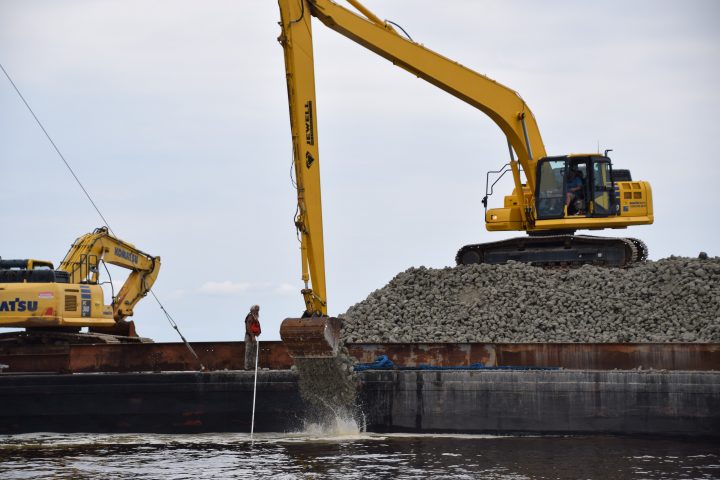
The division began receiving materials in October 2023 and from then until this August, more than 140,000 tons of limestone and granite were delivered. Over the last three years, division staff and contractors with Stevens Towing & Riverbulk of Chowan County spent more than 150 days on the water deploying up to 1,000 tons of limestone and granite at a time.
“Material was deployed along predetermined coordinates to create hundreds of parallel ridges within the permitted sanctuary sites,” Paradis said, with the last deployment taking place Aug. 21.
“All in all, the materials, delivery, and deployment cost approximately $14 million between Brant Island and Maw Point,” he said. Completing these two sites was a collaborative effort with the Coastal Federation, N.C. State University Center for Marine Sciences and Technology, N.C. Central University, and the N.C. Aquariums.
Paradis said the two most recent sites account for a significant amount of habitat footprint within the sanctuary network.
“We basically doubled our output compared to what was done at Swan Island and Cedar Island previously, to develop approximately 145 acres of protected oyster habitat. On top of that, the quality of this habitat is notable. These reefs create up to 4-6 feet of vertical relief off the bottom, providing refuge and increased water flow to oysters. The reefs also serve as nursery and foraging habitat for many economically important fishes of North Carolina,” Paradis said.
The sanctuary program team monitors the sanctuaries after they’re completed by diving on the various reef materials to quantify the oyster condition and efficacy over time. “There are sanctuaries over 30 years old that continue to support significant densities of adult oysters,” he said.
Coastal Federation Oyster Program Director Alyson Flynn said in an interview that even though the 500-acre goal had been reached, “this is by no means the end of construction of sanctuaries” in the state.
“We hope to continue to grow the sanctuary network,” she said, adding that there are acres within the existing footprint that are permitted to be built, “it’s a matter of getting the funding and resources aligned to make that happen. There’s plenty of room for the sanctuary network to grow.”
The oyster steering committee is working to determine what the sanctuary will look like in Pamlico Sound in the future and mulling over the possibility of similar programs in other state waters. The committee is made up of state, federal and nonprofit representatives that work together on establishing the goals for the blueprint.
Flynn also mentioned plans to audit the oyster reefs built early in the program to determine their overall health, and carrying the knowledge forward on what has been learned through the course of building the 500 acres, such as where these reefs are most productive and best materials and shape.
Paradis said that with this milestone reached, there are a few different paths the sanctuary program can take.
Since some of the oldest sanctuaries were built in the 1990s, the approach to constructing the reefs has changed. “We may decide to revisit these older sanctuaries, incorporating alternative materials and more modern designs as we seek to manage aging reefs,” he said. “Alternatively, there are some sanctuaries with undeveloped area within the permitted boundary. NCDMF will continue to monitor the performance of the sanctuaries and conduct quantitative analyses with researchers to guide future restoration efforts.”
NC Oyster Month
North Carolina Oyster Month highlights a range of activities focused on oysters and the role the seafood plays in the economy and environment.
“NC Oyster Month is my favorite time of the year,” Jane Harrison, coastal economics specialist with Sea Grant and voice of the North Carolina Oyster Trail, told Coastal Review.
The Oyster Trail is a program with more than 100 sites across the state that connects tourism and the oyster industry through tours of working shellfish farms, suggestions on where to find fresh local oysters and facts about the protein-rich seafood.
“We have almost 30 events across the state where you can enjoy local oysters and give back to the environment. Not only are they delicious but oysters are a keystone species on the coast, providing numerous ecosystem benefits. I’m especially looking forward to our stewardship events with trash clean-ups and opportunities to learn about building living shorelines with oyster shells,” Harrison continued.
New this year is the NC Oyster Trail passport, available at any location on the trail. The program launched Oct. 1 and “is designed to be your companion for exploring the NC Oyster Trail all year long,” according to the website. Passport holders collect stickers at each site they visit.
For those who complete the Trail survey or share their Oyster Month adventures on social media using #NCOysterTrail could win 50 free oysters.
Visit the event calendar for ways to celebrate oysters in North Carolina.