
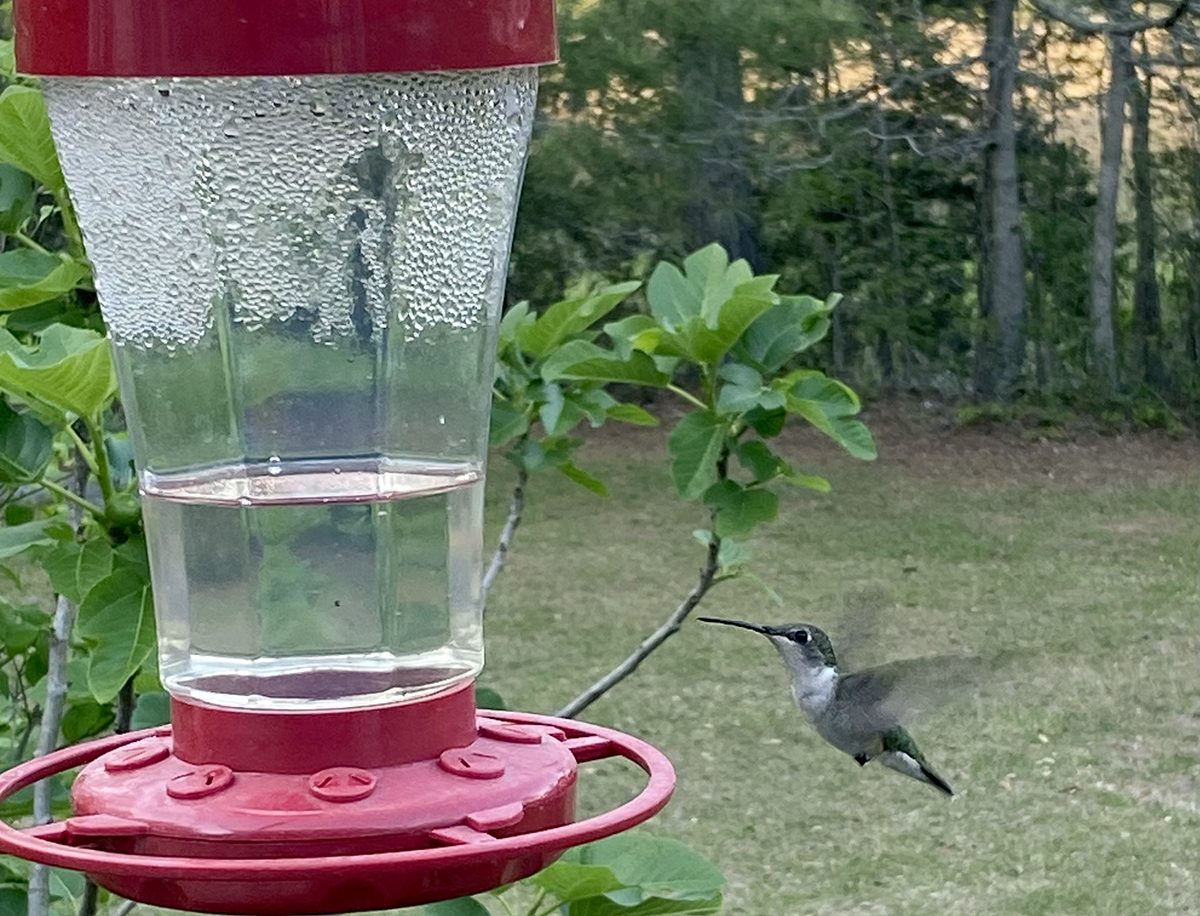
Who doesn’t love hummingbirds? There are more than 350 different types. Native to the Americas, hummingbirds are found from the tip of South America to Alaska.
The chihuahuas of the bird world, one wonders how they can possibly get enough to eat in between chasing other hummers away from feeders and buzzing around like the Tasmanian Devil of Bugs Bunny fame.
Supporter Spotlight

The ruby-throated hummingbird, aka Archilochus colubris, is the one we on the East Coast are most familiar with, and the only one to breed east of the Mississippi. The males boast a showy gorget of iridescent ruby feathers on their throat. Females and adolescent males look about the same, with no ruby gorget and emerald and cream feathers.
Weighing about the same as a marshmallow, or a penny, these tiny, colorful marvels can attain speeds of 30 mph, and up to 60 mph during steep dives and courtship maneuvers. Because their wings move in a figure-eight configuration, beating from 50 times per second and up to 200 times per second for some species, they are capable of flying forward, backward, upside-down and hovering in place.
The smallest hummer, the bee hummingbird, or Mellisuga helenae, can be found only in Cuba. Weighing in at less than a dime, it’s the smallest living bird in the world and is often mistaken for a bee.
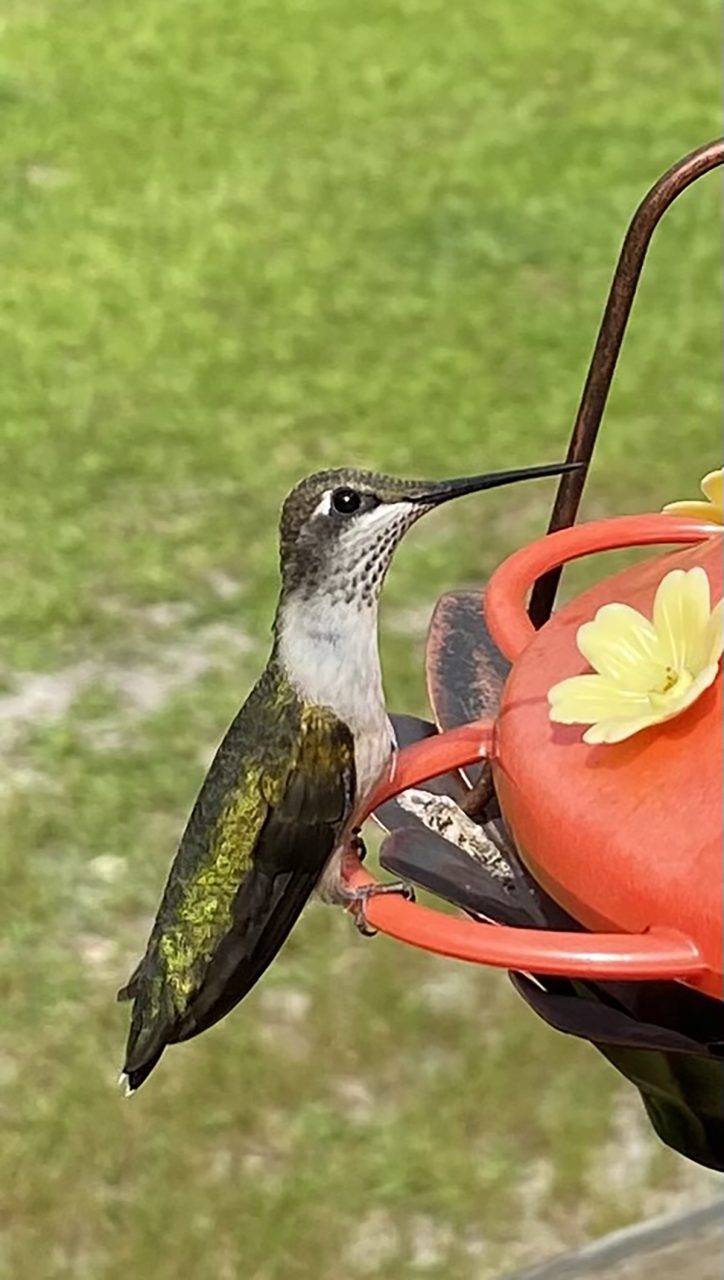
The largest hummer and also the one who migrates the farthest of any hummers — up to a 5,200-mile round trip between the Chilean coast and the Peruvian Andes — is the northern giant hummingbird, or Patagona peruviana. Weighing about as much as one AA battery, it’s about the size of a small human hand, around 8-9 inches long.
Hummers love nectar, which is why they’re so easily enticed by sugar water in hummingbird feeders. Especially attracted to red or orange tubular-shaped flowers, their long beaks and tongues enable them to access nectar other birds and bees can’t reach. In addition, hummers eat spiders, gnats, flies, and even certain types of tree sap when they need extra protein, such as when they’re feeding young.
Supporter Spotlight

With their hearts beating as fast as 20 times per second at rest, or 250 times a minute — up to 1,300 times a minute while actively flying — it’s no wonder they can consume up to three times their body weight each day. At night, or during periods of cold weather,hummingbirds, in order to conserve energy, enter a type of short-term hibernation called a torpor. This dramatically lowers their heart rate and body temperature and conserves fat stores.
Talented nest builders and single moms, the females use spiderwebs, mosses, lichens, Spanish moss, and other natural fibers to make a tiny nest, about 2 inches across and an inch deep, or the size of a large thimble. They then line the nest with thistle or dandelion down. The eggs, usually two, are each about the size of a small blueberry.
Tamping the down by stomping on it — insert visions of a tiny termagant of a hummer mom throwing a temper tantrum: “This stupid rug! Always rolling up and wrinkling! Why won’t it stay flat? — the sides remain flexible and stretch with the growing babies. Camouflaged by the lichens and mosses, the nests are hard to spot.
Hummingbirds don’t seem to mind people too much, especially “their” people. Hummers can learn to recognize the faces they see most often: treat bearers. Often, the same hummers return to the same spot year after year, as evidenced by them hovering in front of a window while you’re washing dishes — “Surprise! You’ve got company!” — or buzzing you to let you know it’s time to put the feeder back up, or to refill an empty one.
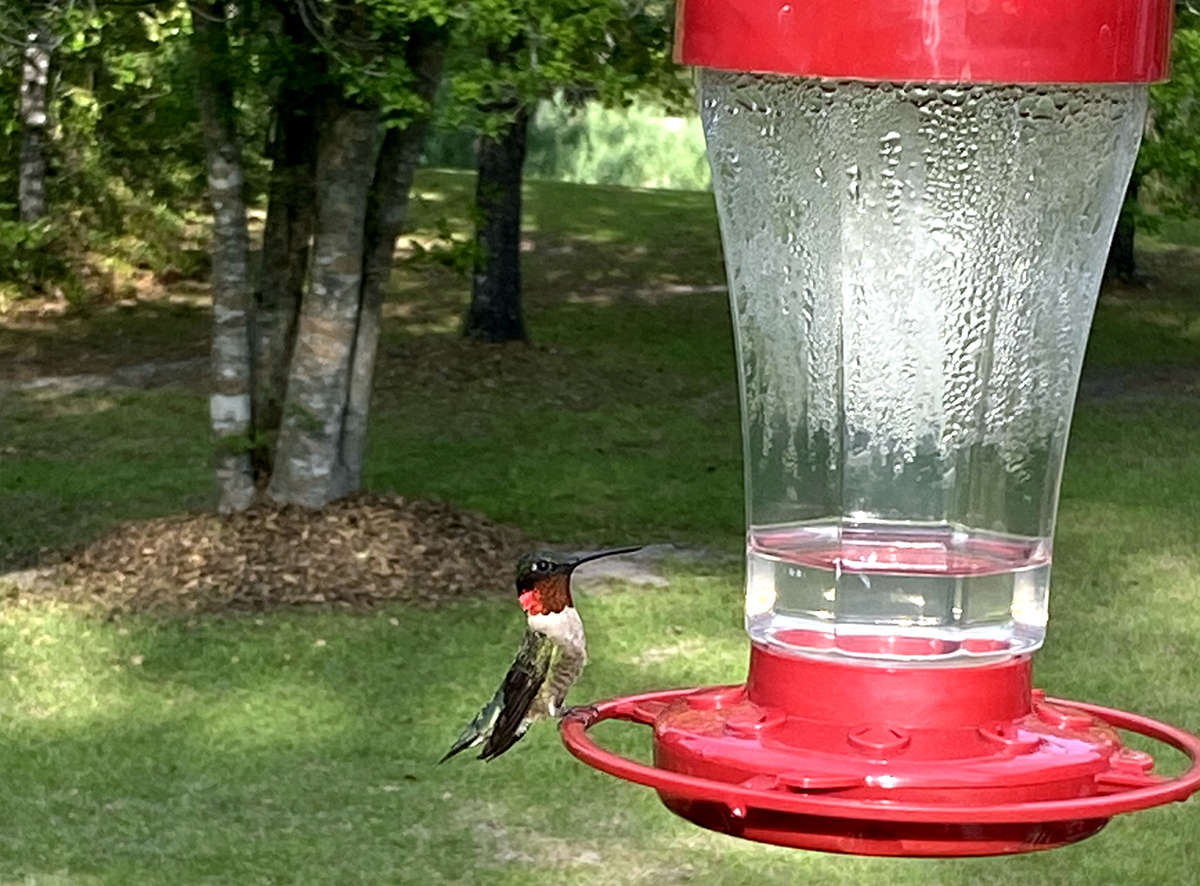
Communicating in a variety of ways, hummers use chirps, whistles, chitters, and squeaks. They also use the buzzing sound their wings and tails make during courting — Have you ever seen a male do the U-shaped side to side flying? — and to drive rivals away.
While humans enjoy hummers and strive to entice them to hang around, they do have lots of predators. Domestic and feral cats are probably the worst threat. Praying mantis, especially the large Chinese ones. Large dragonflies such as common green darners, and orb spiders. The hummers steal strands of spider silk by sticking it to their beaks and chests, but sometimes they get greedy and get caught. They also swipe small insects right out of a spider web. Talk about cheeky!
Blue jays, crows, squirrels, and raccoons are expert thieves of eggs and small chicks. Even frogs have been known to get in on the act when hummers fly too closely to a pond surface.
No wonder hummers are so aggressive!
The hummers are buzzing about right now putting in plenty of overtime and feeding like crazy. They are building body fat in preparation to migrate. Hard to believe these little guys can fly all the way south from wherever they’ve summered, and then fly 500-600 miles across the Gulf of Mexico. Heading to Mexico, Guatemala, Costa Rica, and Panama, these minuscule birds fly a solid 18-20 hours across water. Is that crazy or what?
Some take the scenic route, flying through Texas and then into Mexico. Either way, that’s a long flight, especially when you’re the one doing the flapping.
A few overwinter along the Southern Atlantic Coast from North Carolina right on down through Texas. Can’t you just see some old geezer of a hummer plopping on a branch and shaking his head? “I’m just not feeling it this year, guys. Gonna stay here. Y’all go ahead. Say hi to the family for me.”
It’s amazing what these little guys can do!
The dazzling colors of hummers — hot pinks, bronzes, violets, magentas, purples, and more — are not pigments. Rather, their colors are caused by precisely sized, perfectly arranged, microscopic bubbles in their feathers.
Sadly, it’s almost time to put our feeders up for another year. The hummers will migrate, and hopefully they’ll be back next spring.