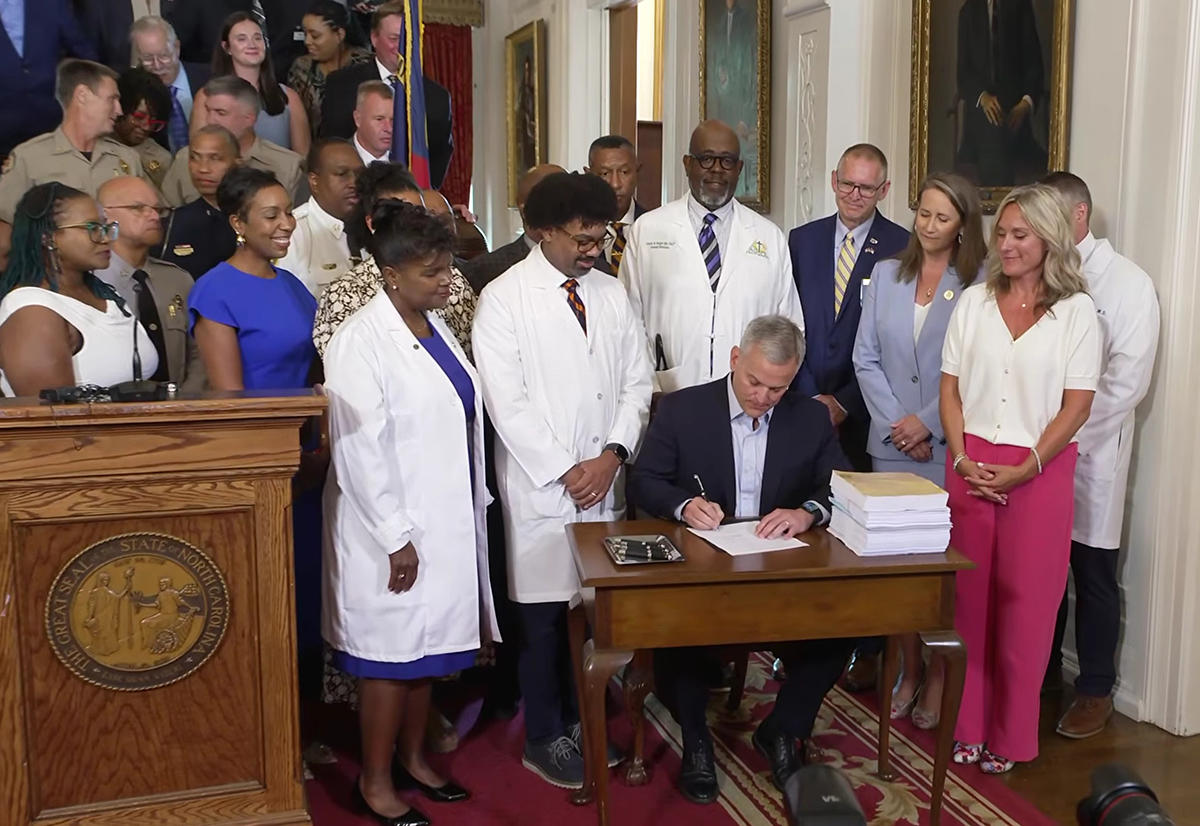
Lawmakers on Thursday sent their approved and long-awaited budget to Gov. Josh Stein, who on Tuesday signed the $34.4 billion spending plan, one that includes notable coastal environmental spending and policy provisions, as well as a blow for commuters who rely on the state ferries that have long been free to ride.
Republican leaders in the North Carolina General Assembly unveiled the measure, Senate Bill 257, on Tuesday, June 30. Despite short notice and the exclusion of Democrats in negotiations, the bill passed both chambers last week with bipartisan support. It’s the state’s first full budget in more than two years.
Supporter Spotlight

On Thursday, Stein told reporters he would carefully weigh its provisions, some of which further diminish the governor’s appointment powers.
“North Carolinians expect their elected officials to come together across our differences to deliver for people,” said Stein in a statement released upon signing the budget, in which he also added that the budget addresses serious concerns such as clean, safe water and disaster recovery.
Stein said the budget “makes meaningful investments” in community colleges and increases salaries for teachers and public safety officers. But the measure “has real flaws” and “unconstitutional and wrong-headed provisions,” the governor said.
“The legislature slashed more than 1,000 state government positions, making it harder for us to keep people safe and healthy,” Stein said in the statement.
The budget includes a provision mandating that the North Carolina Department of Transportation begin charging tolls on the state’s four free vehicle ferry routes. The measure does not set fare amounts. This prompted Sen. Bobby Hanig, R-Currituck, and Sen. Norman Sanderson, R-Pamlico, to cast preliminary “no” votes earlier last week, but both senators voted affirmatively in the final tally. Sanderson had been successful in striking down proposed ferry tolls during his tenure in the legislature.
Supporter Spotlight

Coastal environmental advocates were largely pleased with the bill’s coastal provisions, including those pertaining to water, wastewater, and stormwater projects. Among these are Flood Blueprint and other resiliency projects, creation of a state-nonprofit partnership with the North Carolina Coastal Federation, publisher of Coastal Review, to remove abandoned and derelict vessels from waterways, measures to protect wildlife and natural lands, and efforts to study and address per- and polyfluoroalkyl substances, or PFAS, pollution.

“This is a very strong budget for North Carolina’s coast,” said Coastal Federation Executive Director Braxton Davis. “From investments in removing derelict vessels and improving stormwater management to addressing PFAS, the legislature and governor have reinforced their bipartisan commitment to making our coastal waters cleaner and safer. These investments will also strengthen the coastal economy by protecting the natural resources that support our communities, businesses, and way of life.”
The nonprofit Coastal Federation was also more fully empowered to establish and administer a stormwater retrofit pilot cost-share program and award grants, including to support a temporary position in the Division of Energy, Mineral, and Land Resources. This position would be to provide compliance assistance for existing stormwater permitholders.
The Coastal Federation was also awarded a $1 million grant for its Center for Coastal Protection and Restoration in Carteret County. That project will be completed this summer.
The budget incorporates language from Senate Bill 1053, the 2026 Water Safety Act, introduced by Sen. Michael Lee, R-New Hanover, and with Sen. Danny Earl Britt Jr., a Republican representing Hoke, Robeson and Scotland counties, and Sen. Val Applewhite, a Democrat representing Cumberland County, as cosponsors.

This section defines “emerging contaminants” as PFAS and 1,4-dioxane and establishes an Emerging Contaminant Mitigation Fund under the Division of Water Infrastructure seeded with $45 million nonrecurring under the Department of Environmental Quality to support efforts to offset the compounds’ negative effects on municipal and county public water and wastewater systems. The fund will also go to support detection, reduction, and prevention of exposure to PFAS and 1,4-dioxane, and related research and development. Another $10 million is to cover costs of emergency drinking water supplies resulting from emerging contaminants.
“For nearly a decade, families in the Cape Fear region have carried the burden of PFAS contamination they did nothing to create,” Lee said in a statement in response to Coastal Review. “This budget delivers the most significant state investment yet in confronting that problem: a new $45 million Emerging Contaminant Mitigation Fund to help local utilities test for and treat PFAS, more than $10 million in additional help for families on private wells, and a statewide sampling initiative to trace these compounds back to their sources. The fund is also built for the long haul, because when polluters settle in court, those dollars will flow directly into cleaning up our water. Add the moratorium on new water transfers out of the Cape Fear basin, and this budget treats clean water as exactly what it is: a public health imperative and the foundation of our region’s future.”
The budget authorizes the State Water Infrastructure Authority to award grants from the fund on a priority basis to public water or wastewater system operators to cover costs associated with sampling, treatment, emergency response, remediation and technical assistance to eliminate PFAS and 1,4-dioxane discharges.
About $7.68 million in federal infrastructure money is budgeted for grants for projects addressing emerging contaminants. And $16.5 million in federal Clean Water Act Emergency Response funding will go toward grants to help wastewater systems address emergencies.
The budget appropriates $1 million in recurring funds to DEQ for positions and operating costs associated with the increased need for emerging contaminant research and response. The department may create up to five positions for this purpose. An additional $7 million in nonrecurring funds are provided for the collection of samples for PFAS and 1,4-dioxane research to be conducted by the North Carolina Collaboratory at the University of North Carolina, as directed in the Water Safety Act language.
The Collaboratory is appropriated $15 million for research, development, and remedial activities associated with PFAS and its effects on firefighters. This includes funding of a partnership with the Office of the State Fire Marshal and North Carolina State University to develop and implement a pilot program for deep-cleaning firefighter protective gear to mitigate PFAS exposure and remediation activities related to PFAS at or near fire stations.
The Collaboratory, in cooperation with DEQ, is to conduct a two-phased study to identify and quantify measurable industrial PFAS discharges in the state, first, by collecting samples from publicly owned treatments works and National Pollution Discharge Elimination System permitholders and then sampling other significant dischargers. The final Phase 1 report is due to DEQ, the Environmental Management Commission and the Environmental Review Commission no later than March 31, 2028, and Phase 2 no later than March 31, 2029.
The Collaboratory must also conduct a study of PFAS contamination in biosolids.
The Collaboratory is further directed to conduct a Cape Fear River Basin study with $1.5 million appropriated for that purpose through the end of the decade, when a report is due, and conduct a study of long-term water supply needs in river basins experiencing high rates of growth.
Of the total $4.5 million in Collaboratory operating funds, $170,000 nonrecurring is to support the FerryMon water quality monitoring program that employs sensors mounted to state ferries, and $160,000 nonrecurring for the ModMon river monitoring, a Neuse River Estuary modeling and monitoring project.
DEQ’s total appropriation, net of $295.5 million in receipts, is $111.9 million.
Abandoned vessels
The budget directs the Wildlife Resources Commission to contract with the Coastal Federation to remove and dispose of commission-identified abandoned and derelict vessels with priority given to those in public waters. This refers to vessels left for more than 30 days in a wrecked, junked, or substantially damaged or dismantled condition, docked, grounded, or beached upon the property of another without owner consent.
The measure also provides for expedited vessel abatement during declared emergencies and liability protection for removal work absent gross negligence.
Lee told Coastal Review that owner protections are “built in” to the legislation. After a 30-day notice period, such vessels are deemed forfeited. Funding for removal is to come from boating registration fees, 10% of the total, which is estimated to generate about $1.01 million.
“Our coast has lived with abandoned and derelict vessels for too long,” Lee said. “This budget finally builds a standing program to get them out of our waters, with a dedicated funding stream and the Coastal Federation as the state’s partner on removal.”

The Coastal Federation launched its first coordinated, large-scale, marine debris cleanup in 2019 and has worked with the Wildlife Resources Commission on abandoned boat removals since 2021. The organization’s larger clean water effort dates back much earlier.
“Several of the investments included in this year’s budget strengthen programs that have been central to the North Carolina Coastal Federation’s mission of protecting and restoring the coast for decades,” Federation Chief Program Officer Ana Živanović-Nenadović told Coastal Review Tuesday. Noting the bipartisan support of coastal conservation, she explained how reducing amounts of polluted stormwater runoff keeps estuarine waters clean, supports shellfish harvesting and sustains healthy fisheries.
“Funding for abandoned and derelict vessel removal improves public access and navigation while restoring habitat. Together, these investments will deliver lasting benefits for North Carolina’s coastal ecosystems, communities, and economy,” she said.
Resilience spending
The budget appropriates $4.5 million for projects defined in the Flood Resiliency Blueprint, a planning tool geared to increase community resilience to flooding, and $850,000 for time-limited, associated DEQ positions. Another $250,000 is appropriated to the Resilient Coastal Communities Program to convert two temporary staff positions to permanent. This program administered by the Division of Coastal Management provides financial and technical assistance to help local governments in the 20 coastal counties become more resilient to flooding.
Other provisions
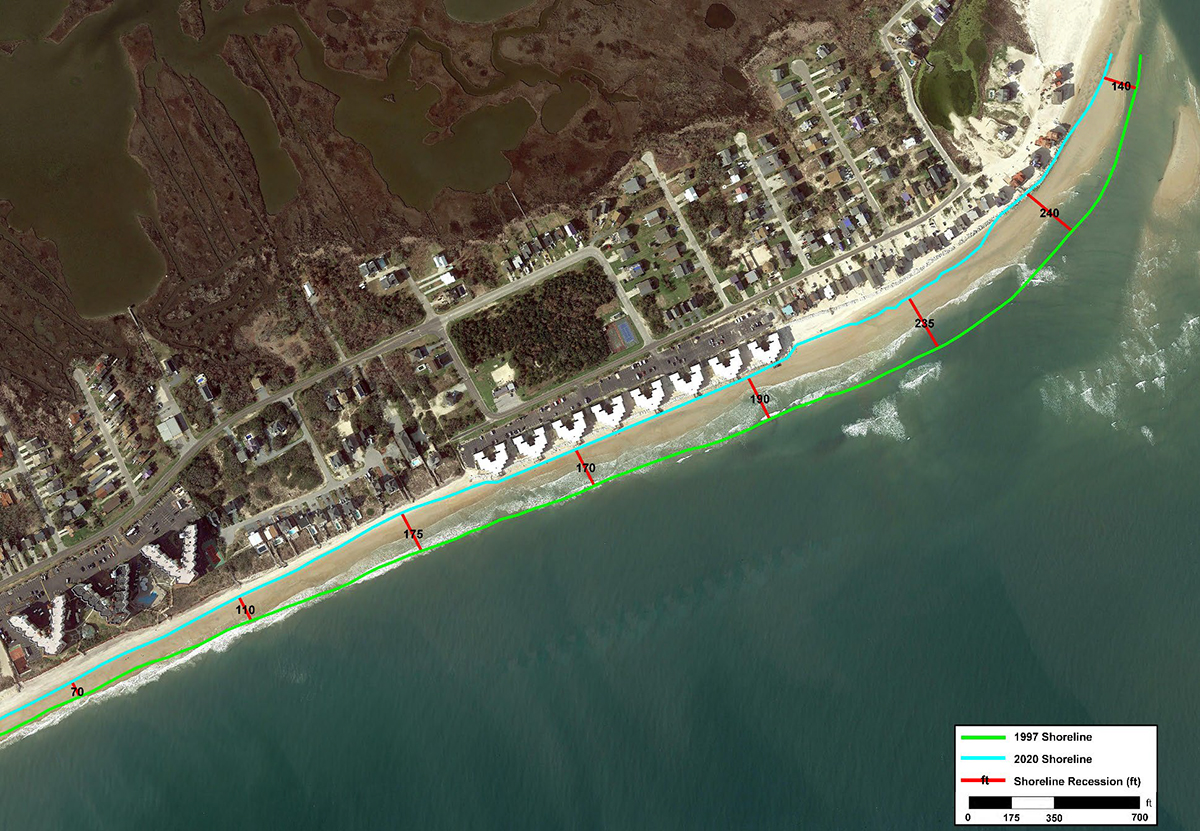
Lee said the budget also modernizes the state’s beach and inlet management planning with a required four-year cycle of planned maintenance and resiliency projects and with DEQ’s updated plan due July 1, 2027. The measure provides roughly $11.5 million combined for coastal storm risk management at Wrightsville Beach, Carolina Beach, and Kure Beach.
The budget eliminates two Department of Environmental Quality positions assigned to the Environmental Justice initiative. It also eliminates the state Office of Environmental Education.
Senate President Pro Tem Phil Berger, R-Rockingham, released a statement in which he said he was “glad” Stein had signed the bill into law and that he “recognizes how vital this budget is for the people of North Carolina.”
The North Carolina Democratic Party also released a statement, noting that after more than 1,000 days, the state finally has a budget that addresses some of the most urgent needs. “While this budget isn’t perfect, it takes real steps in the right direction,” party officials said.