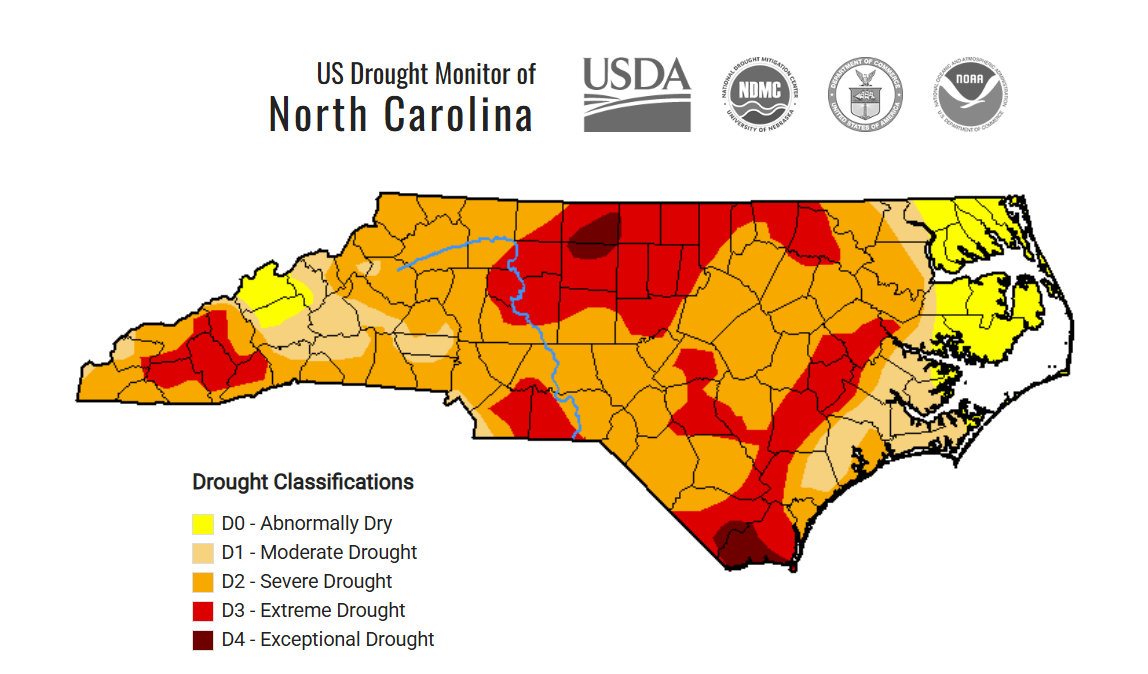
Recent rainfall over much of North Carolina has not been enough to make up for double-digit precipitation deficits counties are experiencing throughout the state.
Some parts of the state are suffering rainfall deficits of more than 20 inches, according to North Carolina Drought Management Advisory Council officials.
Supporter Spotlight
“The big concerns are the reservoir levels,” Klaus Albertin, the council’s chair and water resources engineer with the N.C. Division of Water Resources stated in a release. “Forecasts have called for 3 to 5 inches of rain in the next week, and we’ve seen some areas get significant accumulations already on Thursday. It’s not going to bring everything back up to full, but it’s going to make a difference. Even if areas get 4 inches of rain, some will still be a dozen inches behind. Some of the water will be captured by reservoirs, and some won’t. It’s going to take a while to really get out of this one.”
As the advisory council’s July 23 drought conditions update, the state’s southernmost coastal county, Brunswick County, remains in exceptional drought, which is the highest drought classification.
All of New Hanover and portions of Pender and Onslow counties are in severe drought. The remainder of the state’s coastal counties are classified under moderate drought or abnormally dry.
Rain that fell between July 14-21 improved drought conditions in some parts of the state, but all 100 counties are experiencing drought or abnormally dry conditions.
In all, 32 counties are in extreme drought, 48 are in severe drought, seven are in moderate drought and 11 are classified as abnormally dry. Rockingham County is under exceptional drought.
Supporter Spotlight

Reservoirs and groundwater levels across the state are below normal.
The recent precipitation trend may be bringing more regular rains and significant precipitation, Albertin said in the release, though he cautioned that water is typically used more this time of year through the hot summer.
“All of our reservoirs are still challenged,” he said. “The last few weeks have really helped them stabilize, but we’re not seeing improvements yet. It’s a good thing, but we’re going to need more rain for them to start filling up.”
North Carolinians are encouraged to conserve water and check with their local water supply system for information on water use restrictions that may be in place. Those systems may also have tips for conserving water, including washing only full loads of laundry.
Water systems in counties in exceptional or extreme drought are advised to follow their water shortage response plans, adhere to water use reduction measures, and are required to report weekly water use and conservation status at the Water Use Reporting website.
The Drought Management Advisory Council is a collaboration of drought experts from government agencies in North Carolina, South Carolina, and Virginia organized by DWR. Council members meet weekly and submit their drought condition recommendations to the National Oceanic and Atmospheric Administration, U.S. Department of Agriculture and National Drought Mitigation Center for updates to the U.S. Drought Monitor.