Elizabeth City State University biology students have become the first researchers from a historically Black college or university to participate in the American Campus Tree Genome Project and have their work accepted into a worldwide genetic database.
The research on one of the oldest oak trees on campus is now publicly available through the National Center for Biotechnology Information, or NCBI, one of the world’s largest repositories of genetic information.
Supporter Spotlight
HudsonAlpha Institute for Biotechnology, a nonprofit research lab in Alabama, began the American Campus Tree Genomes initiative to provide students a way to interact with the latest genome sequencing technologies.
The project involved biological research students Nicole Villardi, Camdyn Peck, Laneya Evans, Zakiya Sledge, Nyaziah Sears, Justin Franklin, Juelle St. Clair and Angelina Sanchez, and Dr. Alex Harkess, Lauren Whitt and Sarah Carey, all with HudsonAlpha.
Margaret Young, professor of biology and faculty expert in plant tissue culture at Elizabeth City State, said Friday in the release that the project marked a significant milestone for both the university and the HBCU community.
“We are the first HBCU to be part of the American Campus Tree Genome Project, part of Dr. Harkess’ National Science Foundation CAREER grant. This is the first time that we are sequencing/annotating a tree on this campus and having the data readily available on NCBI,” Young said.
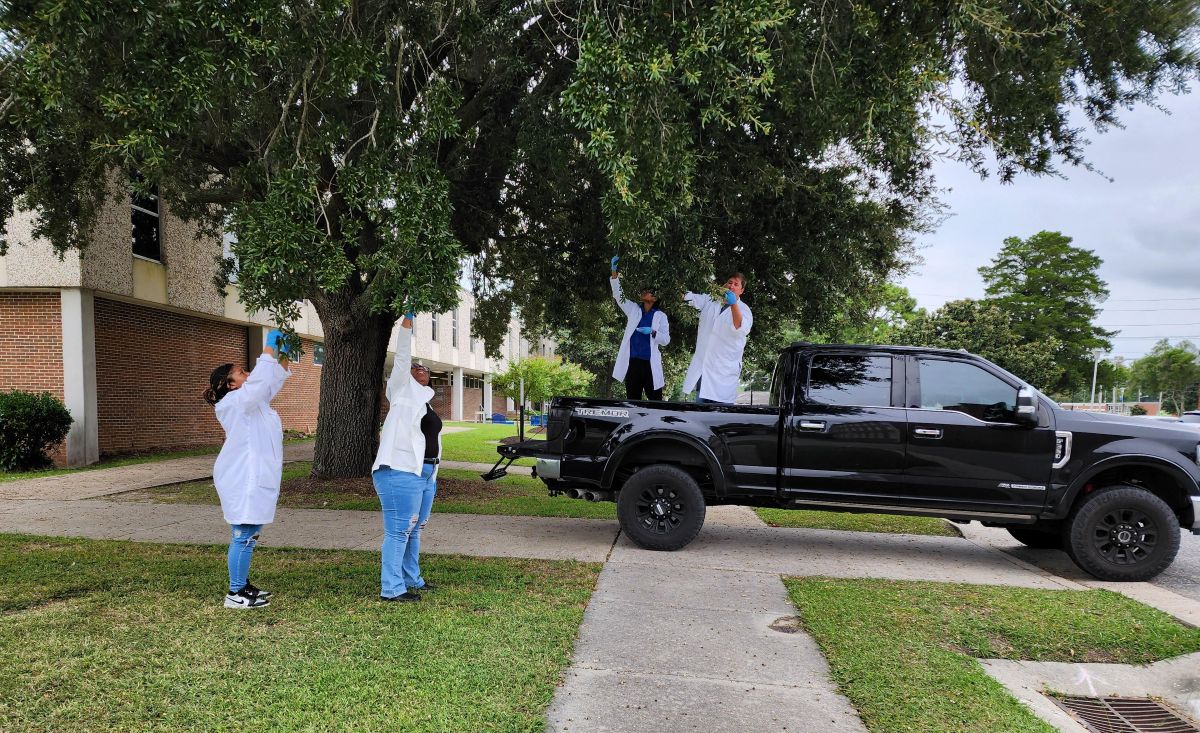
Students collected leaves from an oak tree near the G.R. Little Library on campus and extracted high-quality DNA that was sent to HudsonAlpha for sequencing. Researchers returned the data to the university for the students to analyze before submitting the completed work to NCBI. The research is now available on the international database.
Supporter Spotlight

Young said each step of the process required a level of precision and expertise that is uncommon for undergraduate researchers.
“We were praised by Dr. Harkess. Plant DNA can be difficult to extract due to the tough cell walls and the fact that plants store their waste and have secondary compounds in their cells,” she said.
Unlike traditional laboratory courses, where experiments are often completed within a few hours, this project took an investment of several days.
“Extracting the DNA took several tries, about 8 hours each from start to finish. This would not work in a traditional lab setting, which is two to three hours,” Young said. “Annotating also took several hours. Luckily, the students had done Computer Programming and could figure out the coding when there were hiccups. Dr. Harkess’s staff also helped polish the data. In a course such as Biological Research, there is a lot of latitude—defined meeting times, plus meeting times each week the students decide upon, which makes it ideal for such a project.”