North Carolina lawmakers pushed forward a pair of bills Wednesday that, in tandem, would repeal a decades-old ban on hardened coastal erosion-control structures and secure state funding for terminal groins.
Senate Bill 1009 aims to erase the state’s 40-year prohibition on hardened structures, including breakwaters, bulkheads, seawalls, jetties, revetments, and terminal groins.
Supporter Spotlight

A provision in amended Senate Bill 1001 would allow state funds to cover permitting, building, or repairing terminal groins, rock- and steel-constructed wall-like structures built perpendicular to the shore at inlets to contain sand in areas of high erosion.
Both measures were advanced Wednesday morning to the Senate Appropriations Committee, but not without pushback. The next step for these bills is unclear as the Senate Appropriations Committee does not meet regularly.
Before the Senate Committee on Agriculture, Energy, and Environment voted on the bills Wednesday morning, Sen. Julie Mayfield, D-Buncombe, questioned how state rules may be written to equally protect oceanfront properties facing severe erosion and adjacent properties that may be negatively affected by erosion-control structures.
Asking rulemakers, in this case the Coastal Resources Commission, to write such rules would be “asking them to pick winners and losers,” Mayfield said.
“It’s the vast majority of downstream, I say downstream, I don’t know if it’s called something else on the coast, but downstream properties are disadvantaged when these sorts of structures go in,” she said.
Supporter Spotlight

Hardened erosion-control structures have long been controversial because they capture sand that travels down the beach nearshore, depleting the sand supply to the beach immediately downdrift of the structure, stripping land that is natural habitat for, among others, sea turtles and shorebirds.
Sen. Michael Lazzara, R-Onslow, one of the primary sponsors of the bill to lift the hardened structures ban, responded to Mayfield by asking whether the many homes destroyed by landslides and floods caused by Hurricane Helene in 2024 should not be permitted to be rebuilt.
“It’s the same thing on the coast. We’re losing a lot of homes due to these erosions and anything that we could do to mitigate that is just responsible, the same that we’re addressing that in western Carolina. I think these natural storms have a lot of erosions, whether it’s in the west or the east and people are affected by it,” Lazzara said.
Mayfield said she appreciated the analogy, but that thousands of homes will not be rebuilt in western North Carolina “because the land that they were on doesn’t exist anymore.”
Furthermore, she said, Hurricane Helene was not a once-in-a-lifetime storm, but rather a “once-in-a-10,000-year storm.”
“But that’s not what happens on the coast, right?” she continued. “On the coast, we have storms much more frequently, not nearly as intense, but much more frequently, much more flooding on a regular basis. And, again, I acknowledge that there are houses standing in the water right this very moment, and we need a solution to that, because having them fall down and disintegrate in the water is not the right answer, but also, using these structures to try to protect homes – Mother Nature is undefeated. I’ll just say that.”
Republican Sen. Bob Brinson, who represents Beaufort, Craven and Lenoir counties, pointed out that Senate Bill 1009 also would direct funding to the North Carolina Collaboratory to update the state’s Beach and Inlet Management Plan. That plan was last updated 10 years ago.
He told the committee that sand nourishment, a method by which sand is typically removed from nearby inlets or offshore and placed on the beach to build up eroded ocean shorelines, is not always an appropriate erosion-mitigation measure.
“As I addressed last week, beach nourishment also is getting more and more expensive and not lasting as long,” Brinson said. “And so, in repealing the hardened structure ban, it’s giving our state the opportunity to explore other options rather than saying ‘no’ or ‘never’, it’s ‘how about this’ and ‘how about’ because it will be site specific.”
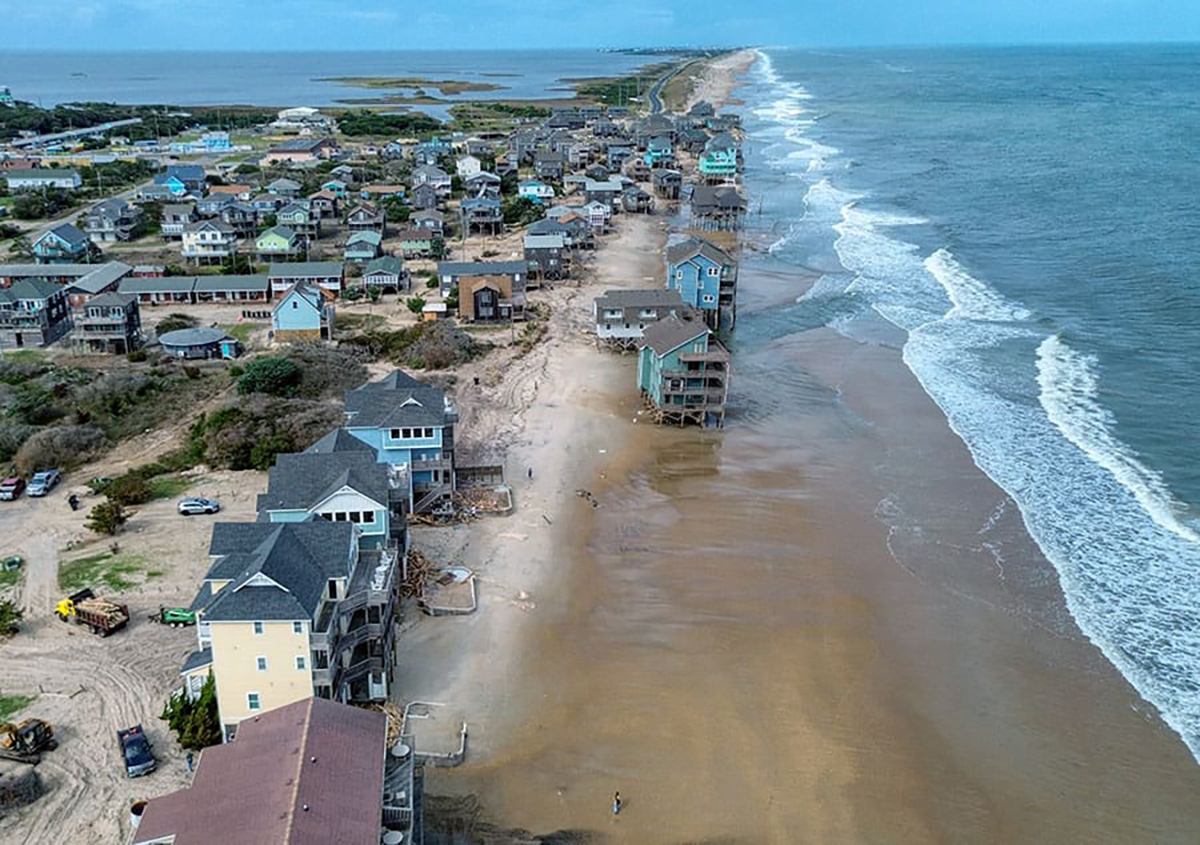
Some members of the committee asked whether other alternatives have been explored to address problems associated with escalating erosion along portions of the state’s coastline. On the Outer Banks, more than 30 homes have toppled in recent years on ocean beaches that vanished because of erosion.
“We shouldn’t keep banging our heads against the wall, doing the same thing over and over again,” Mayfield said. “That’s not helping. Homes will continue to be put at risk. Businesses will continue to be put at risk. I think it’s time to start looking for permanent solutions to problems we’re seeing on the coast and the only way that I can see to do that is to have a permanent buyout fund. You know, government works best when it steps in to where the private market doesn’t work, and the private market doesn’t work on the coast right now.”
Brinson said the repeal does not focus solely on homes, but also public infrastructure, including the erosion and overwash-embattled N.C. Highway 12.
“This gives the CRC the authority to drop rules for these hardened structures, which will be informed by the Beach and Inlet Management Plan that we’ve tasked the Collaboratory to do, and also the science board under the CRC and their report that’s coming out,” he said.
The science advisory panel’s report, intended as a guide for coastal managers and policymakers to tackle the escalating erosion along the state’s coastline, is on the CRC agenda for discussion Thursday in New Bern.
“Our constituents are tired of hearing ‘no, you can’t do this,’ and ‘no, you can’t do that.’ Repealing this ban gives the state the ability to say, ‘here’s what you can do,’” Brinson said.
Nearly 15 years have passed since the North Carolina General Assembly repealed the law banning permanent, hardened erosion-control to grant a handful of beach communities along the state’s southern coast the option to pursue installing a terminal groin at an inlet area.
Since then, Bald Head Island and Ocean Isle Beach have been the only local governments to fund and build terminal groins on their beaches.
As the law stands, state funds may not be used for terminal groins.
A provision in Senate Bill 1001 would allow money from the Coastal Storm Damage Mitigation Fund to be tapped for costs associated with the permitting, construction or repair of a terminal groin. In order to receive funds, terminal groin projects would have to meet specific requirements, including a determination that the structure would benefit public lands and that costs to build or repair a groin will “not include the costs of financial assurance or costs of implementation of any component of the applicable inlet management plan.”
Lazzara indicated Wednesday morning that the language pertaining to state funding for terminal groins in Senate Bill 1001 may be revised.
Coastal Review will not publish Friday in recognition of the Juneteenth holiday.