While state lawmakers consider two bills that would eliminate the state’s longstanding ban on hardened structures along the ocean shoreline, a report providing details about the effects and effectiveness of coastal erosion-control structures is expected to be presented this week during the regular meeting of the North Carolina Coastal Resources Commission.
The commission, which meets at 10 a.m. Thursday at the DoubleTree in New Bern, had assigned to its science advisory panel in February the task of creating the document that is intended as a guide for coastal managers and policymakers to address increasingly destructive erosion along the state’s 320 miles of coastline — dramatically illustrated in recent years by more than 30 houses on the Outer Banks falling into the ocean.
Supporter Spotlight

Two measures in the North Carolina General Assembly, Senate Bill 1008 and Senate Bill 1009, had not advanced as of the time this story was published, with some legislators expressing caution about taking action prematurely.
“I guess I’m a little concerned about putting the provisions of these two bills in place before that study comes out,” said Sen. Julie Mayfield, D-Buncombe, Wednesday during a meeting of the Senate Committee on Agriculture, Energy, and Environment. “My instinct is, ‘Let’s just see what happens there, see what they say, see what that leads us to do that’s different than what’s here.’”
Impacts of climate change on long-term erosion rates are also a factor to consider, said Wake County Democrat Sen. Lisa Grafstein, noting that the topic may be covered in the CRC Science Panel report.
Sen. Bob Brinson, R-Beaufort and also representing Craven and Lenoir counties, told the committee while introducing the bills that while coastal communities suffer direct economic and personal losses from severe erosion, the general public is also affected. Alluding to safety concerns from fallen house debris spreading along public lands and waters, he said that there are also losses to the local tax base and tourism revenue as well as to visitor access to the seashore.
The two bills are different sides of the same coin, that is, the stated goal of allowing the option to build hardened structures that are now banned, if deemed appropriate.
Supporter Spotlight

The primary sponsor of the bills is Sen. Bobby Hanig, a Currituck County Republican who also represents Dare County in Senate District 1, which includes the Outer Banks’ beaches in both counties. Hanig did not respond to messages left on his cellphone seeking comment.
Senate Bill 1008 would establish a pilot program that authorizes construction of shoreline-stabilization projects at locations where oceanfront houses are at imminent risk of collapse. A limited number of projects would be evaluated and recommended by the North Carolina Collaboratory, which the General Assembly authorized in 2016 to apply scientific scrutiny to projects in the state that may serve the public good.
Senate Bill 1009 would eliminate the prohibition of temporary or permanent erosion-control structures and create regulations to ensure the structures “will not result in significant adverse impacts to private property or to the public recreational beach.” In addition, the bill would require funding the Collaboratory to update the state’s 1,000-plus-page Beach and Inlet Management Plan, which was last fully updated in 2016.

Brinson told committee members that whatever pilot projects are approved would include strict limitations and monitoring requirements and would not be funded by the state. Still, in defending the need to eliminate the ban to allow the erosion-control structures, he cited the hundreds of millions of taxpayers’ dollars spent in maintaining and repairing N.C. Highway 12 on Hatteras and Ocracoke islands. But Brinson was referring to areas where virtually none of the typical hardened structures would work for long — if at all. Even if seawalls or other structures were affordable at those locations, the intensity of the coastal conditions would either soon undermine or pummel the structures, or create worse situations at the site or downstream.
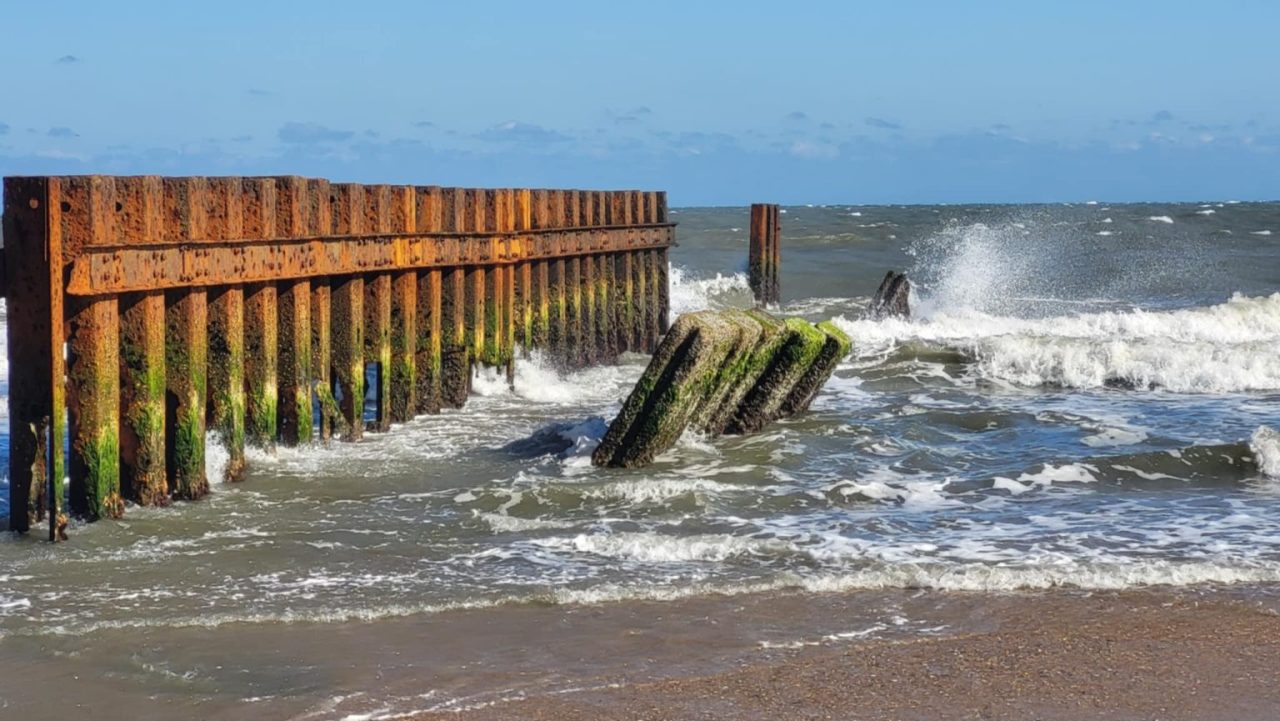
Sandbags, which are considered temporary structures under coastal law, have been widely used for decades on the Outer Banks and coastwide. In a sign of the increasingly difficult challenges created by rising seas, shifting channels, and steeply and rapidly eroding beaches, today’s larger and tougher sandbags also often fail to hold back destructive surging surf for long. Protective coastal management measures have been evolving toward more nature-based solutions such as living shorelines, as well as combined measures, such as beach nourishment and one or more of various types of structures, according to an April 2025 study, “Challenges and lessons learned from global coastal erosion protection strategies,” published in the journal iScience.
And while erosion-control structures may buy time, coastal scientists warn that consequences are not always quickly evident. For instance, in one of the few success stories Brinson noted among the handful of existing hardened structures on the North Carolina coast, the terminal groin at Oregon Inlet also has had a significant, albeit slower moving, negative impact.
While providing the intended protection of the Bonner Bridge, now the Marc Basnight Bridge, and the tie-in to N.C. Highway 12, the groin has also caused a hazardous shoal to grow into the navigational channel, which is at risk of becoming much narrower and deeper as it is pushed closer to the groin. That could present a huge issue to Dare County and the U.S. Army Corps of Engineers, which share responsibility and costs of maintaining channels in the inlet, the only sound-to-sea passage between Virginia and Hatteras.
North Carolina’s ban on hardened structures first went into effect in 1985, when the Coastal Resources Commission put rules in place restricting their use to very few instances, such as protection of historic structures. After a court ruling upheld the ban, it was put into law in 2003.
In a recent social media post, Rob Young, the director of the Program for the Study of Developed Shorelines at Western Carolina University, wrote that the both political parties in the General Assembly voted in favor of the law because they recognized the harm the structures had done in other states, as well as in North Carolina.
“It was, and still is, good science and good policy,” Young wrote. “Seawalls destroy beaches and increase erosion on neighbors’ properties. Seawalls on individual parcels create a nightmare for coastal managers.”
But Young pointed to the provision in Senate Bill 1009 that would “ensure” no adverse impacts to public and private property, creating “an impossible standard to meet,” he noted.
“The bill would open the door to a coastal management free-for-all,” he wrote.