Despite last week’s abysmal report from the state auditor of the funding prospects for the long-planned Mid-Currituck Bridge, the proposed project connecting the Currituck County mainland to its northern Outer Banks beaches will remain officially alive in the state transportation plan, at least for the time being.
The auditor’s Rapid Response Special Report issued June 22 painted a dire fiscal picture: The current $1.2 billion projected cost of the bridge had more than doubled since it was approved in 2019, the project’s borrowing capacity based on toll revenue had plummeted by about 42%, and a funding shortfall of $702 to $832 million would be nearly impossible to fill.
Supporter Spotlight

The audit also found that the transportation department had discovered that between 2012 and 2019, the traffic volume, population growth, and tourism growth on the Outer Banks region had all been significantly less than originally projected. In response, projected daily vehicle counts had to be reduced at all the locations that were measured.
“The people of Currituck County following this project have been dragged along for 30 years,” State Auditor Dave Boliek said in a press release. “What the team at the Office of State Auditor found is that despite spending money, no dirt has been moved. Taxpayers are more than $60 million in the hole on a 30-year project that certainly remains far from completion.”
Meanwhile, the agencies working on the bridge, North Carolina Turnpike Authority and the North Carolina Department of Transportation, said they remain committed to the project, which still has $173 million allocated for it in the State Transportation Improvement Program, or STIP, the state funding document.
“While the project’s current funding gap presents a real challenge, the transit authority and NCDOT continue to work closely with our regional and state partners as well as federal stakeholders to identify and pursue every available funding pathway, including federal discretionary grant programs, toll revenue and public-private partnerships, which is a key next step for the project,” Turnpike authority Chief Communications Officer Logen Hodges said in a June 26 email, responding to an inquiry from Coastal Review. “We look forward to continued collaboration with our local and regional partners as we work to continue advancing this critical infrastructure project.”
The budget difficulties portrayed in the audit were not a surprise — transportation officials had presented the details about the bridge project shortfalls and options during a Feb. 18 meeting with the Albemarle Rural Planning Organization, or ARPO, and its two boards, the Rural Transportation Advisory Committee and the Rural Transportation Coordinating Committee. ARPO was also informed that it had until April 17 to notify them whether to keep the STIP funds for the bridge, or ask for them to be released to be used elsewhere in the 14-county Division 1.
Supporter Spotlight

The Albemarle Commission, a regional planning and development body for northeastern North Carolina, has served as the lead planning agency for the ARPO since May 2002, according to its website. Since then, the RPO has been working cooperatively with NCDOT on development of long-range regional transportation plans, providing related data and prioritizing projects for the STIP.
On April 15, the Albemarle RPO, which serves Camden, Chowan, Currituck, Dare, Gates, Hyde, Pasquotank, Perquimans, Tyrrell and Washington counties, voted to keep the $173 million earmarked for the Mid-Currituck Bridge for the next year, allowing time to pursue alternative funding sources. It would also allow consideration into whether the project would potentially score high enough to submit in the next STIP prioritization cycle.
Since the release of the audit, the panel has not yet had its regular meeting that would provide an opportunity to discuss the findings, Rural Transportation Advisory Committee Chairman Lloyd Griffin, who is also a Pasquotank County commissioner, said in an interview. But for that matter, the April vote had a built-in reaction to the project’s worrisome budget chasm.
“I think the response from the RPO is that we’re giving it one year,” he said. “After that time, it would go back to discussion … We would have to see where the other counties come together on that.”
In other words, if the money wasn’t forthcoming, he said, the RPO could vote to have the STIP funds redistributed. Or, depending on the funding status, they could decide to have the project reapply for scoring.
“However, Boliek was very specific about the feasibility of obtaining additional funding,” Griffin said, referring to the unlikelihood of the rural project scoring well enough in the competitive process that carves up funding largely based on population and traffic numbers.
“If there are no funds this year, then we’re just going to have to say, ‘Hey look, we’re just going to have to move on with the STIP,’” he said. Division 1 is the largest transportation district in the state, he added, and those Currituck bridge funds sitting now in the STIP are “a lot of money” that should be put to good use one way or another.
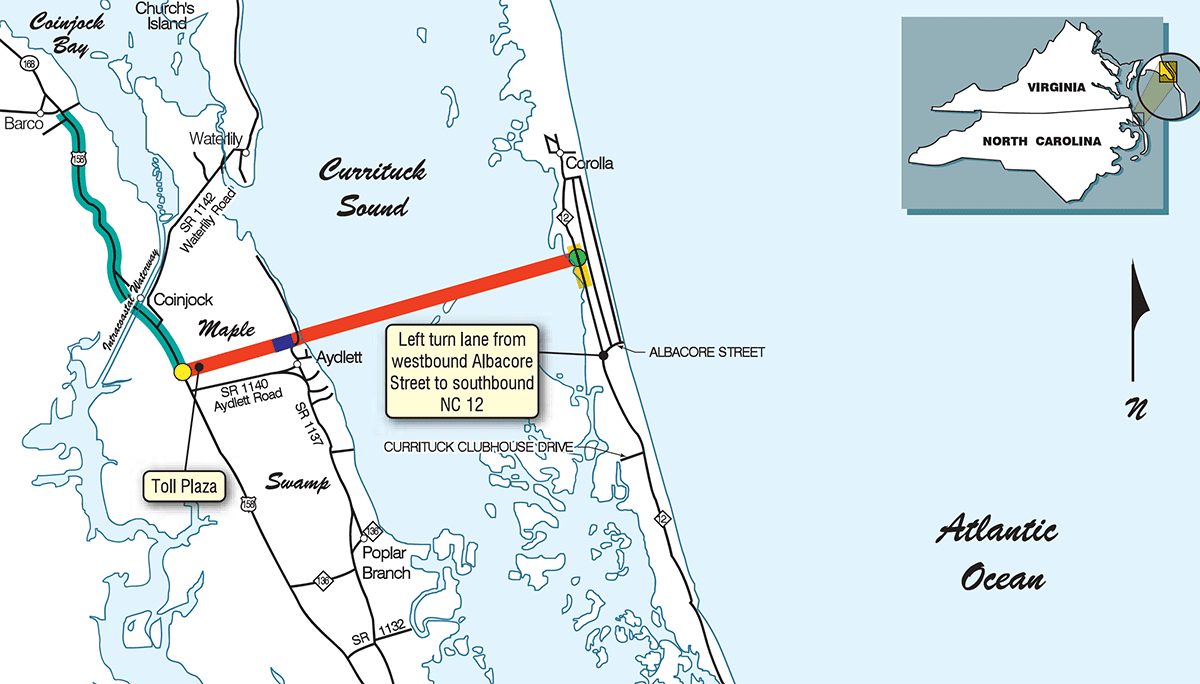
Ever since the bridge was first identified as a need in 1975, the project has had a series of challenges, including inconsistent political and financial support. Supporters have maintained from the beginning that the bridge, which would connect the Currituck mainland at Aydlett to Corolla, on the Currituck Outer Banks, was critical for hurricane evacuation, as well as a shortened route that would relieve summertime bumper-to-bumper traffic from the Wright Memorial Bridge in Kitty Hawk along N.C. Highway 12 to Corolla. The 4.66-mile-long bridge would cross Currituck Sound, and a 1.5-mile-long bridge would cross Maple Swamp on the mainland side, about 25 miles south of the Virginia state line, saving as much as an hour for some travelers.
But opponents contend that it would only make traffic to the resort area worse, and year-round communities on both ends of the bridge lack the infrastructure needed to deal with the additional traffic or visitors. Environmental groups also say that the bridge would cause pollution and harm wildlife and submerged aquatic grasses in the Currituck Sound and surrounding habitat areas.
Two legal matters challenging the bridge, the most recent of several cases filed over the years, are still pending, said Julie Youngman, senior attorney at the Southern Environmental Law Center, a Chapel Hill-based nonprofit, in a recent email responding to questions from Coastal Review.
Representing No Mid-Currituck Bridge, a group of residents opposed to the bridge, and the Sierra Club, an environmental nonprofit, a petition for a contested case hearing was submitted to the state Department of Environmental Quality in November, she wrote. The petition challenged the state Coastal Area Management Act, or CAMA, permit the state had issued, she said, arguing that the bridge would disrupt the communities on both sides of the bridge with increased traffic and development and have negative effects on drinking water and wastewater infrastructure.
That petition was pending in the North Carolina Office of Administrative Hearings, but it has been stayed, pending resolution of another petition that was submitted to the state in December challenging the CAMA permit issued by the Coastal Resources Commission.
“We are asking the Currituck County Superior Court to rule on whether the CRC exceeded its authority when it purported to limit the issues we could raise,” Youngman wrote in the email. “Once we get resolution on this issue, the permit challenge can proceed in Office of Administrative Hearings.” The second matter is set to be heard at the Dare County Courthouse during the week of July 27, 2026, she added.
Youngman said “enough is enough” and NCDOT must either acknowledge that it is not going to be able to build the $1.2 billion bridge, it will release the $173 million STIP funds, or it has to explain how it will manage to fund the bridge’s construction.
“Much of the information presented by the state auditor echoed concerns raised by SELC and our clients over the past decade,” Youngman said. “In its initial analysis of the bridge, NCDOT severely overestimated the amount of traffic and growth that would come to the region in the future. Since that time, the price of the bridge has increased dramatically, while the forecasts of toll revenue have decreased. As a result, there is simply no viable financial path forward for the bridge.”
The SELC agrees that traffic congestion on the south end of Currituck County and northern beach communities in Dare and Currituck counties needs to be addressed, whether it’s with a traffic circle (roundabout) or management of pedestrian crossings or other strategies. But Youngman said that for a proposal that over its lifetime has already expended $61 million of tax dollars, “with nothing to show for it,” it’s high time to switch course.
“We are disappointed that despite all the past waste of money, time, and other resources, NCDOT is continuing to press agencies to issue permits and expend resources litigating those permits in court,” Youngman wrote.
“It is beyond time to put this project to bed and to focus all our energies on solutions for the Outer Banks that are actually viable and can be much more quickly set in motion.”