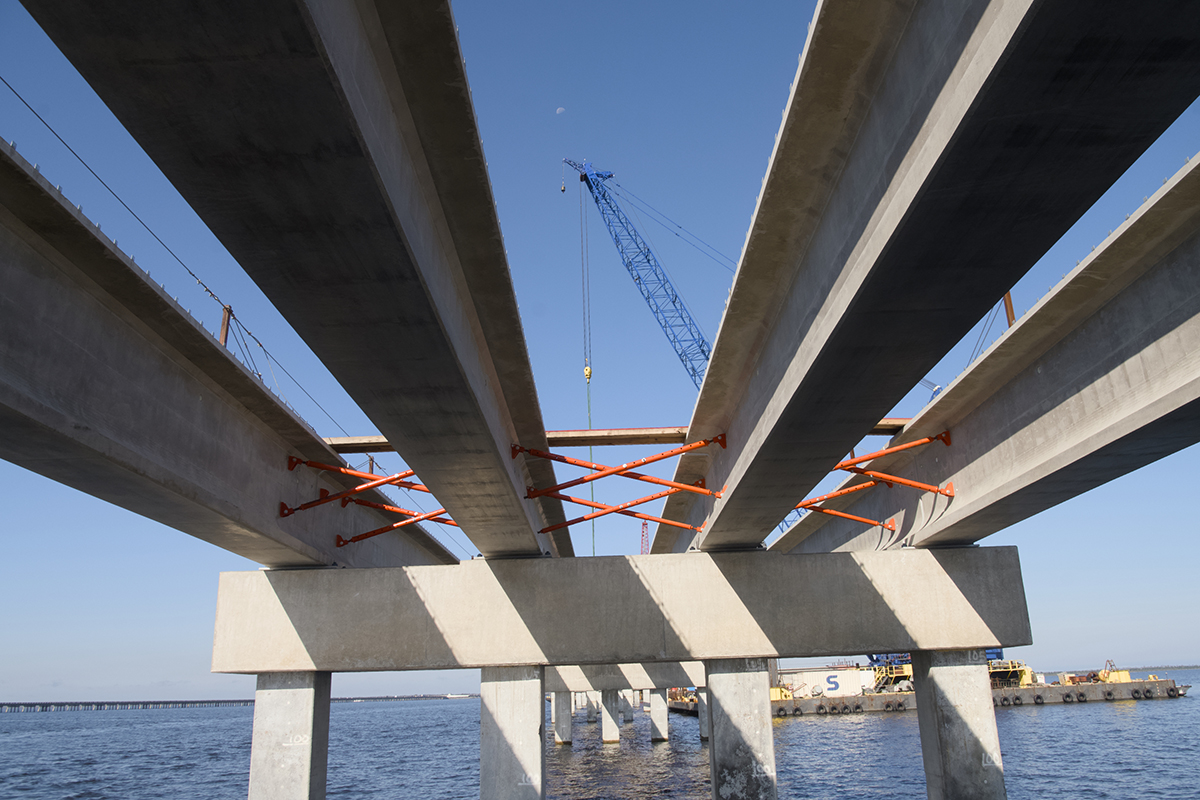
As the new Alligator River Bridge on U.S. Highway 64 takes shape, and, because progress is a little ahead of schedule, contractor Skanska USA Senior Vice President and Project Director Phillip LeFave is cautious with his optimism.
“We’ve been lucky with the weather over the last year and a half. We’ve had really good weather in both summers (2025 and 2026), and so far, this year, our season has been uneventful. It’s helped us move the bridge along,” LeFave told reporters during a recent tour of the site, prior to the recent nor’easter. Skanska USA is a global construction and development firm with offices across the country, including two in the Raleigh area.
Supporter Spotlight

The weather, LeFave noted, is beyond Skanska’s control, but he pointed to two other factors that have contributed to the progress on the bridge, construction for which began in February 2025. The cooperation with North Carolina Department of Transportation, he characterized as “excellent…Everybody’s got the project first mentality.”
Lafave also pointed to the workforce as “the utmost importance.” Adding, “Being able to find qualified, dedicated, skilled bridge-building people in a part of the state like this has been good for us, and we’ve got people that are dedicated to the work show up every day and just do a good job for us and for the state.”
There are 150 workers on the project commuting from as far away as Elizabeth City and Greenville. The commuting time to the work site from those cities is about an hour and 15 minutes to an hour and a half.
The bridge being built replaces the Lindsay C. Warren Bridge. Opened in February of 1962, the swing-span bridge cost $2.48 million to build, about $27.7 million in today’s dollars. The fixed-span bridge now under construction has an estimated price tag of $523 million, although that price includes removing the old bridge and environmental restoration work.
There are considerable upgrades with this new bridge compared to the original design. Perhaps the most visible, and for drivers the most important, is what Lafave termed “a flyover, a 65-foot bridge that flies over the channel.”
Supporter Spotlight

He added that the “big benefit, and the one that most people are waiting for anxiously, is not having to stop for every boat that comes through.”
The flyover will cross a 135-foot-wide channel and will replace the swing span on the Lindsay C. Warren bridge. Unlike a traditional drawbridge that lifts both sides of the road to create passage past the bridge, the swing span pivots open to allow boat traffic through. After more than 60 years of use, the swing span requires, “mechanical replacement parts…that are not readily available and that typically require custom fabrication,” NCDOT noted in June of 2021.
The scheduled completion date for the bridge is the fall of 2028, although that will not be the end of the project Lafave told reporters.
“It’s not just a new bridge; it’s removal of the old one,” Lafave said, adding that after the original bridge is removed the shoreline “goes back to the way it was before the bridge was there…make the old place look like the wetlands again, and then reforestation of the wetlands.”
Although the flyover is the most visible improvement compared to the Lindsay Warren Bridge, there are several other improvements in the design and materials used to build the bridge that will make the bridge safer and reduce maintenance costs, SKANSA officials said.
The new bridge will have 8-foot shoulders. Lafave compared that to the old bridge, saying, “when you drive over that guy out there, she’s tight. It’s just a double yellow (line), no shoulders, no safety for you. This is a big upgrade.”
The biggest improvements, though, may be in the materials used in constructing the bridge.
Sometime in the mid-19th century twisted iron bars, or rebar, began to be used to reinforce concrete in construction. By significantly increasing the tensile strength of concrete, rebar allowed, among other things, longer bridges to be constructed that could handle much heavier vehicles.
Metal, however, rusts over time. That has certainly been the case at the William B. Umstead Bridge, also known as the old Manns Harbor bridge, linking mainland Dare County with the Outer Banks. Built in 1955, weather and time have corroded the concrete pilings exposing rusted rebar encased in the pilings. The bridge is safe to use, according to NCDOT officials, but the corrosion found in the rebar during a major renovation has contributed to pushing the projected completion date of that project into 2027.
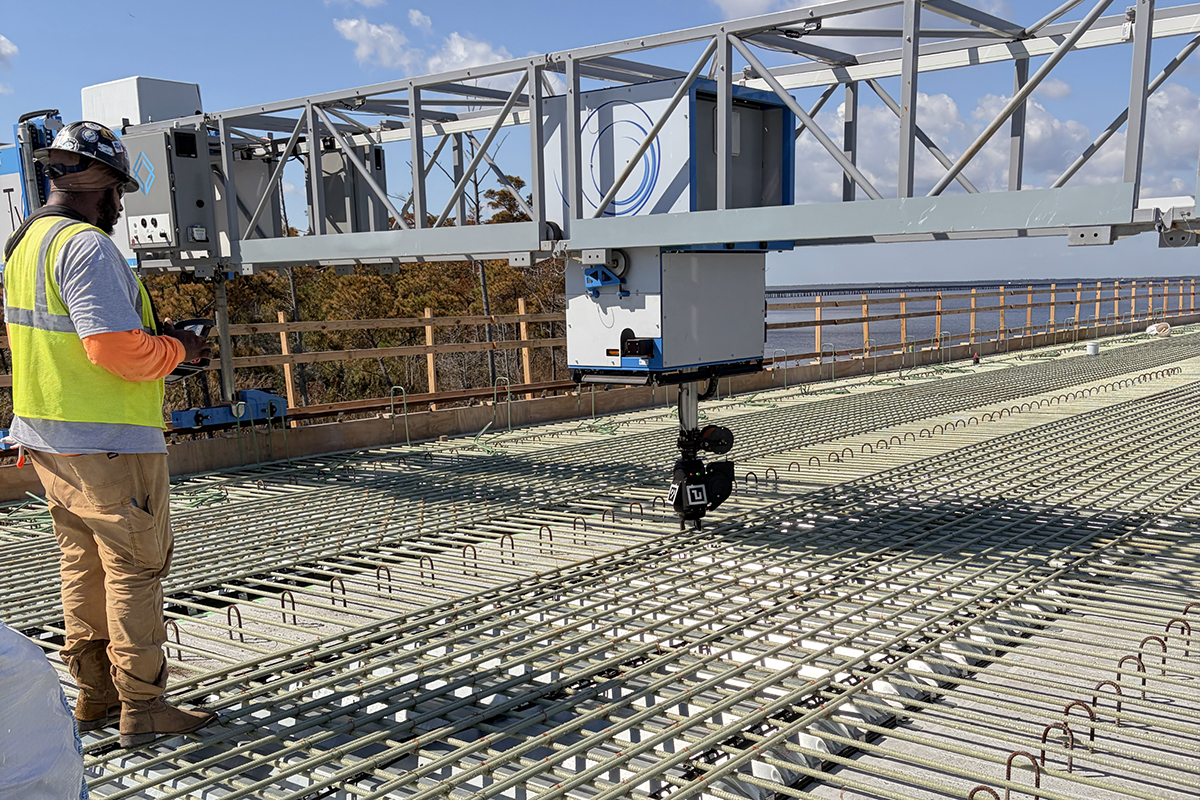
The new Alligator River Bridge will not be using metal rebar. Rather the design calls for Glass Fiber Reinforced Polymer, or GFRP, rebar.
“In all the substructure there’s…GFRP rebar for reinforcement, glass fiber reinforced polymer, so it avoids the corrosion,” Lafave said. “That technology will add life to the bridge and hopefully prevent or reduce maintenance for NCDOT.”
Although its resistance to corrosion is a significant advantage over metal rebar, GFRP has another benefit—it weighs less than steel.
After acknowledging the maintenance advantages for GFRP, Project Manager Eduardo Estrepo noted, “for us the contractor, it’s lightweight. It’s about a three-to-one ratio (compared to) steel. It allows us as a contractor to be able to tie big cages…actually flat them.”
The cages are part of the “high-level substructure,” Estrepo said. Used for stability and strength in stabilizing the spans, the lighter weight of GFRP allows the largest rebar cage on the project—an 80-foot by 20-foot cage—to be lifted onto the superstructure by a crane.
“You would never ever see that with steel (rebar). It’s way too heavy for any crane to pick up,” Estrepo said.
The amount of GFRP needed is extraordinary. The road surface will require “5.1 million linear feet of glass fiber reinforced polymer or rebar for the roadway,” Lafave said.
Rebar used for roadbeds is laid in a crisscross pattern and each intersection of rebar requires a tie to hold in in place. Traditionally that has been done by hand. The Alligator River Bridge, though, is using TyBOT—a fully autonomous rebar-tying robot.
Asked if a skilled worker or TyBOT is faster, Lafave answered, “It’s a tortoise and a hare type thing. You can beat it in the short run, but in the long run, the machine will always last longer.”
With about two years to go until the bridge opens to traffic, construction has focused on the substructure that will support the road, Lafave said, pointing to “the operations below the roadway deck making their way up out of the water. That will continue to be the focus for the next few months, and then it will transition into the bridge decks and the roadway surface.”
There is still considerably more to be done before work can begin on the bridge’s road surface, but by the end of this year, “our big focus going into 2027 and throughout the entire year 2027 is the bridge decks,” Lafave said. “Our operations will make their way from either end, from the east and the west side, out towards the center, and then up over the hub.”