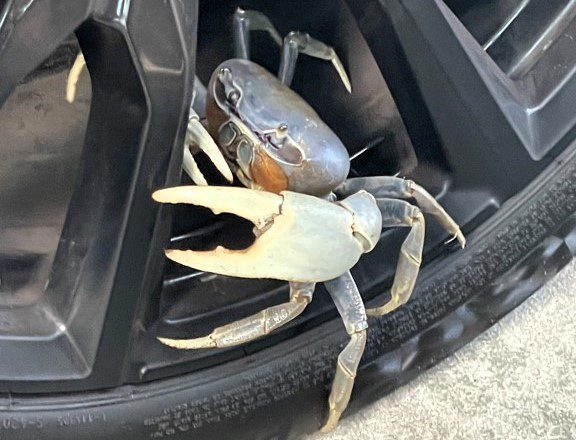
As researchers search for answers related to the blue land crab, such as the extent of the crustacean’s range throughout the Carolinas, state biologists continue to ask people to report sightings of the non-native species.
The crabs, which look like giant fiddler crabs, are native to the southern Atlantic coasts from Brazil to South Florida. Sightings of these difficult-to-catch crabs have been on the rise in North Carolina, South Carolina and Georgia in recent years, with the species being first reported in South Carolina in 2008.
Supporter Spotlight

North Carolina’s first confirmed blue land crab sighting was in summer 2023, according to the North Carolina Department of Environmental Quality’s Division of Marine Fisheries.
“Since then, there have been 23 confirmed sightings in North Carolina and another 34 unconfirmed reports,” according to DMF officials. “Two of the 23 confirmed cases were this year, both in Emerald Isle.”
These crabs vary widely in color, with adult males typically having the characteristic blue-gray coloring, while females can also be white or ash-gray. Juveniles may color from orangish to dark brown to purple.
Blue land crabs live uncharacteristically long lives and are slow-growing among crab species. They reach maturity at the age of 4 and can survive up to 11 years.
These crabs retreat into burrows deep below the ground and possess a large claw they can use to dexterously defend themselves.
Supporter Spotlight

Researchers do not yet know whether the species arrived through natural expansion or human intervention.
“Reporting sightings can help biologists learn more about where these crabs are spreading,” according to a DMF release.
If you spot a blue land crab, snap a photograph and report the date and location of your sighting. Crabs may be more visible following heavy rains, which can drive them out of their burrows.