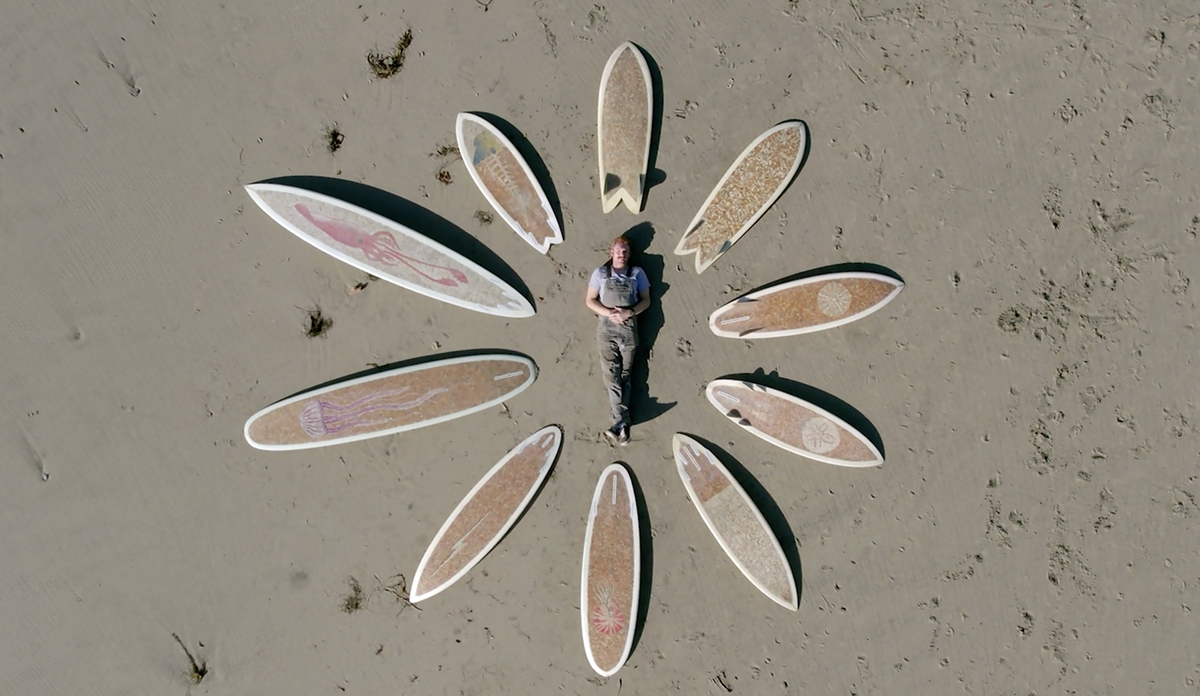
“The Cigarette Surfboard” is a documentary about the environmental impact cigarettes can have, and the film about a surfboard created using thousands of butts collected from beaches also serves as a cautionary tale about the damage that pollution has done and will continue to do to the world’s oceans.
“The Cigarette Surfboard” online premiere will span Tuesday through Sept. 27, which is timed in conjunction with International Coastal Cleanup Day Saturday, Sept. 19. As part of the live premiere, and included with the $10 film ticket, virtual Q&A sessions are planned with pro surfers and ocean activists who appear in the film.
Supporter Spotlight

The star of “The Cigarette Surfboard” is a surfboard that was made with cigarette butts by the movie’s co-producer, Taylor Lane, who is introduced in the film as an “industrial designer/average surfer.”
Lane created the surfboard in 2017 and entered it into the Vissla + Surfrider Creators & Innovators Upcycle Contest, which was held that year in San Juan Capistrano, California. The Vissla contest features boards made of “upcycled” materials.
Taylor’s cigarette surfboard won first place, and that was the beginning of a remarkable voyage of discovery.
Judkins, who has known Lane since they were college students, began filming the story of the cigarette surfboard, “from the very first beach cleanup. We kind of embarked on this journey together, and we had no idea where it would take us, and that’s the beauty of documentary, you start with an idea, you follow that, you become passionate about it, and it leads you to all sorts of of new and interesting places,” he recently told Coastal Review.
Cigarette butts and the pollution they represent are the film’s focus. As Judkins takes the viewer on a journey that includes talking to professional surfers in Hawaii, Ireland, Fiji and other places around the world, he never loses sight of the “single cigarette butt and the symbolism of that,” he said.
Supporter Spotlight
“We wanted to talk about everything,” he said. “We wanted to talk about all of these issues that are plaguing the ocean, all of these solutions that are happening in in response to those problems, but at the end of the day, it all had to make sense in the context of a 90-minute film centered around the cigarette surfboard.”
After winning the upcycle contest, Lane began to think about other ways the cigarette surfboard may be used to serve larger purpose. “Could I use this surfboard to connect with professional surfers, to tell a bigger story about surfers protecting and restoring the health of the ocean?” he wonders aloud in the film.

That first cigarette surfboard was a prototype, the first of 10, and improvements were needed. Lane took it to Hawaii and asked Dr. Cliff Kapono, a molecular bioscientist and professional surfer, to ride it. The board weighed 18 pounds, three times the weight of a normal surfboard of the same size. And, Kapono observed, “It was one of the most difficult surfboards I had ever ridden.”
For Lane, the quest to create a lightweight, professional quality surfboard was its own voyage of discovery. Among other things, he had to invent a machine that would flatten the cigarette butts using what he described as a “funky homemade contraption” that was a modified printing press.
It took him, he said, “years to figure it out.”
But Lane did figure it out, and when he went back to Hawaii and had Kapono ride the new “Ciggy Board,” his reaction was, “Whatever version I’m riding now, it’s insane. I love it.”
With this, Lane and his cigarette surfboards began their travels around the world. In Ireland, he met with Dr. Easkey Britton, a social ecologist and professional surfer. They discussed the ocean’s relationship with society and took a board out to ride some waves.
He journeyed to England and met with Cliff Hines and Steve England, co-founders of the U.K. charity, Surfers against Sewage, which took on waste-disposal practices of the 1990s when raw, untreated human waste was still being discharged into the ocean.
In the film, Hines recalls being told, “You’re just a bunch of surfers. You can go to hell.” That was followed by a trip to court where, he said, “We whipped their asses.”
The film crew also journeyed to Fiji, where professional surfer Hannah Bennett took them to see the plastic pollution covering the island nation’s beaches.
Among the film’s standout segments were interviews with Dr. Tom Novotny, University of San Diego professor of public health and a researcher of tobacco product waste.
“Cigarette butts are the single most picked-up item off of beach and urban cleanups, and that’s been the case for the last 30 years or so,” Novotny says in the film, going on to describe their nicotine filters as, “a piece of litter, but also a toxic, hazardous waste product, both in terms of the plastics as well as the chemicals that are in it. Cigarettes contain about 4,800 chemicals. Two-hundred fifty of these are known to be toxic in some form. Fifty of those are carcinogens.”
It was Novotny who suggested a possible remedy. Cigarette companies like “getting brigades out there to clean up their mess for them,” he noted. But, he said, “What will really work is if we ban the sale of filtered cigarettes.
“It’s a simple solution,” he said.
Simple in concept, maybe, but the political reality turned out to be far different. The film tracks an ill-fated bill in the California State Assembly that would have banned single-use cigarette filters. That bill was never brought to the floor for a vote.
What followed, however, was a more successful attempt, this time, working at the local level. The film follows Lane and others in 2022 as they address the city council in Santa Cruz, California. Judkins told Coastal Review that local governments in Santa Cruz County, the city of Santa Cruz and Capitola, also in Santa Cruz County, have acted, and in these locations, the ban will “go into effect in 2027.”
But political action, Judkins said, wasn’t the initial aim of the cigarette surfboard project. “It was just a couple surfers, a couple friends who had a wacky idea, and we wanted to see it through, and we rode that wave (to see) where it took us.”