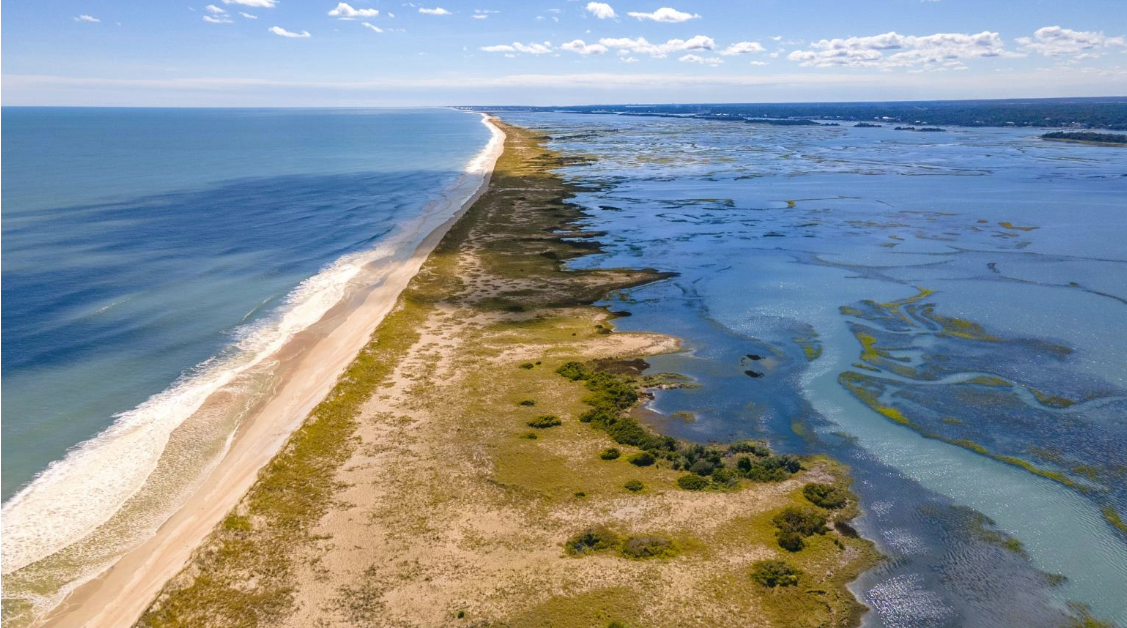
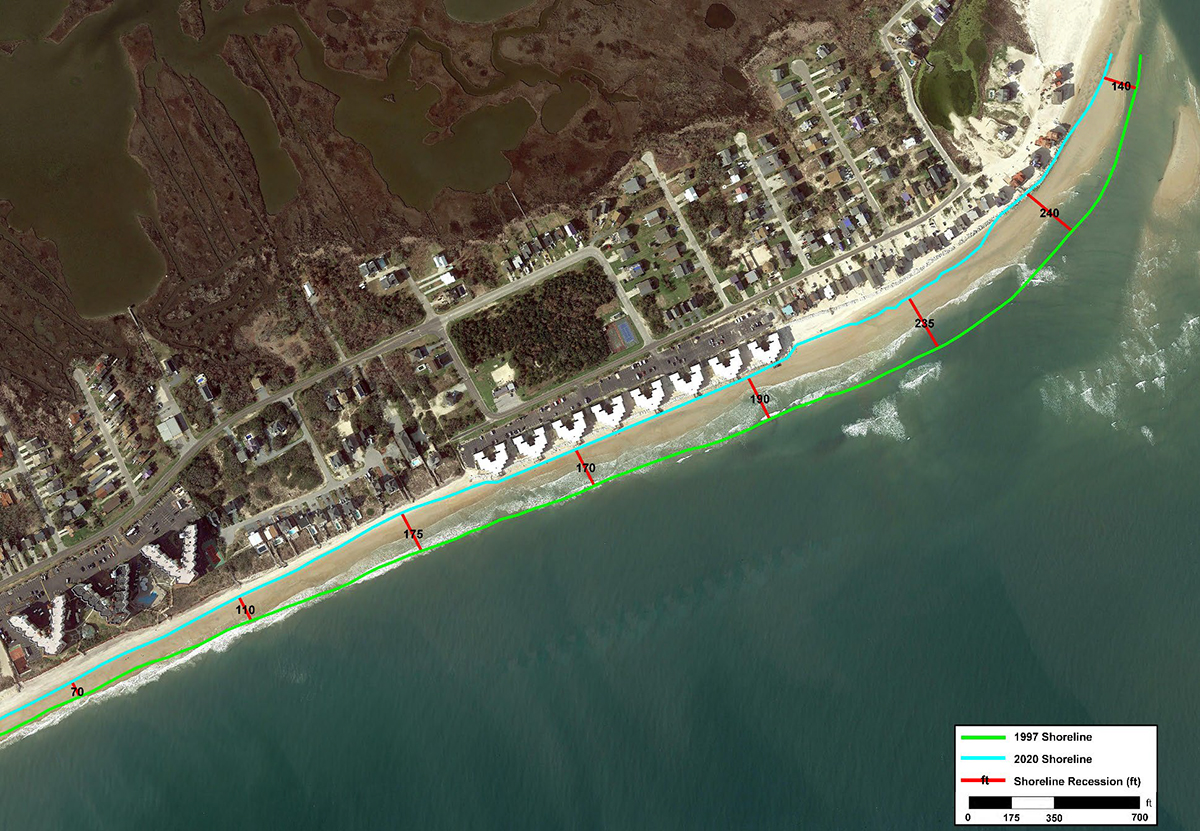
NORTH TOPSAIL BEACH – Residents and property owners here made clear in a public hearing Tuesday night that more must be done to manage the erosion-battered oceanfront at the north end of Topsail Island.
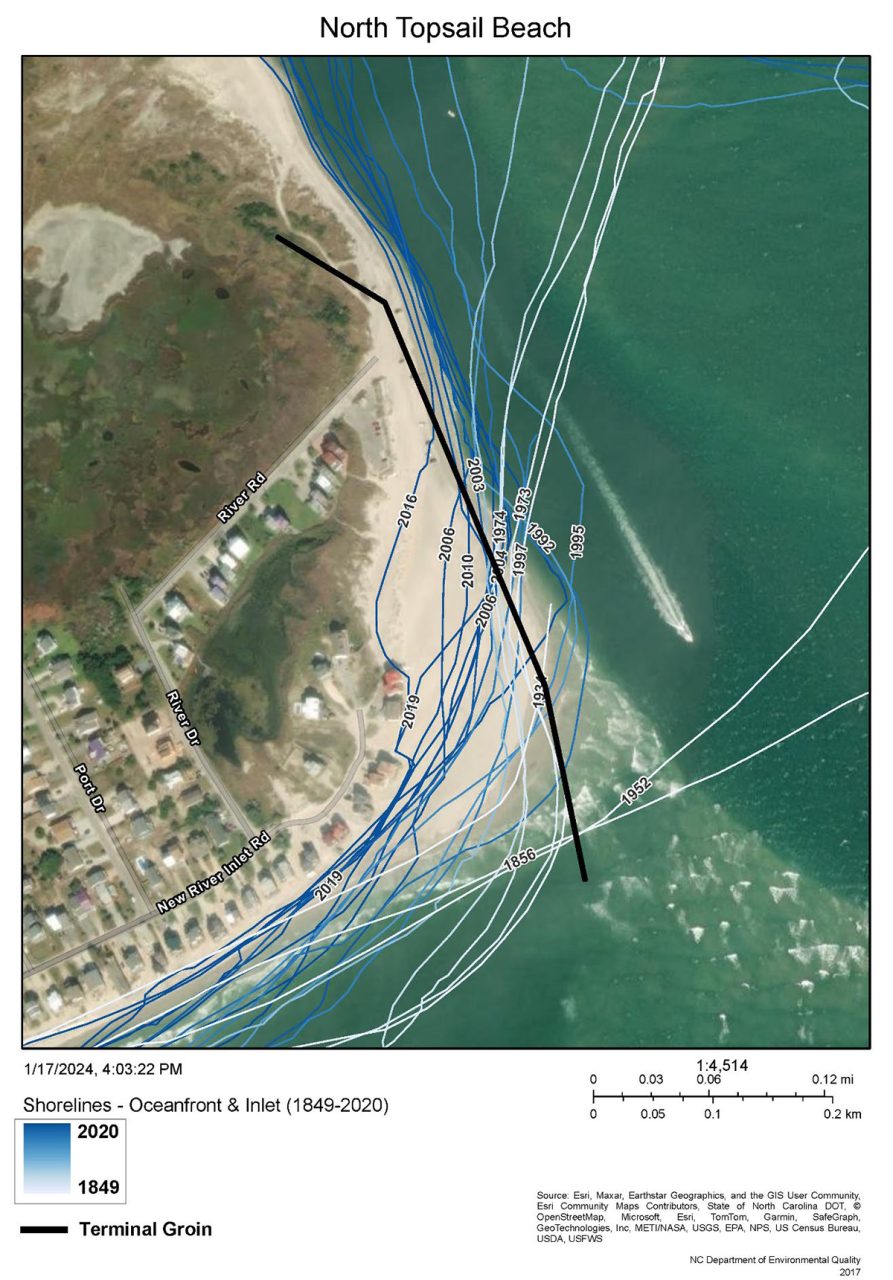
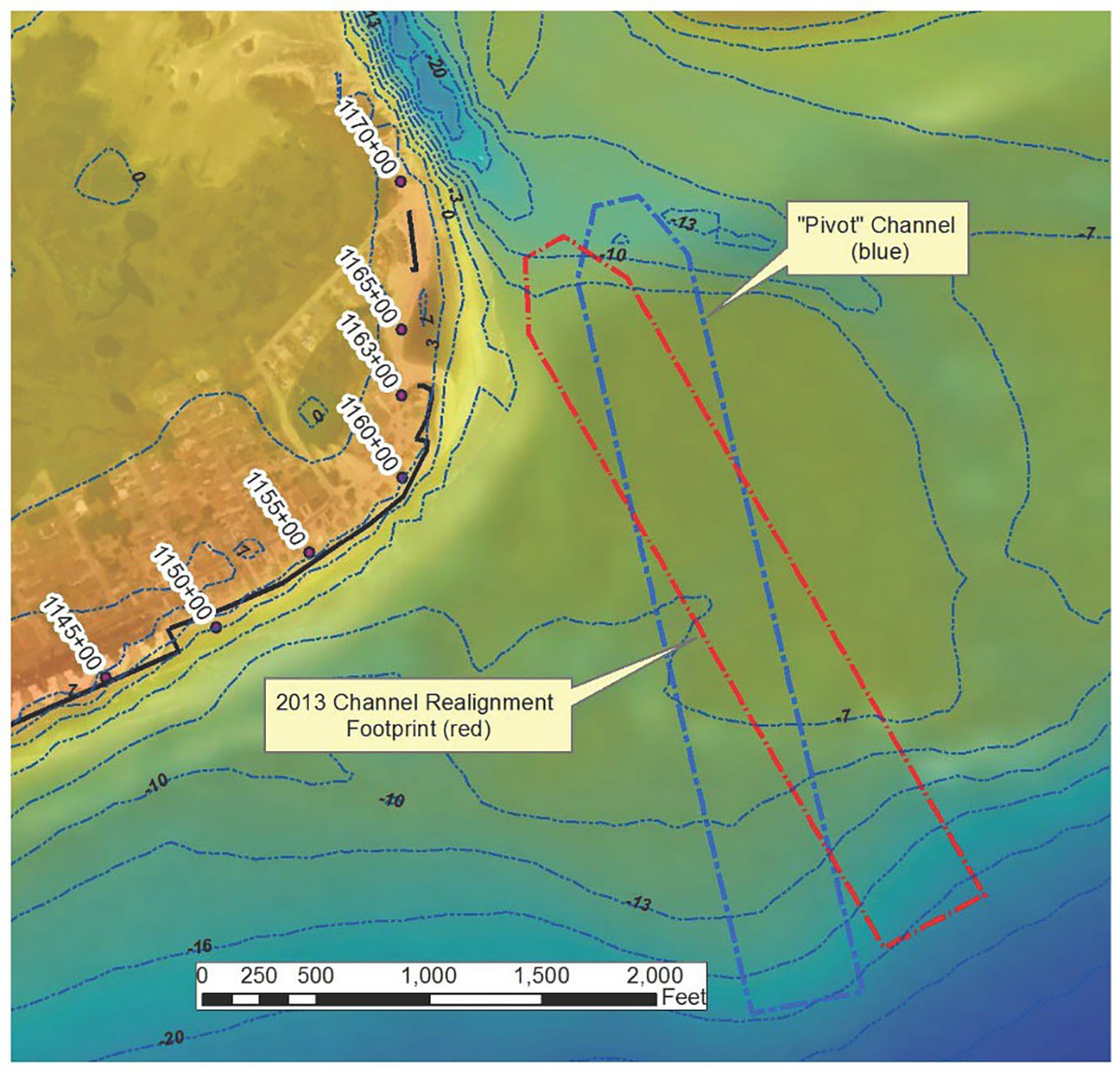
Their preference? Build a 2,021-foot-long terminal groin at New River Inlet, move ahead with plans to pivot the inlet channel’s alignment to redirect the flow of water and capture migrating sediment, and continue maintaining a 5,100-foot-long dune and berm beach fill on the northernmost shoreline at the inlet through routine sand nourishment.
Supporter Spotlight

The preferred plan, one of five alternatives laid out in a draft environmental impact statement released by the Army Corps of Engineer’s Wilmington District earlier this month, is projected to cost nearly $80 million over 30 years. That includes the estimated $18 million price tag to build and maintain the terminal groin and $58 million to dredge the pivot channel and inject the north end of the town’s beachfront with fresh sand every four years.
According to the draft environmental study, forecasted shoreline changes over the next three decades would put at risk nearly 50 oceanfront properties and more than 750 individually owned housing units. Based on current property values, that’s a potential loss of more than $275 million over the next 30 years.
A massive wall of sandbags stretching about 3,600 feet along Topsail Island’s northernmost beach for more than 10 years has staved off destruction of oceanfront single-family homes, duplexes and condominiums.
Fran Way, a senior coastal engineer with Applied Technology & Management, or ATM, explained to a standing-room-only aldermen’s chamber at the town hall Tuesday, that the sandbags “are doing a good job.”
The wall of bags survived Hurricane Matthew, the most powerful storm of the 2016 Atlantic Hurricane Season, and “held up pretty well” two years later through Hurricane Florence, he said.
Supporter Spotlight

“But, obviously there’s still ongoing maintenance all of the time,” he continued.
An overwhelming majority of the more than a dozen people who spoke at the Corps-hosted public hearing said they support the town’s preferred alternative.
Full-time North Topsail Beach resident Terrie Hardy said that while she does not live at the north end of the town, “something has to be done.”
Hardy expressed full support for alternative 5 before reading a letter written by one of her neighbors, a retired Marine Corps officer, who could not be at the public hearing.
“He is an avid fisherman, a recreational boater who regularly uses New River Inlet,” she said. “Over the years, he has witnessed firsthand both benefits of channel dredging and realignment, as well as the continuing challenges associated with shoreline erosion, loss of beachfront access, and damage to private property.”
The North Carolina General Assembly’s decision 15 years ago to amend a longstanding ban on hardened structures and allow up to a little more than a half-dozen terminal groins to be built on the state’s coastal shores gives the town a chance it cannot pass up, her neighbor wrote.
“In his view, failing to pursue this opportunity would represent a missed challenge to implement a long-term solution to a problem that has affected the north end of North Topsail for decades,” Hardy said. “He has a direct and substantial interest in mitigating the severe and chronic erosion that threatens residential structures, infrastructure, public recreational assets and natural resources. As a resident and taxpayer, he strongly supports alternative 5.”
Another round
The hearing Tuesday represented what equates to another round of discussions about building a terminal groin at the inlet to curb severe erosion at the north end of the island.
The town in 2021 released a New River Inlet Management Master Plan, which included the construction of a terminal groin, or a wall-like structure built perpendicular to the shore at inlets to contain sand in areas of high erosion, like that of beaches at inlets.
North Topsail’s elected leaders at the time ultimately decided to pump the breaks on pursuing building such a structure, funding for which may under current law come only from the town’s coffers unless the General Assembly enacts legislation appropriating funds. The town instead turned its focus on post-Hurricane Florence recovery efforts, including restoring its dune system, which suffered an estimated $22 million loss.
This past summer, legislators mulled a bill that included a provision allowing state funds to cover permitting, building, or repairing terminal groins. That bill has since stalled in committee.
So too has a proposed bill to lift the coastwide ban on hardened erosion-control structures entirely.
Last month, the Coastal Resources Commission’s Science Panel released its final report, “Effects of Hard Structures on Sand, Open-Ocean Coastlines,” determining that blocking or trapping sand at one area of beach takes from another area of beach.
Chris Gibson, president of a local coastal engineering firm long-contracted by Topsail Beach for projects on the south end of Topsail Island, said that he is usually a proponent of “soft solutions” to managing beach erosion.
“However, North Topsail Beach is one of those places where a hardened structure is probably much more applicable because of the way the inlet behaves,” Gibson said. “The impacts longshore, further down the beach that may be a concern to people in southern North Topsail Beach, Surf City or Topsail, it just really isn’t there. It’s all in the sediment reversal inside the ebb shoal dimensions. I am a proponent of doing all-of-the-above scenario. I think that’s a good way to do it. You can’t look at the beach separate from the inlet. You can’t look at the inlet separate from the beach.”
Southern Environmental Law Center Senior Attorney Julie Youngman said Tuesday evening that she was speaking at the public hearing neither in favor of nor opposition to any of the alternatives included in the draft analysis.
“I think there are things that need to be studied in depth to make sure that any solution that’s selected works out for everybody,” Youngman said. Building a terminal groin “will not eliminate the need for repetitive and expensive beach nourishment and inlet dredging projects.”
Youngman referenced the Science Panel’s report.
“The report says all structural approaches in place with the intention of mitigating erosion by trapping the sand in place, like terminal groins, lead to the same inevitable impact – an increase in shoreline erosion downdrift. Just keep remembering the people downdrift,” she said. “The report concludes with this statement: ‘The science panel recommends that North Carolina maintain a cautious approach to any expansion of the use of hardened structures.’”
The Corps is accepting written comments on the draft environmental impact statement via its website through Oct. 19.
Corps officials said that the town anticipates submitting a permit application for their preferred alternative sometime around March 2027 and that, barring “unforeseen delays,” the Corps may release its record of decision next summer.