Local governments from the 20 coastal counties are invited to participate in the second of two North Carolina Marine Debris Action Plan workshops aimed at increasing the resiliency and enhancing the management of residential docks and piers and abandoned or derelict vessels in their communities.
Hosted by the North Carolina Coastal Federation and the North Carolina Coastal Reserve and National Estuarine Research Reserve, these workshops will provide crucial resources and knowledge to implement effective inspection programs for docks and ordinances addressing abandoned and derelict vessels, aka ADVs, in their jurisdictions.
Supporter Spotlight
The workshop will be held 9 a.m. to 2 p.m. Sept. 15 at the North Carolina Department of Environmental Quality’s Washington Regional Office (Hearing Room), 943 Washington Square Mall.
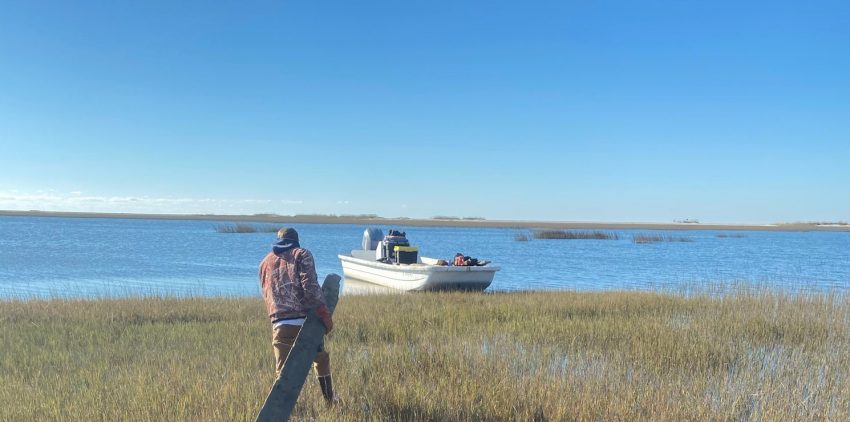
”Local governments are often the first call when an ADV or floating dock appears on the waterway or in the marsh,” stated Coastal Federation Marine Debris Program Director Ted Wilgis. Providing toolkits with resources, contacts and guides to respond to these issues is the goal for this workshop.
The North Carolina Marine Debris Action Plan workshops will provide local governments in the 20 coastal counties with resources for implementing an inspection program for residential docks and piers and for developing and implementing a program or ordinance regulating these vessels.
Since 2019, more than 6.3 million pounds of large-scale marine debris and ADVs have been removed from North Carolina coastal waters. While progress is being made in the removal and reduction of marine debris and abandoned vessels, it is much less expensive and easier on the environment to prevent the occurrence of these types of debris. Enhancing local governments’ abilities and tools to proactively manage residential docks and piers and ADVs in their jurisdictions will greatly expand marine debris prevention efforts, organizers said.
The workshop is offered for local governments, agency partners, marine contractors, engineers, community leaders and other interested individuals. Participants will get opportunities to learn about and discuss the following:
Supporter Spotlight
- Incorporating resilient residential docks and piers into local building codes.
- Addressing ADVs through ordinances, the state program, and accessing support.
- Engagement opportunities through the North Carolina Marine Debris Action Plan: 2026-2030.
- Resources, guides, and toolkits for adopting and implementing their own programs.
- Panel discussions will feature local and regional stakeholders sharing real-world experiences, implementation challenges, lessons learned and opportunities for continued collaboration.
Lunch will be provided, along with coffee and light refreshments in the morning. Full or partial mileage reimbursements may be available.
Continuing education credits available include the following:
- American Institute of Certified Planners, 4 Certification Maintenance credits: Wilmington, ID 9332178; Washington, ID 9332180.
- Certificate of Participation, 4 hours, provided to self-file for other professional credits such as engineer PDHs.
The workshop was also offered in Wilmington for local governments, agency partners, marine contractors, engineers, community leaders and other interested individuals in August.
These workshops are made possible by support from a 2023 award from the National Oceanic and Atmospheric Administration Marine Debris Program and support from the National Marine Sanctuary Foundation.
Register for the Washington Workshop.
The Coastal Federation publishes Coastal Review.