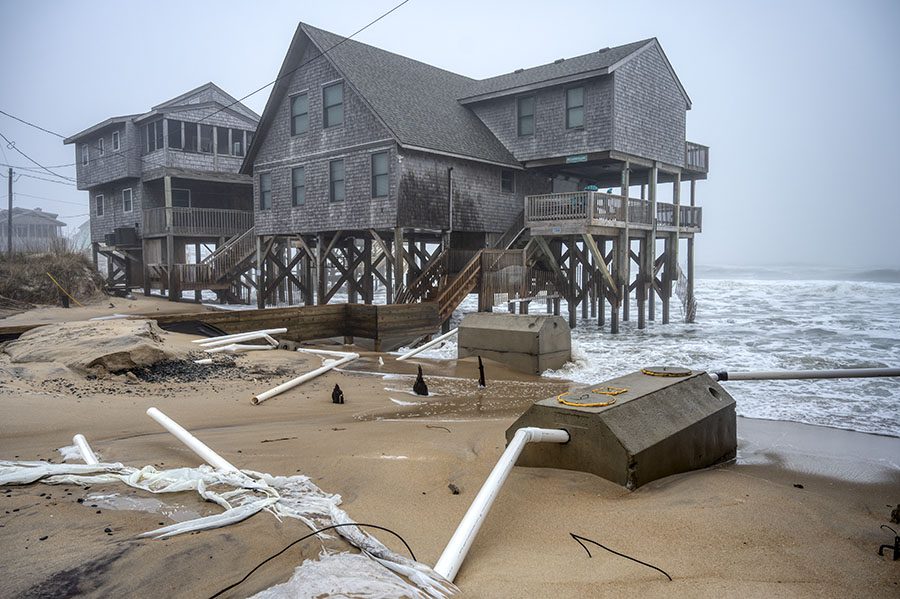
MANTEO — On an oceanfront beach where houses collapse and scatter their debris on the shoreline, the remains of their septic tanks sitting for months or even years in the swash and littering the sand adds insult to injury.
Exposed and broken wastewater treatment systems on eroded ocean shorelines in North Carolina have become an intractable public health and safety hazard, but the current regulations, while ineffective, have been stubbornly difficult to update.
Supporter Spotlight

That persistent challenge was illustrated last week during a meeting of the state’s Coastal Resources Commission, when two proposed septic rule amendments were under consideration. But after much wrangling, the measures could not be wrestled to the ground, and the panel decided to table them for further review.
The nut of the problem is how the commission rules should restrict or permit repair and replacement of septic systems that become exposed.
“Under the existing framework, we’re seeing systems fail, be repaired, remain exposed, and subsequently fail again,” Cameron Luck, coastal policy analyst with the Division of Coastal Management, told commissioners during the Aug. 27 commission meeting in Dare County.
“The recurrence cycle is one of the primary issues these amendments are intending to address.”
In his presentation to the panel about the proposed amendments, Luck pointed to images of partly submerged septic tanks and debris from the systems scattered in the sand.
Supporter Spotlight

“You can see that as the shoreline is migrated landward, wastewater infrastructure that was once in compliance with setback rules is now exposed directly on the beach,” he said.
Currently, even imminently threatened structures can remain on the beach for up to eight years, barring it subsiding or collapsing, Luck said. The rule doesn’t force immediate removal of exposed systems; typically, the systems were in compliance with setback rules before the forces of erosion ate away the shoreline and the first, second or third lines of vegetation.
“While Rodanthe and Buxton have provided the most visible and well-documented examples, this isn’t necessarily an issue that’s unique to Dare County,” Luck said. “The underlying concern is continued shoreline erosion.”
As explained in division documents, the proposed amendments to the existing rule would address repeated failures of onsite wastewater systems on the beach “due to shoreline migration,” while maintaining consistency with the state Department of Health and Human Services’ authority over the permitting of the systems.
Otherwise, the proposals don’t change existing requirements for siting septic or commission standards for new developments within Ocean Hazard Areas. A repair or replacement of systems on the ocean side of vegetation or other appropriate lines would require a Coastal Area Management Act permit, but maintenance work would not need a CAMA permit.
“Right now, the septic tank is considered part of the house — that’s one of the things that we talked about the last meeting was whether to separate the value of tank to its own entity versus the house,” said Commission Chair Renee Cahoon.
Cahoon later suggested that the commission needs to decide whether to make that change. “Right now, it’s always going to be a repair permit because the value of the house is always going to be worth more than the septic tank system,” she said. “If it’s not, then something’s wrong.”
Another complication to rulemaking is that the vegetation line and the demarcation of the public trust beach are not necessary the same, Cahoon said. In Rodanthe, for instance, “you have third-row houses that are considered landward of the vegetation line, but they’re not really on the beach themselves,” she said. “Whereas the first-row house probably is on the beach.”
In addition to the federal, state and county stakeholders, not to mention the private property owners, year-round residents and businesses in the villages, there are numerous nonprofits and special interest groups that have weighed in on how to improve the rules for the oceanfront water systems.
Members themselves had a myriad of questions and comments about how to tweak the proposed amendments, and how inclusive or broad the rules should be, and even when failed systems should run out of chances.
“There are innovative systems that can be permitted … not everything is acceptable to repair,” Cahoon said.
And it is certainly unacceptable to allow damaged or abandoned systems to stay for years on a public trust beach.
“You just can’t keep septic tanks on the beach,” she said.
The commission agreed to ask Division of Coastal Management staff to review the amendments and return revised versions in time for the next meeting in October.
Coastal Review will not publish Monday in recognition of Labor Day.