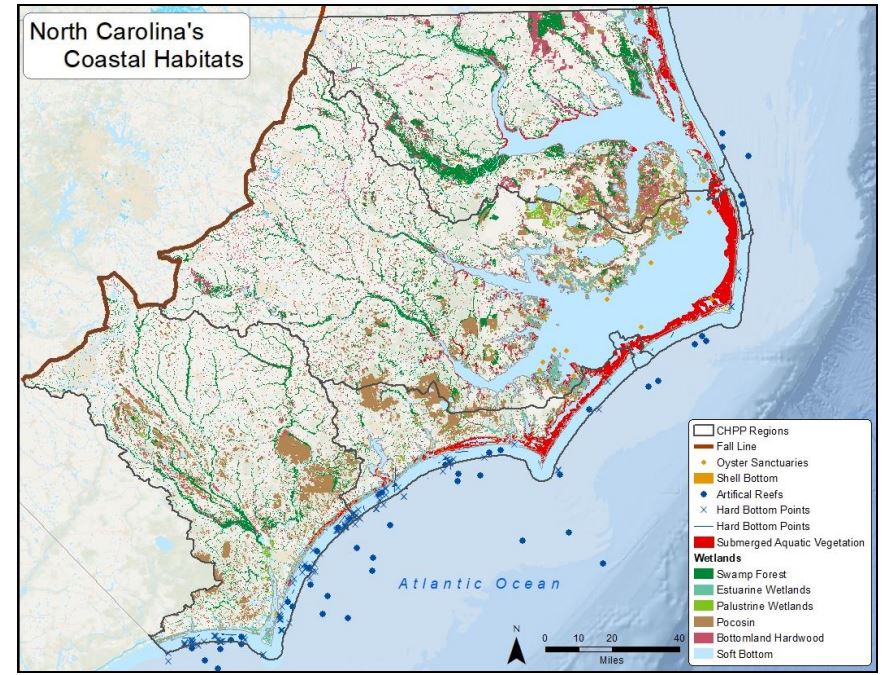
North Carolina Department of Environmental Quality staff are in the process of updating the state’s long-term strategy to protect coastal habitat, a necessity for a sustainable seafood industry.
According to the strategy called the Coastal Habitat Protection Plan, or CHPP, the need for a coastwide habitat plan came about in the 1990s because of growing concerns about fish populations, declining coastal habitats, and deteriorating water quality.
Supporter Spotlight

The CHPP was mandated by the Fisheries Reform Act of 1997, and the first plan was adopted in 2004 by the Marine Fisheries, Environmental Management and Coastal Resources commissions. The document, which was designed to “achieve the long-term enhancement of coastal fisheries by identifying, protecting, restoring, and enhancing critical fish habitats,” and is updated every five years.
CHPP is to provide “information on the habitats’ distribution and abundance, ecological functions and importance to fish production, status and trends, threats to the habitats, and includes recommendations to address threats,” according to DEQ’s Division of Marine Fisheries.
The Division of Marine Fisheries staff that make up the CHPP team, with guidance from a steering committee, have been working on the 2026 update. Charlie Deaton, habitat protection supervisor with the division, presented an status update to the Environmental Management Commission during the July 9 meeting in Raleigh.
He said the staff are drafting issue papers for the 2026 update that are broadly organized under three different themes: ecosystem-based management for coastal habitats, seagrass protection and restoration, and planning for multi-decadal wetland change, all of which build on previous editions of the CHPP.
The outlines of these papers are to be presented to the steering committee by web conference 1-3 p.m. Wednesday, the division announced July 15. The full agenda and link to the meeting are on the NCDEQ website.
Supporter Spotlight

Deaton said that the last full rewrite of the plan was in 2016. New issue papers were added to the 2016 CHPP as the 2021 update, and “we are continuing efforts on these issue papers and introducing a few more with this edition of the CHPP.”
Deaton reminded members that the 2021 CHPP prioritized submerged aquatic vegetation, or SAV, protection and restoration through water quality improvements. The chapter on seagrasses “had 13 different recommended actions, but the big one that this commission has heard the most about is the recommended water clarity standard to ensure that adequate light penetration allows for seagrass growth.”
According to that document, seagrasses are “critical for healthy fisheries, such as shrimp, blue crab, red drum, and flounder and provides valuable ecosystem functions.” The state has one of the largest seagrass habitats on the East Coast, but water quality impairment coupled with climate change stressors can limit their growth, reproduction, and distribution.
The chapter for the 2026 update on seagrasses will use data from the Albemarle Pamlico National Estuary Partnership’s recent findings on seagrass decline. APNEP, a partnership of NCDEQ and the Environmental Protection Agency, has been fundamental in CHPP development in some capacity since its inception.
From 2006 to 2020, the state’s estuaries continue to lose more than 1% per year of its seagrass extent, which “might not sound like a lot, but that’s 15% in the time period. And if you look 30 years into the future, that’s another 35% that we would be losing if we continue at this rate. So, it’s a concerning rate of loss,” Deaton said. “We’ve lost 50% of our continuous seagrass meadows, and the losses have been most notable at the deep edge of the seagrass beds. So that implies a connection to water quality and decreased water clarity, light not penetrating deep enough.”
This new seagrass chapter is to build on the 2021 CHPP’s proposal to develop a water clarity standard, which was referred to the Environmental Management Commission’s water quality committee where it’s on hold.
Turbidity “remains the biggest threat we see to seagrasses, and so it’s something we really want to get some action on,” Deaton said. Staff are also going to work on a permitting framework for active seagrass restoration projects, which could be planting seeds or transplanting seagrasses in areas that no longer have seagrass but should still have the conditions to support it.
The paper is also to explore habitat protections under the Marine Fisheries Commission authority. The commission considered restrictions for shrimp trawling in 2023 but decided against those. Instead, staff was asked to look into what that rulemaking might look like.
For the ecosystem-based management chapter, Deaton said that staff are reviewing how the Division of Marine Fisheries uses mapping and monitoring data to guide species management work. Staff will determine goals and targets on how to better integrate the research, as well as create indicators with data from the North Carolina Collaboratory’s study on 25 years of the Fisheries Reform Act.
“The other half of the ecosystem-based management chapter is advancing strategic habitat areas,” Deaton said, that were identified in the first edition of the CHPP as a priority. “These are areas that are defined as high quality, connected habitats that were identified to protect biodiversity and ecological function through a nonregulatory approach.”
The “Planning for wetland change” chapter concentrates on laying the groundwork for thin-layer placement. Other states are exploring this method to accent natural sediment accumulation by taking dredged material and placing it directly on the marsh in a layer of 6 to 18 inches.
North Carolina doesn’t have a permit for the process, meaning any applications for thin-layer placement must be approved through the Coastal Resources Commission’s variance process for rule exceptions.
“We have a couple projects in the hopper right now that may reach the variance process in the coming year or two and seeing those as potential pilot projects. If they show promise, this is something we could explore to make a little easier to for restoration practitioners to implement,” Deaton said.
“The other half of the sea level rise and coastal wetlands picture is marsh migration,” he said.