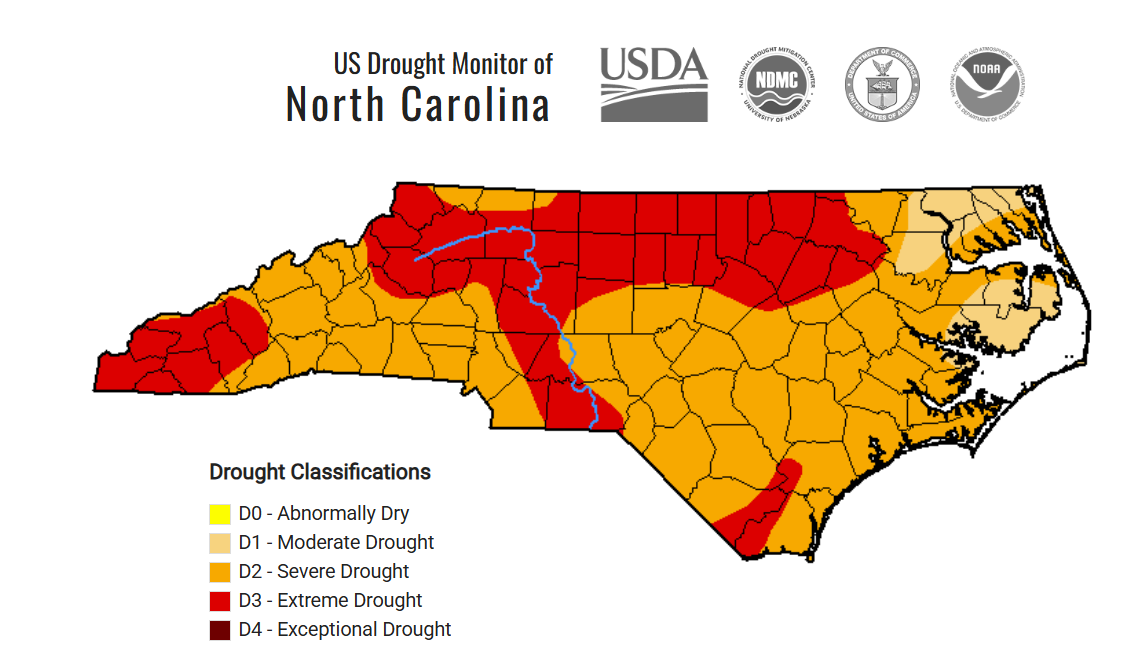
While rain through the holiday weekend offered relief to some parts of the state, most North Carolina counties, including those along the coast, remain in severe or extreme drought conditions, according to the latest update from the N.C. Drought Management Advisory Council.
A handful of counties in the western part of the state on Thursday were removed from the exceptional drought classification under which they were placed the previous week.
Supporter Spotlight

“The weekend rains were beneficial in much of the state,” Council Chair Klaus Albertin stated in a May 28 release. “For the first time in months, we actually saw the rainfall deficits drop a little. We still have a long way to go, but for the short term, soil moisture and stream flows have increased. The drop in reservoir elevations slowed as a result of the rain, but water demand is still higher than inflows to many water supplies.”
Most of the 20 coastal counties remain under severe drought. While some portion or all of some coastal counties in the northern part of the state are in a moderate drought, western portions of two southern coastal counties, Brunswick and Pender, continue to experience extreme drought, a condition that extends to southern Georgia, according to the U.S. Drought Monitor. From there, an area of even more extreme condition classified as exceptional drought extends along the the coast and back toward the Florida Panhandle.
The heaviest rains fell late last week and earlier this week on the southern Piedmont and western part of the state, including Asheville, which recorded nearly 8 inches of rain as of Wednesday. The precipitation improved the drought classification by one category in those areas of the state.
But reservoir levels, stream flows and other measures are “still much below normal,” according to a release.
In Boone and Raleigh, rainfall totals since August remain about 18 inches lower compared with historical averages for the same period, according to the N.C. State Climate Office.
Supporter Spotlight

“We are hopeful that the recent rains are an indication that the dry pattern we experienced since last August is shifting towards a more typical pattern for North Carolina,” Albertin stated.
Check your local water supply system for information related to water-use restrictions that may be in place.
Members of the advisory council, which is a collaboration of drought experts from various government agencies in the Carolinas and Virginia, meet weekly and submit their drought recommendations to the National Oceanic and Atmospheric Administration, U.S. Department of Agriculture and National Drought Mitigation Center for updates to the U.S. Drought Monitor. The monitor is a map of the nation’s drought conditions.
The state’s drought map is updated every Thursday based on conditions through the previous Tuesday.