Reprinted from the Outer Banks Voice
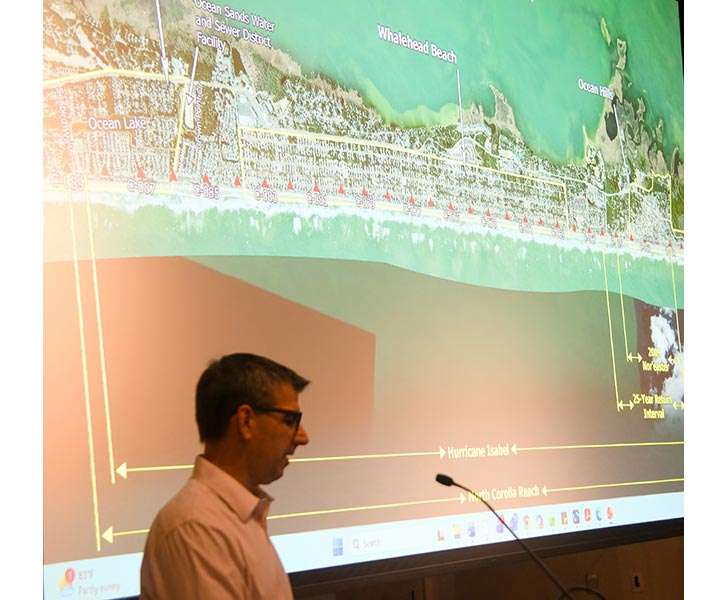
Speaking before a standing-room-only audience at the Outer Banks Center for Wildlife Education in Corolla on Tuesday, Coastal Protection Engineering (CPE) Senior Project Manager Ken Willson said that beach nourishment on the north end of Corolla “appears to be the preferred alternative of the ones that we’ve evaluated.”
Supporter Spotlight

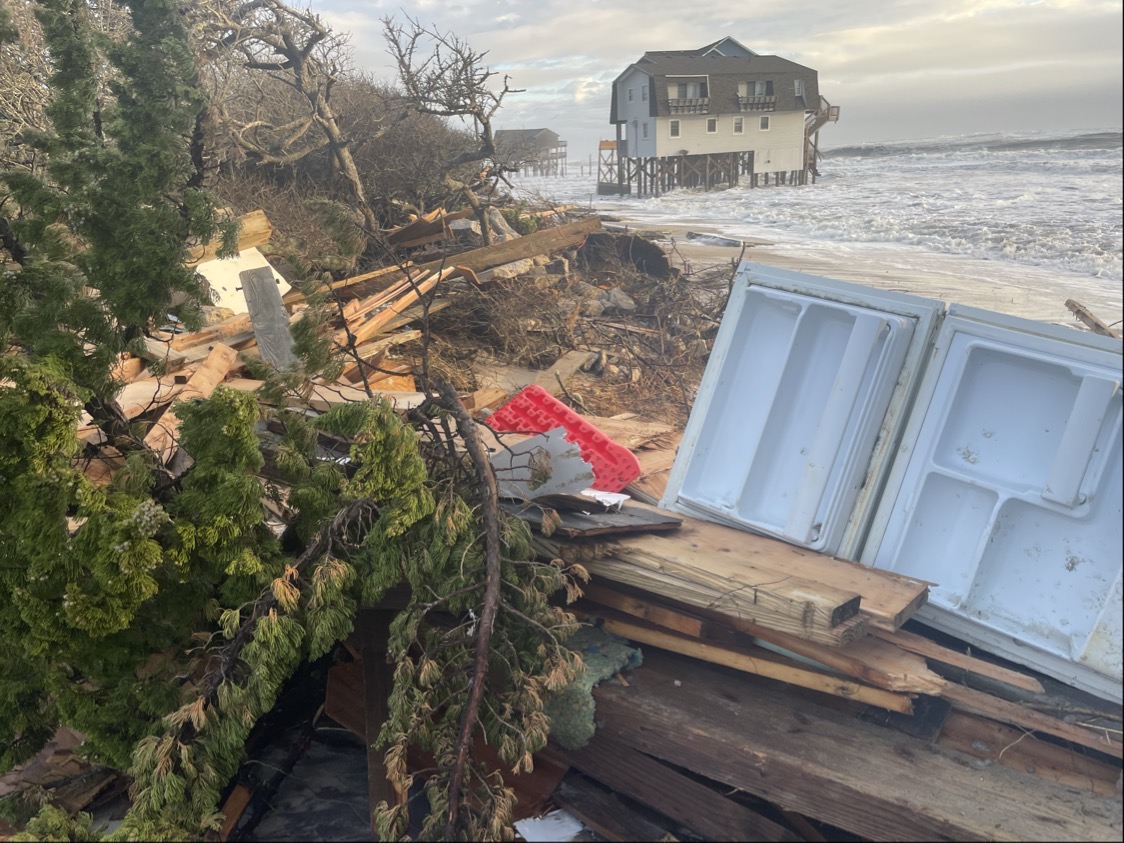
In his 45-minute presentation, Willson discussed four areas that were experiencing high rates of beach loss. The areas include the four-wheel-drive beach just north of the Horse Gate, an area Willson referred to as the Reserve/Refuge Reach. He also highlighted two relatively small areas, the Spindrift community and Pine Island South. The largest area is the North Corolla Reach, beginning at the Horse Gate on the north end and ending at Seabird Way.
Although the Spindrift and the Pine Island areas did not lend themselves to convenient solutions, Willson’s analysis of the North Corolla Reach indicated that beach nourishment was “the only one out of those three … that would technically meet the goals and objectives for the area south of the Horse Gate.”
The Reserve/Refuge Reach has a path forward with the recommendation of buyouts and removal of threatened structures by Currituck County, based on a cost-benefit analysis and the potential for legal challenges.
Willson’s presentation followed the February 2026 release of CPE’s five-year “Beach Monitoring and Beach Stability Assessment.” That report recommended additional monitoring, but did not call for any specific action to address property owner concerns about areas of the Corolla shoreline that are eroding.
Residents and the Corolla Civic Association have been pressing the county to be more proactive in addressing the loss of beach, and have presented a number of plans to county officials that include beach nourishment.
Supporter Spotlight

In his remarks, Willlson displayed a feasibility chart that presented options that included doing nothing, moving structures, and beach nourishment. In some areas, they included fencing and trucking sand to the beach, steps the county is already taking.
The charts offered an assessment of whether the project could be permitted under current law or would face significant regulatory challenges, as well as a cost-benefit analysis. But Willson also noted that, “We have not done a rigorous cost-benefit analysis the way the Corps of Engineers would do for one of these federal beach nourishment projects. We have made some assumptions … that we’ve seen with other projects.”
The Spindrift and Pine Island South areas have seen erosion on their beaches, but the affected shoreline is too short for a beach nourishment project, Willson explained, adding that, “When you build a very narrow section of beach (using) beach nourishment, there’s a lot of losses. We call them diffusion losses, off of the side of that project. For a project that’s 1,200 to 3,000 feet long, you’re almost losing more than you actually placed there.”
In a beach nourishment project, Willson explained, there is a taper “kind of a wedge-shaped fill,” on either side of the nourished beach that mitigates sand loss, But in a smaller project, the effect of the taper is minimal. Smaller projects, such as truck haul that have been used to protect sand the beach in Spindrift and Pine Island, may provide a temporary buffer, but are on a much smaller scale than nourishment.
In developing possible solutions, Willson noted one alternative that could not currently be permitted.
“We’ve considered the potential of putting some small structures on either side of the beach nourishment that might over the long term reduce the cost of the shorter beach nourishment projects,” Willson said. Those small structures would be short groins and would be considered hardened structures. Current North Carolina law does not allow hardened structures on the state’s beaches, a state Senate bill would repeal the ban.
Asked by the Voice after the meeting about the small structures, Willson acknowledged that “none of those short structures that we mentioned today could be permitted under the existing law, but,” he added, “the commissioners have asked us to consider everything.”
When he was asked about sandbags during a question-and-answer period, Willson responded that “Sandbags are designed to be temporary structures to hold the line until you can do something more permanent. Essentially, you have to be in really dire conditions to be able to qualify. The water line needs to be 20 feet from your structure, I believe, before they will allow you to install those.”
As he finished his presentation, Willson told the audience that “we haven’t gone into a ton of detail here, because we’re pushing the process and that determines the final alternatives.”
This story is provided courtesy of the Outer Banks Voice, a digital newspaper covering the Outer Banks. Coastal Review partners with the Voice to provide readers with more environmental and lifestyle stories of interest about our coast.