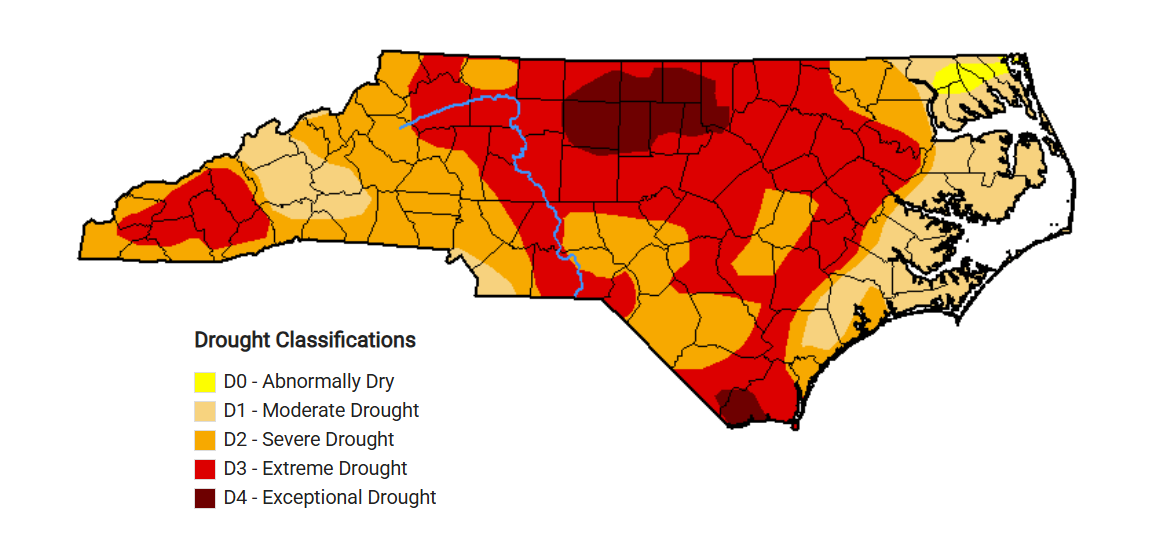
Nearly a dozen North Carolina counties, including Brunswick County, are experiencing exceptional drought, according to the latest update of the North Carolina Drought Management Advisory Council.
Exceptional drought is the highest drought classification.
Supporter Spotlight
Nine counties around the Triangle and eastern Triad remain under exceptional drought, 46 are in extreme drought, and 31 are in severe drought, according to the DMAC update posted Thursday. Most of the state’s coastal counties are under moderate drought.
Localized heavy rainfall in parts of the state in recent days “did not lead to substantial improvements” in drought conditions throughout North Carolina, according to a North Carolina Department of Environmental Quality release.
“Parts of the Triangle saw more than 4 inches of rain or more this past week, but to substantially improve our drinking water supplies, it has to rain upstream of the reservoirs,” Linwood Peele, supervisor DEQ’s Division of Water Resources Water Supply Planning Branch, stated in the release. “It matters where the rain falls, and how fast it falls. The rain helped conditions here, but we need the lakes and reservoirs to fill back up, the groundwater and aquifers replenished and soil moisture restored.”
Reservoirs in the state remain below normal and rainfall totals are significantly down in localized areas of the state, including Wilmington, which has a rainfall deficient of more than 23 inches, compared with historical averages for the same period, according to the North Carolina Climate Office.
Peele said that while rainfall in parts of the state have recently received helps reduce demand for irrigation or outdoor water use, reservoirs need to refill, “and that will take time.”
Supporter Spotlight
“We’re in a huge deficit,” he stated.
More than two weeks have passed since Brunswick County’s largest water utility provided implemented mandatory water restrictions in response to drought conditions there.
“If a water system is asking people to cut back on non-essential water use, they should listen,” Peele said. “The more people do it, the longer the water should last. This is something we have to conserve our way out of.”
The DMAC is a collaboration of experts from government agencies in North Carolina, South Carolina and Virginia organized by the North Carolina Department of Environmental Quality’s Division of Water Resources.
Members of the council meet weekly and submit their drought condition recommendations to the National Oceanic and Atmospheric Administration, U.S. Department of Agriculture and the National Drought Mitigation Center for updates to the U.S. Drought Monitor.