Forecasters and health officials warn that this Fourth of July weekend the “feels like” temperatures of between 100 and 110 starting Friday can be dangerous to your health.
Inland highs are expected to be between 90 and 100 degrees Fahrenheit through Monday with a real feel of 105 to 110. Highs for beaches are projected to be 85 to 90 degrees.
Supporter Spotlight

National Weather Service’s Wakefield, Virginia, office, which covers the state’s northeastern counties, said on social media Thursday that along North Carolina beaches, heat index values will be around 100°F, due to the cooling influence of the ocean.
“This heat wave is predicted to be prolonged and expected to have major to extreme impacts for the majority of Eastern NC this weekend into early next week, coinciding with the 4th of July celebrations,” the service’s Newport office, which monitors most of the state’s coastal counties, explained in an update Thursday morning.
Forecasters with the service’s Wilmington office warn that heat advisories are possible for the southeastern part of the state beginning Friday, and some areas may require an excessive heat warning for dangerous conditions early next week.
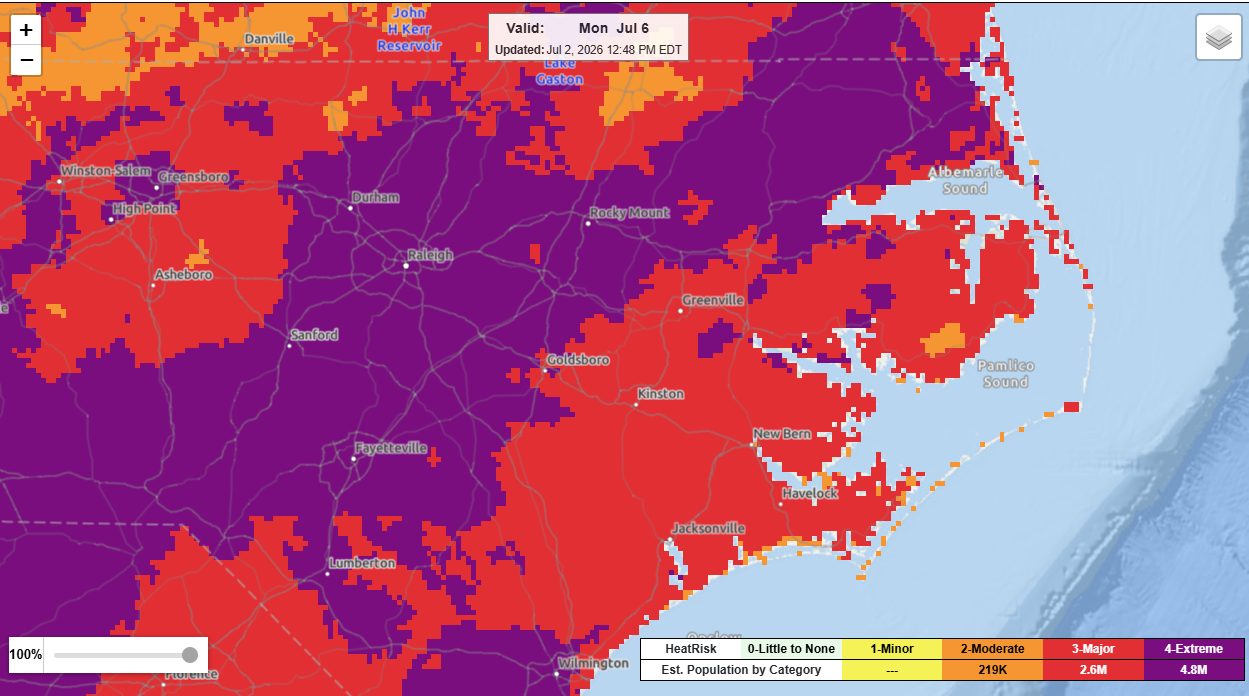
Meteorologists project that the HeatRisk for most of eastern North Carolina will be moderate Friday, the second of four levels, and increase to major by Sunday, with some areas west of Interstate 95 experiencing extreme heat. HeatRisk is an experimental index that “provides additional information that can be used to better identify those days of the year when heat may be at levels that pose a risk to certain populations or economic sectors.”
These heat waves are associated with increased hospital admissions for cardiovascular, kidney, and respiratory disorders. Signs a person is overheating include nausea, muscle cramping, unusually heavy sweating, shortness of breath, dizziness, headaches and weakness.
Supporter Spotlight

“Extreme heat can make everyone uncomfortable, but heat commonly affects certain groups, typically identified as heat-sensitive, at lower thresholds than other populations,” the National Weather Service states.
While everyone is at risk from the dangers of extreme heat, the weather service warns, the elderly, very young and people experiencing homelessness are among the groups most susceptible to heat, as well as those:
- On certain medications and/or have preexisting conditions that make them more sensitive to heat.
- Working outdoors, especially if they are new, temporary or returning to work after a week or more off.
- Working indoors in a non-cooled space.
- Exercising or doing strenuous activities outdoors during the heat of the day, especially if they’re not used to the level of heat expected, are not drinking enough fluids, or new to the type of activity.
- Without a reliable source of cooling and/or hydration, including otherwise healthy individuals attending outdoor activities that are exposed to the heat and may not recognize the early symptoms of heat stress.
- Not acclimated to the level of heat expected, especially if they’re new to a much warmer climate.
- Sensitive to poor air quality that can be exacerbated by heat waves.
- Living in low-income communities.
The weather service also warns that some economic sectors can be affected by increasing levels of heat, such as energy and transportation.
The CDC recommends for those spending time outside and the HeatRisk is red or above to stay in the shade as much as possible, take breaks whenever possible, and do outdoor activities during the coolest parts of the day or evening, if possible.
When indoors, use air conditioning and/or fans, but only if indoor temperatures are less than 90° Fahrenheit. If temperatures are above 90° indoors, a fan can increase body temperature.