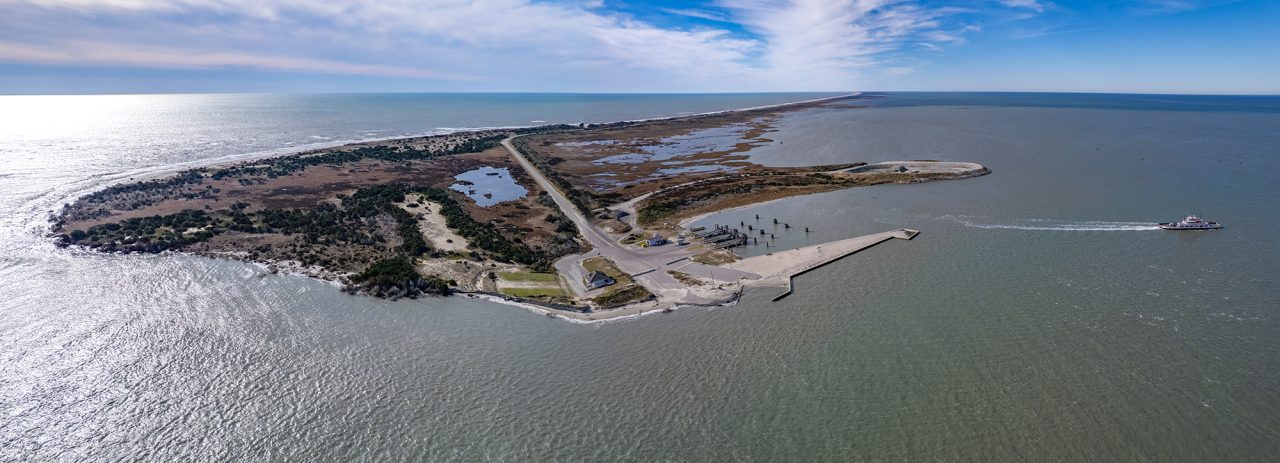
The busiest, most popular route in North Carolina’s vehicle ferry system — the first and, until recently, the largest system in the country — has been between Hatteras and Ocracoke islands on the Outer Banks. Until the state budget was signed into law last month, no proposal to toll the only vehicle access to Ocracoke Island had made it to the governor’s desk. Now it’s part of a provision in a bill that requires tolls be established and implemented for the state’s four free vehicle ferry routes.
The law provided barely six months to develop a plan, identify funding, build the physical and digital infrastructure and inform the public. Immediately, requests were made to extend the Jan. 1 deadline; letters were written, amendments were offered. And during last week’s North Carolina General Assembly sessions to adjust the budget bill, legislators who pushed the tolling provision refused to budge.
Supporter Spotlight

“There’s no way,” said Sen. Bobby Hanig, a Currituck County Republican, in response to Coastal Review’s questions regarding the majority’s refusal to consider an extension. “Everyone involved is working their tail off to make this happen … but it’s going to be impossible.”
As Hanig sees it, legislative leaders insisting on the accelerated schedule for tolling show they are “agenda driven” because so little thought has been put into addressing the impacts on the people who use the ferries, or even on the complexity of tolling the sprawling system that serves diverse needs and populations. For instance, school buses were exempted at the last minute, he said, but what about state-owned vehicles, student drivers, emergency workers, waste management trucks, delivery drivers, essential workers?
“You can tell it’s agenda-driven by how it’s probably the worst-drafted provision in the budget,” said Hanig, adding that he had drafted seven amendments to address the deficiencies, including the implementation date for tolling, but legislators at last week’s session wouldn’t hear any of them.
Even the purported reason for tolling doesn’t measure up, he said.
“You know they’re doing this under the ruse of putting it toward new ferry purchases. Well, the best-case scenario, from talking to people that are working on this is, ‘Probably the best we will net is $5 million a year.’ Well, you know, a sound class ferry costs $60 (million). So do the math.”
Supporter Spotlight

Telephone messages and emails to Sen. Vickie Sawyer, R-Iredell, and Sen. Mike Lazzara, R-Onslow, both proponents of the tolling measure and its Jan. 1 implementation, yielded no reply.
At the very least, Hanig said, it makes sense to wait for the state auditor to complete the audit of the Ferry Division that is underway and is expected to be presented to the legislature at the start of the 2027 session in January.
Signed by Gov. Josh Stein on July 7, the budget bill’s ferry provision requires tolls be set to fund vessel replacement and upgrades as specified by the Ferry Division’s schedule. The tolling infrastructure and technology must be covered by funds in the division’s operational budget. In addition, the law included an annual systemwide pass for residents and active-duty military to be set at $150 per vehicle, but provided no exemptions or discounts.
Also, Stein noted after signing the bill that he had found the ferry toll provision problematic. “North Carolina’s ferries for many are not a luxury; they’re an essential part of our state’s transportation system that residents rely on for daily life,” the governor said in a statement. “In many cases, ferries are the only practical way for families to access jobs, schools and health care.”
The Ocracoke Access Alliance, which advocates for the ferries, had sent a letter to legislators asking for the tolling to be delayed for a year to provide a more realistic timeframe to set up a program. Alliance Executive Director Justin LeBlanc told Coastal Review that the group had requested an allowance for a free annual residential pass for full-time residents of Ocracoke, “so that we would have at least one route available to us to be able to go to from our homes for free.”
Neither request was granted.
Until recent years, islanders had successfully fought back each time tolling of the Hatteras-Ocracoke ferry bubbled up in Raleigh. Since the only way to “drive” on and off the island is on a vehicular ferry, islanders contended ferries are to them the same as a highway like U.S. 64, which is not tolled in northeastern North Carolina, is for other state residents.
But this time, LeBlanc said that it was better to work with the state to find a reasonable way to help keep the ferry system operational. As stated in the 2024 Ferry Division Vessel Replacement Study, many of the 23 ferries in the state’s fleet are old, with an average age of 26 years in 2023 and the vessel Silver Lake at 55 years old. In today’s dollars, the ferries, which are categorized from small to large as river class, Hatteras class and sound class, cost anywhere from $25 million to $55 million per vessel.
LeBlanc said that the alliance had suggested rates of $20 per round trip, or $10 each way, for the Hatteras ferry, with adjustments for inflation over time.
“There is no established tolls in the legislation now,” he said.
The bill directs the Board of Transportation to develop the tolls under the Ferry Division’s advisement. Boiled down, LeBlanc said, the toll comes down to how much of ferry vessel replacement costs should be covered by tolls, and what is the replacement schedule?
“Because if you want to try to cover 100% of vessel replacement costs, tolls are going to be exorbitant,” he said.
In addition to the Hatteras-Ocracoke route, the Currituck-Knotts Island, Bayview-Aurora and Cherry Branch-Minnesott Beach routes have to date been free to ride. The Cedar Island-Ocracoke, Swan Quarter-Ocracoke and Southport-Fort Fisher routes, as well as the Ocracoke Express passenger ferry, are tolled. According to the ferry report, the 70-year-old North Carolina ferry system transported more than 1.5 million passengers and 700,000 vehicles in 2023, making it the second-largest state-run ferry system in the U.S., behind only Washington state.
While discussions continue behind the scenes, Ferry Division officials said they are fully engaged in the process and remain committed to providing access to the state’s coastal communities.
“The N.C. Department of Transportation Ferry Division will work closely with the N.C. Board of Transportation and stakeholders to execute the state budget requirement that tolls be established on all ferry routes,” Tim Hass, Ferry Division communications officer, said in an email. “In the coming months, we will begin discussions about the pricing system, method of tolling and other infrastructure that will be required for this implementation.”