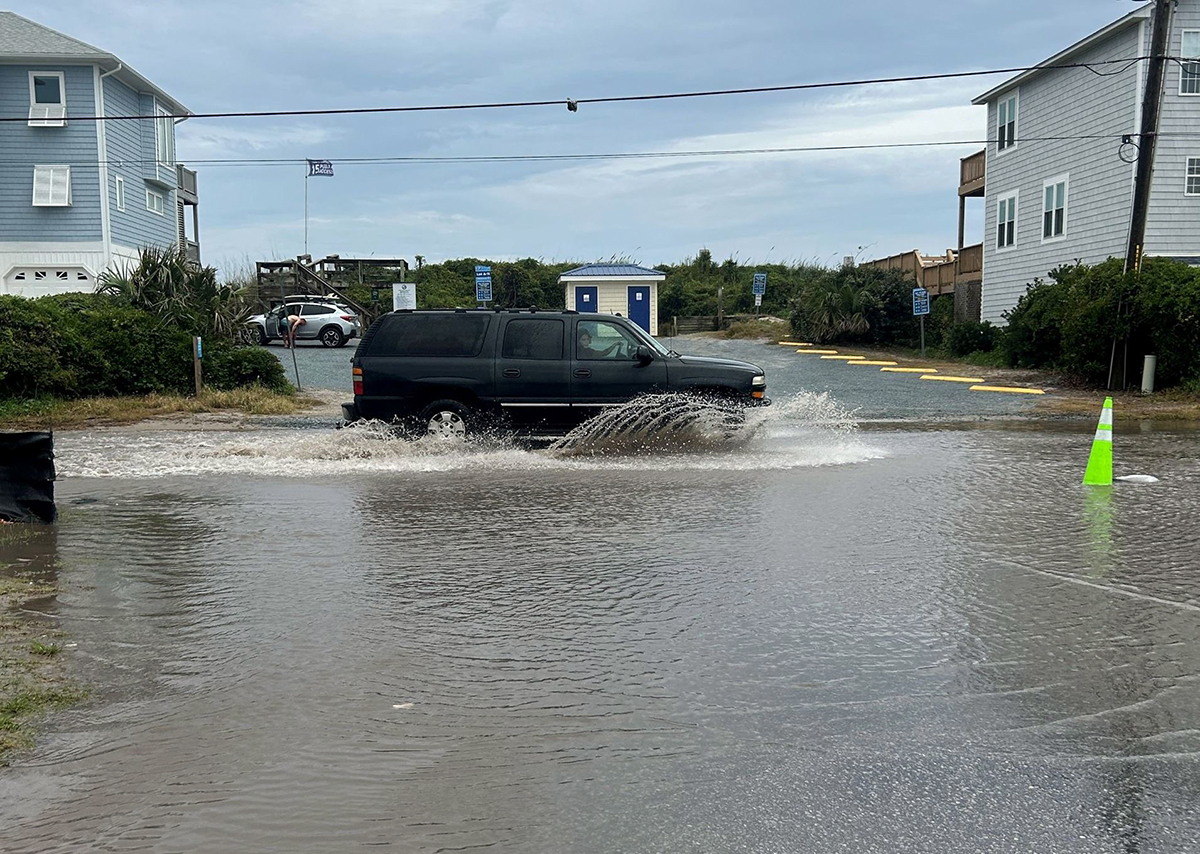
SURF CITY — There was a time when even a quick summer thunderstorm turned stretches of one of the main drags on the island side of this town into a chain of shallow pools.
Habitual flooding on portions of South Shore Drive, aka N.C. Highway 50, effectively cut off residents and visitors on the barrier island south of the Surf City Bridge from safely accessing the mainland.
Supporter Spotlight

“That flooding that traditionally would have occurred there has really not happened in the last four years, which is just astonishing,” Town Manager Kyle Breuer said.
That’s all thanks to a multiphase, nature-based stormwater project that was designed and constructed to divert floodwater off the road and into catch basins.
That project, and the subsequent success thereof, became the catalyst for the town to look at putting similar stormwater controls along streets plagued by historic, chronic stormwater flooding.
Earlier this year, the town hosted a ribbon-cutting ceremony to celebrate the completion of the Roland Avenue stormwater project, one that included installing catch basins, an underground filtration system to rapidly clear standing water from the road and replacing a traditional road intersection with pervious pavers.
Roland Avenue was one of five stormwater flooding hot spots identified in Surf City through an islandwide resiliency project created under the North Carolina Division of Coastal Management’s N.C. Resilient Coastal Communities Program, or NC-RCCP.
Supporter Spotlight

NC-RCCP is a product of the state’s 2020 Climate Risk Assessment and Resilience Plan, which was the result of Executive Order 80 signed in 2018 by then-Gov. Roy Cooper.
The program provides technical and financial assistance to communities in the state’s 20 coastal counties to support locally driven approaches to finding solutions and prioritizing projects designed to help communities bounce back from flooding and storms.
The multiphase program starts with inviting residents, business owners, and local government officials to identify climate-related risks and assess vulnerabilities in their community. In the second phase of the program, communities use that input, risk exposure and local needs to develop a resilience strategy and identify projects.
Surf City, Topsail Beach and North Topsail Beach officials came together in December 2021 for their first public meeting about an island-wide resiliency project.
They agreed that stormwater street flooding is an issue that affects all three towns. So, they created a partnership that would allow them to development solutions that were consistent from town to town, examine each completed project’s performance, and share those results with one another.
In all, 15 stormwater improvement sites have been identified across the 26-mile-long island.
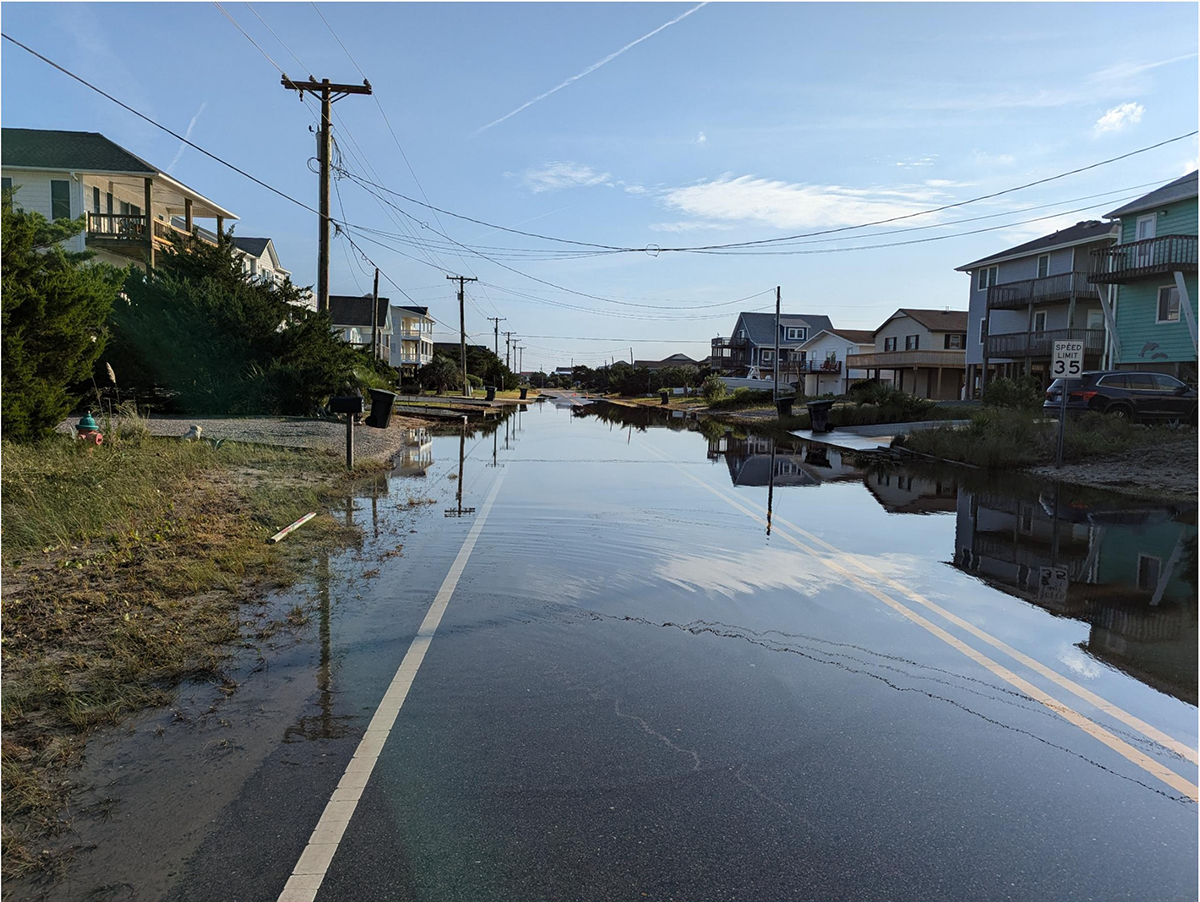
Last year, Topsail Beach hired a civil engineer and consulting firm to map its stormwater system and study areas that experience chronic flooding. The study was released earlier this year.
North Topsail’s initial stormwater improvement plans focus on two areas deemed the most critical in that town – Island Drive at Gray Street and New River Inlet Road at Richard Peters Park. Projects for those areas are pending.
To date, three of the five projects identified in Surf City, including those on Seahorse Avenue, Roland Avenue and the intersection of Mecklenburg Avenue and North Topsail Drive are complete.
A project planned for intersection of Charlotte Avenue and South Shore Drive was, as of Coastal Review’s Aug. 7 interview with Breuer, out for bid. That project will entail replacing portions of asphalt with permeable pavers.
As for the fifth project, this one along North New River Drive, the town has “not addressed that one quite yet, but we will continue to look at that,” Breuer said.
Town officials also have on their radar Old Settlers Beach, an area commonly referred to as the canals at north side of town, as the likely location of their next stormwater capital improvement project site.
“We’re thrilled about the momentum that we’ve been able to carry through in the execution of the projects to try and start making a difference,” Breuer said. “I think we’ve been able to try and look ahead and try to get ahead of things and having a better understanding of how things are functioning from a stormwater perspective.”
The town has in two years received more than $2 million in grants for stormwater improvement projects through the Golden LEAF Foundation, N.C. Department of Environmental Quality, and N.C. Emergency Management.
“We’ve been really, really pleased that the last several projects there’s really been no town funding that has gone towards that,” Breuer said. “Staff has been very forward pressing on getting the projects done even though we’re a small down and we have limited staff capacity to be able to do that.”
Recognizing that “coastal resilience is not something that we can ignore,” the town in 2024 established a stormwater division and implemented a utility fee for all properties within town limits. The fee is $6 a month for a typical single-family home.
The town has also started implementing stormwater mitigation projects within its mainland borders. Last year, the town’s stormwater division restored ditch lines in the rights-of-way along Little Kinston Road.
“We’ll continue to evaluate certain things on the mainland, but a lot of the development that has occurred on the mainland is still going to be under a state-issued stormwater permit and, at this point, the town is not considering taking over those systems,” Breuer said. “We have discussed potential mechanisms for evaluating that, but that’s going to take a very strong partnership with the entity, like the homeowners association, to bring in an engineer to certify or qualify that that system is up to standards before we take on a major maintenance or liability issue with a system like that.”