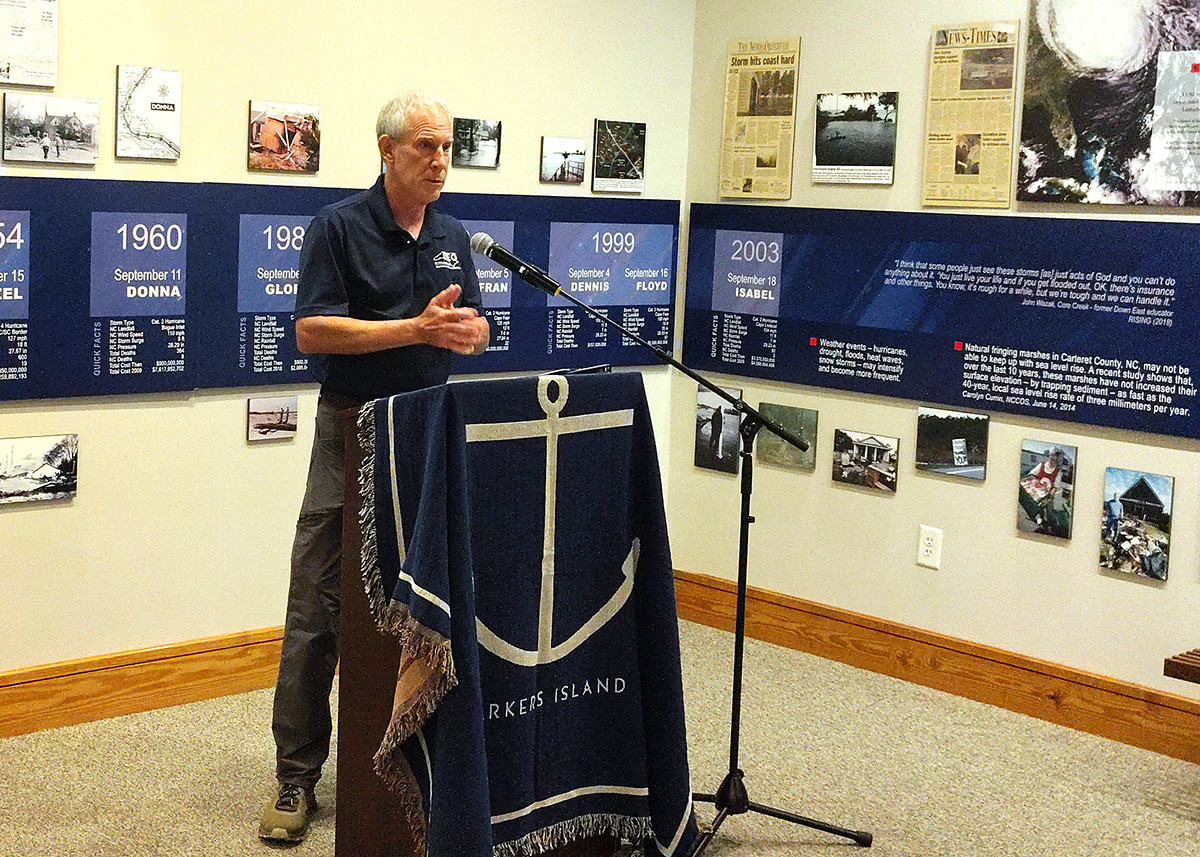
Preparing for future hazards by strengthening resilience to natural disasters across the state is one of the North Carolina Department of Environmental Quality’s top priorities, Secretary Reid Wilson told a few dozen Monday morning at the Core Sound Waterfowl Museum and Heritage Center on Harkers Island.
He, along with Albemarle-Pamlico National Estuary Partnership, or APNEP, Director Bill Crowell were in the Down East Carteret County community to announce $300,000 through the engagement and stewardship grants program to support the eight projects chosen this year “that advance environmental stewardship and community engagement across the region,” according to DEQ.
Supporter Spotlight

APNEP is a collaborative program dedicated to understanding, protecting and restoring the Albemarle-Pamlico estuarine system.
“We are seeing heavier rainfall, more frequent flooding, even on sunny days. While also, on the flip side, more droughts, more wildfires, and I don’t need to tell people from Down East that these conditions place enormous pressure on people’s lives, on infrastructure, and on our natural systems,” Wilson continued.
He said that maintaining healthy water bodies and estuaries is a critical part of this resilience work. “By protecting and conserving these natural systems, we help strengthen our communities and make them safer and better prepared for what is coming in the future.”
Grant funding is from the Environmental Protection Agency and DEQ, which hosts APNEP, the largest of the National Estuary Program’s 28 estuary partnerships. The region covers 36 counties in North Carolina and 18 cities and counties in Virginia.
Wilson said that through APNEP, the state invests “directly in communities through grants that support local efforts to protect and restore this amazing estuary,” and “will support projects that advance environmental stewardship and promote community engagement.”
Supporter Spotlight
DEQ has been awarding these grants for about five years, and “saw incredible boost in the number of applications. We got 29 applications for almost $1.6 million. Both of those, the number and the amount of money, are a record, and it demonstrates a clear need for continued funding of community engagement and outreach, so that we can really engage with communities up and down this watershed.”
And, Wilson continued, many of the grantees are bringing their own money and resources to the table, meaning that “every dollar can go a little bit further to protect this amazing ecosystem.”
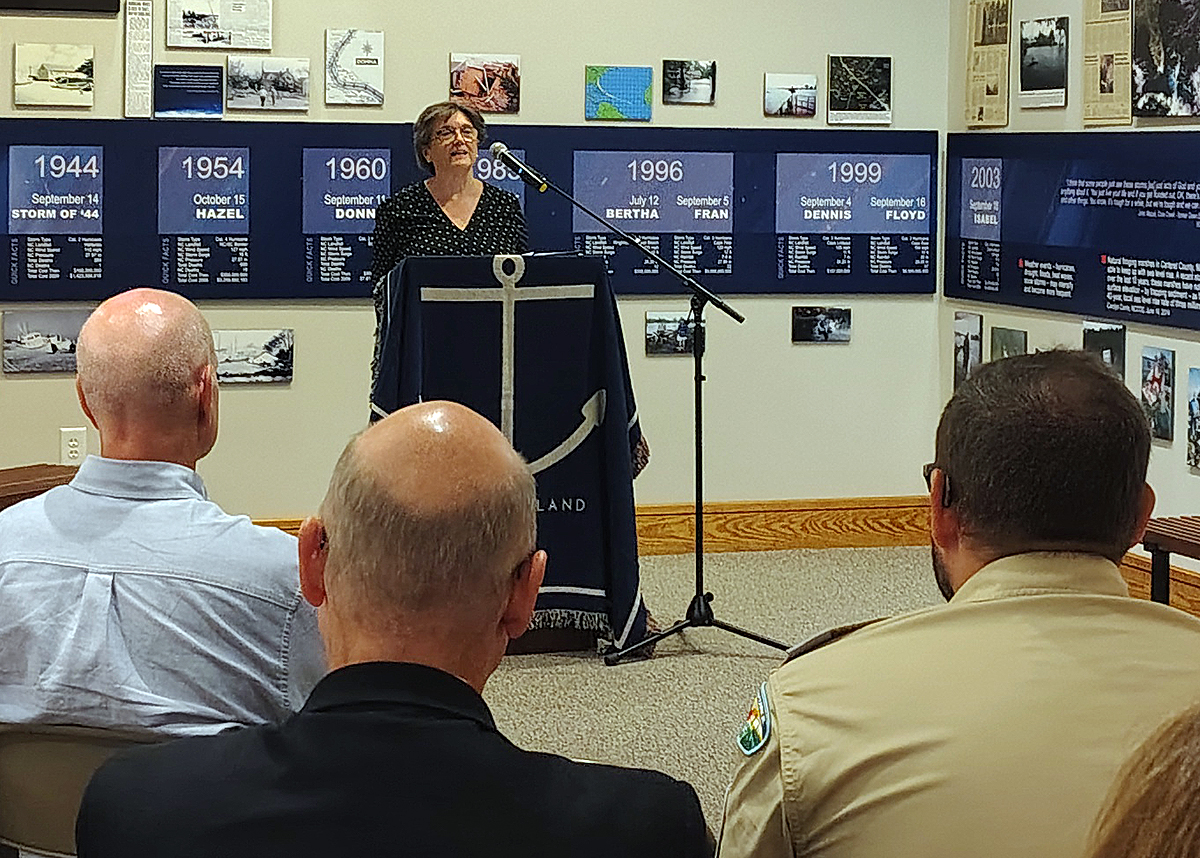
Crowell briefly summarized the projects, starting with the Down East Resilience Network, housed by the waterfowl museum. The network has been awarded $29,700 to produce videos documenting stories from across the APNEP region and create opportunities for community interactions through field trips through their project, “Building Coastal Resilience Through Community Knowledge Exchange.”
Wilson described the Down East Resiliency Network during his opening remarks as “a truly remarkable grassroots effort” that brings together academics, community members, and local, state and federal government agencies to solve the challenges that the 13 unincorporated communities Down East face as they live on the front lines of environmental change.
The North Carolina Coastal Federation, which publishes Coastal Review, has been awarded $91,600 for “Planting a Culture of Coastal Stewardship: Native Landscapes and Outdoor Classrooms.”
The project is to expand native landscapes and promote water quality and stewardship throughout nature-based stormwater management projects and education activities across the region, Crowell said.
Carteret Community College, East Carolina University, North Carolina Sea Grant and the Mid-East Commission Council of Governments were awarded $49,178 to develop educational materials and implement the Beaufort County Living Shoreline Academy.
“Moving further upstream toward their headwaters, the downstream connections of the Albemarle-Pamlico, the North Carolina Museum of Life and Science will host a series of educational workshops that will focus on water quality and estuarine habitats and key stakeholders and governance structures that oversee the waters throughout the watershed,” Crowell said. The Durham-based museum was awarded $25,000 for “Downstream Connections in Albemarle-Pamlico.”
The North Carolina Museum of Natural Sciences in Raleigh was awarded $57,915 to host School of Rockfish. Crowell explained that the project is similar to APNEP’s Shad In the Classroom program. Students will raise and release juvenile striped bass in partnership with fishery biologists for North Carolina Wildlife Resources Commission and the U.S. Fish and Wildlife Service, while also learning about water quality and habitats in the watershed.
The North Carolina Estuarium in Washington has been awarded $4,396 for “Walking Workshops on the Pamlico” and “Meet and Eat: The Eastern Oyster,” which includes establishing new learning stations on coastal ecosystems and water quality along the town’s waterfront and boardwalk, and to support an oyster-focused program connecting area educators with oyster farmers at the estuarium.
Scouting America East Carolina Council based in Kinston was awarded $36,850 for Camp Bodie Field Science Academy to support explorers in developing and leading field science programming.
“The explorers will learn water quality monitoring techniques, habitat assessment, shoreline ecology, while serving as trained peers for mentors visiting groups, mentors and visiting groups to the camp and the eco center, along with public schools,” Crowell said.
East Carolina University’s was awarded $4,325 for a project to test different interpretation signs at Bertie Beach on the Chowan River, the Roanoke/Cashie River Center and the North Carolina Coastal Reserve’s Kitty Hawk Woods Reserve. This project is intended to improve trail signs and understanding of science communication strategies in eastern North Carolina.
“The Albemarle-Pamlico Estuary System is truly a national treasure. The NEP Citizen Advisory Committee is very pleased to support these projects and partnerships, working to promote engagement and stewardship in the region, and supporting our estuary of national significance,” Crowell said.
Core Sound Executive Director Karen Amspacher, when welcoming representatives from Gov. Josh Stein’s office, DEQ, APNEP and grant recipients, explained that there was never a plan for the “somewhat accidental” Down East Resilience Network that formed soon after Hurricane Florence hit Carteret County in 2019.
“We at the Core Sound Waterfowl Museum never intended to be in the resilience business, but we are, and actually, we always have been. Our changing landscape, our crumbling roads, our soggy ground, our somewhat uncertain futures have caused us to be on the front lines of trying to accept and understand, adapt, plan and hope,” she said.