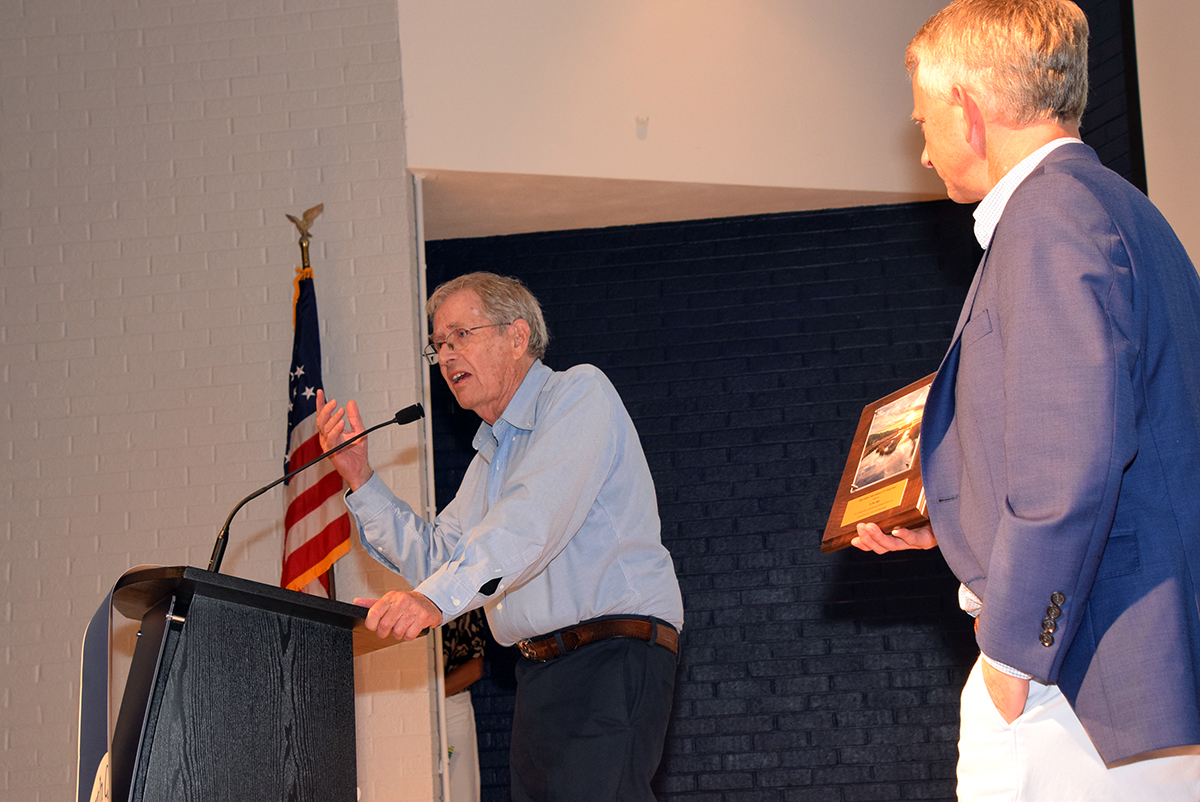
Geologist Dr. Stan Riggs quoted the scientist Loren Eiseley, who said, “If there’s magic on this Earth, it’s contained in water,” to the more than 150 gathered Saturday for the North Carolina Coastal Federation’s 23rd annual Pelican Awards.
“And water, if you think about it, is everywhere,” Riggs continued. “It’s everything. It’s what we’re made out of. It’s what drives our coastal system. Where the water comes in contact with the land, that’s a high, high-energy environment. Not on a pretty, sunny day, but when the storms come in, you know there’s energy there. There’s wind. There’s water. There’s power, and we have to learn to live with that. Doesn’t mean we pack our suitcases and walk away. We have to understand it.”
Supporter Spotlight
Riggs, professor emeritus of geology at East Carolina University, was at the podium inside Carteret Community College’s Joslyn Hall accepting his Lifetime Achievement Award “For Distinguished Leadership and Lifetime Excellence in Coastal Research, Science, and Stewardship.”
He was among the 13 individuals and groups recognized this year by the nonprofit organization’s staff in its office in Wanchese, headquarters in Carteret County, and office in Wrightsville Beach.
“Today we honor extraordinary people and partnerships that are making a lasting difference for North Carolina’s coast through collaboration, dedication, and shared commitment. Our honorees are helping to ensure a healthier coast for generations to come,” April Clark, president of the organization’s board of directors, said early in the program.
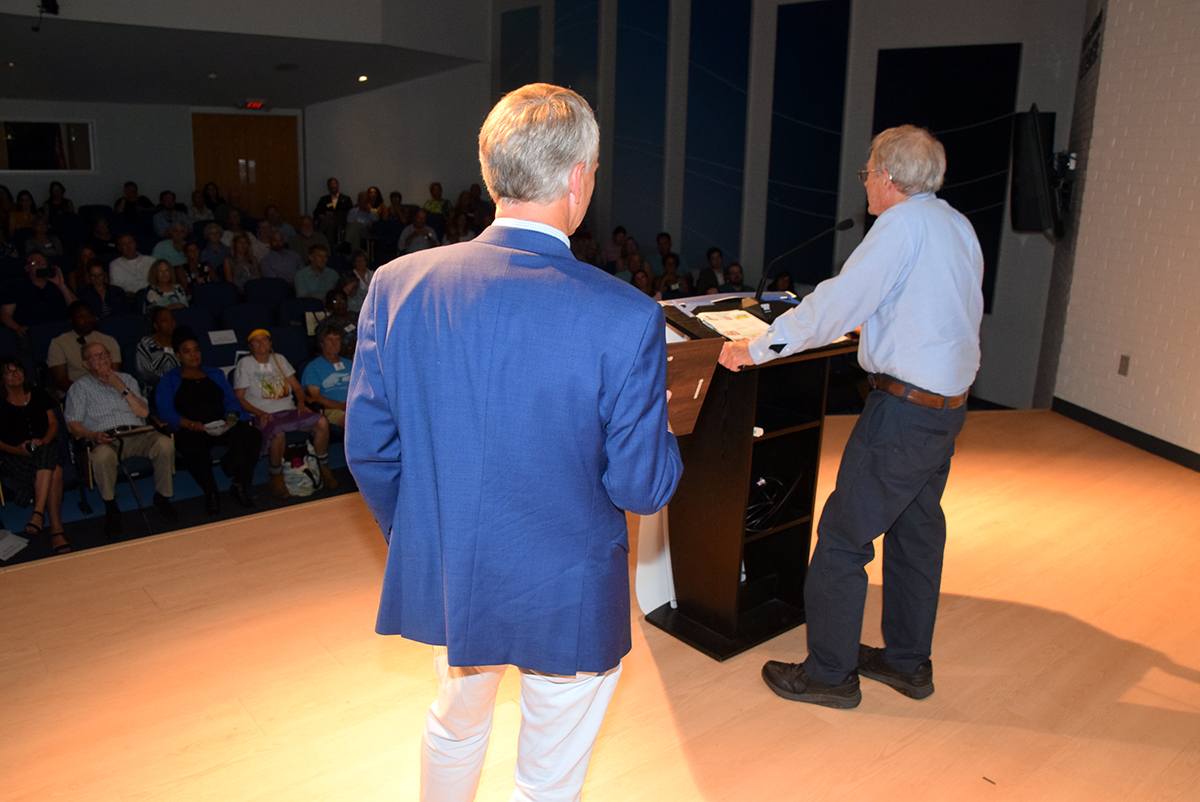
Riggs, who has been studying the coastal environment for more than 60 years, told the crowd that he had spent his career working with others to take a holistic approach in understanding the planet. About 15 years ago, he and other researchers representing a range of disciplines began pooling their resources to learn about North Carolina’s coastal systems.
“In 2010, there was a big change in North Carolina,” when some laws put in place in the 1970s and 1980s were threatened, and there was a population surge putting pressure on the coastal system and “we understood the science, but the science doesn’t do a darn bit of good for anybody if it’s just in a scientist’s head. And one of the things that became clear was that we weren’t making the science available to the public.”
Supporter Spotlight
He and a group of partners decided to start a foundation called North Carolina Land of Water, or NCLOW, that focuses on the education and application of science and its dissemination to the public. Then, in the late 2010s, he realized that there was a lot of information and data that nobody would ever see.
“So, I decided to sit down and start writing a book. One book led to two books, led to — all of a sudden, I was up to number 10,” books that “I didn’t know what to do with.”
He then approached a bunch of publishers, but with the first book being around 850 pages, and wanting lots of photos, maps and history, a mixture of everything in the book, these companies “finally pointed their finger at me and said, ‘We’re in a business to make money, and you’re talking about a $200, $300 book,’” he said, in describing the rejections.
“I finally realized that ‘OK, if we’re going to make this happen, we got to do it ourselves’ but then it means we need a team of people who know how to do this,” he said, and a team appeared, leading to the recently published volume 1, “Cape Lookout National Seashore: Paradigm for a Coastal System Ethic.”
Riggs closed with words written by photographer and poet, John Riggs: “If water is life; abundant water is abundant life. And abundant life is abundant Spirit. She not only thrives in these wild places, she dances, she sings aloud, and she rages. My how she rages!”
Coastal historian
Historian Glenn Blackburn, professor emeritus of history at University of Virginia’s College at Wise, was presented with a Lifetime Achievement Award “For Excellence in Coastal History and Conservation Writing.”
Blackburn, author of “Saving Great Places” and “A Spectacular Coast and Its Guardians” spent the last two decades researching the Coastal Federation’s growth from when it was founded in 1982 to becoming a leader in coastal protection and restoration.
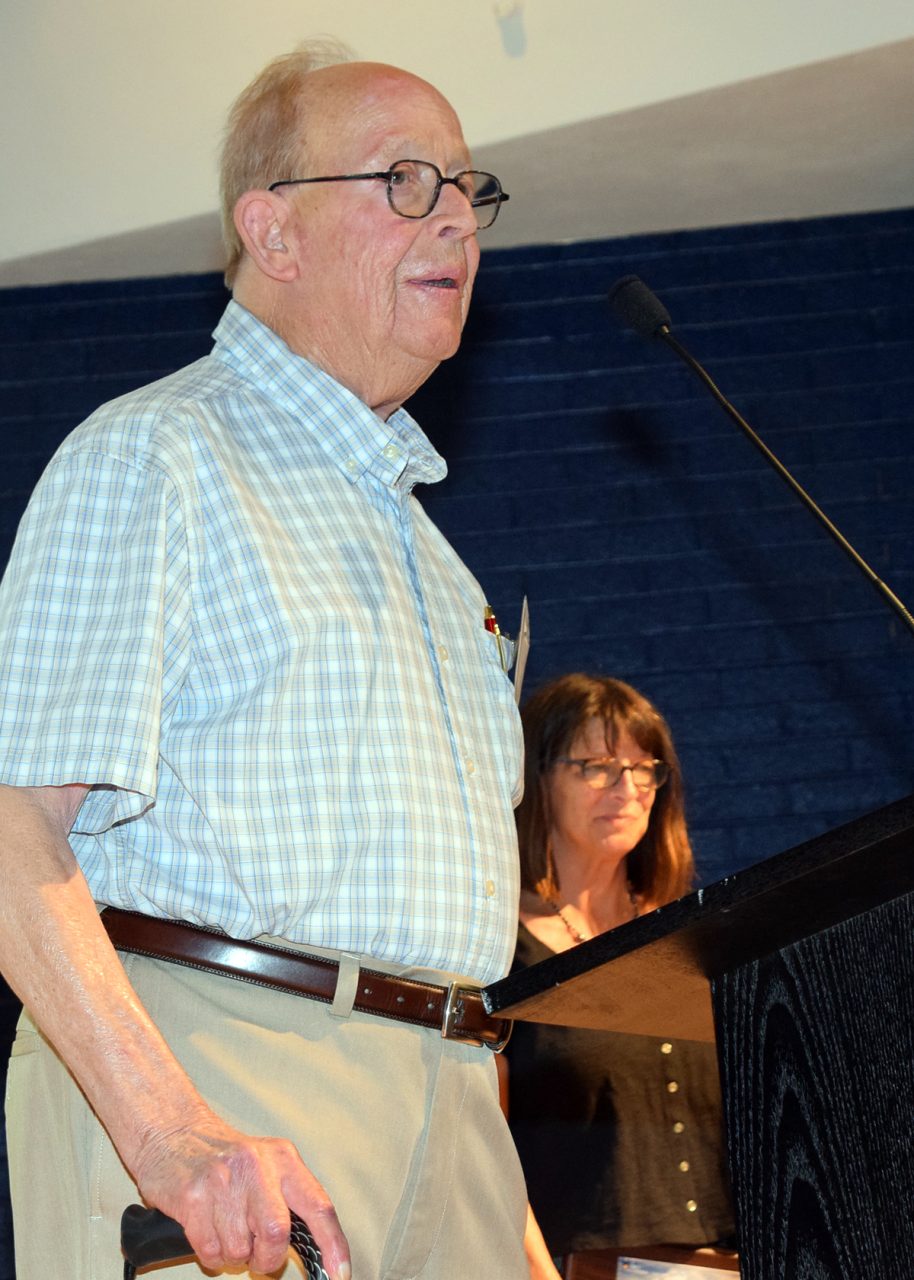
Blackburn told the audience that he first learned about the organization 20 years ago when learned how the organization spent 10 years fighting the development of an undeveloped island that was habitat to birds and turtles. Then he learned about a fight early in the organization’s history to stop peat mining on the Albemarle peninsula, saving thousands of acres of wetlands.
“Shortly after that, the Stump Sound fight,” when the organization teamed with the community to stop a developer from ruining oysters and fishing in the Onslow County waters.
It “began to hit me,” Blackburn continued. “This is an environmental group that wins. That’s unusual. This is a story that needs to be told. That’s what got me started on these two history books.”
During his opening remarks, Executive Director Braxton Davis shared a list of the organization’s milestones, including that later this year the organization plans to have a grand opening for its new headquarters called the Coastal Protection and Restoration Center and event venue, Pelican Landing, located on N.C. Highway 24.
The effort to raise the funds to build the new center began in 2020, construction began in February 2025, and staff have moved in over the last month.
With the grand opening planned for this fall, the organization recognized its Capital Campaign Cabinet with a Coastal Visionary Award “For Extraordinary Leadership and Commitment to Establishing the Coastal Protection and Restoration Center.”
Chief Development Officer Sarah King, when presenting the award, said the “truly inspirational” group’s steadfast work “allowed us to raise over $10 million to establish new coastal protection and restoration center.”
As part of the Coastal Visionary Award, King recognized honorary chair, Hugh Cullman, who “was actually the very first person that we shared this idea with, and he was so encouraging.”
Vic Medlin, speaking for the family members attending, accepted the posthumous award for Cullman.
“He loved the North Carolina coast,” and “completely believed in the federation’s vision of providing a better place to live, work, and visit, and he believed in that vision, and he showed it in his donations,” Medlin said. “And on behalf of the Cullman family, we’d like to say thank you again.”
Cabinet Chair Charles C. Meeker said the campaign was a team effort and reminded him “that the federation has a lot of friends, friends who care about the federation and its work, friends who are willing to give substantial donations to make the campaign a success.”
Northeast coast awards
Joy Cook “For Leadership and Dedication to Coastal Protection, Recreation and Cultural Resources.”
Now retired, Cook dedicated nearly 30 years to North Carolina State Parks, including nine as superintendent of Jockey’s Ridge State Park, thanked the organization and its staff for being “one of the easiest and most wonderful relationships that I’ve had the honor of working with.”
Jayne Young “For Outstanding Volunteer Service Advancing Coastal Environmental Education.”
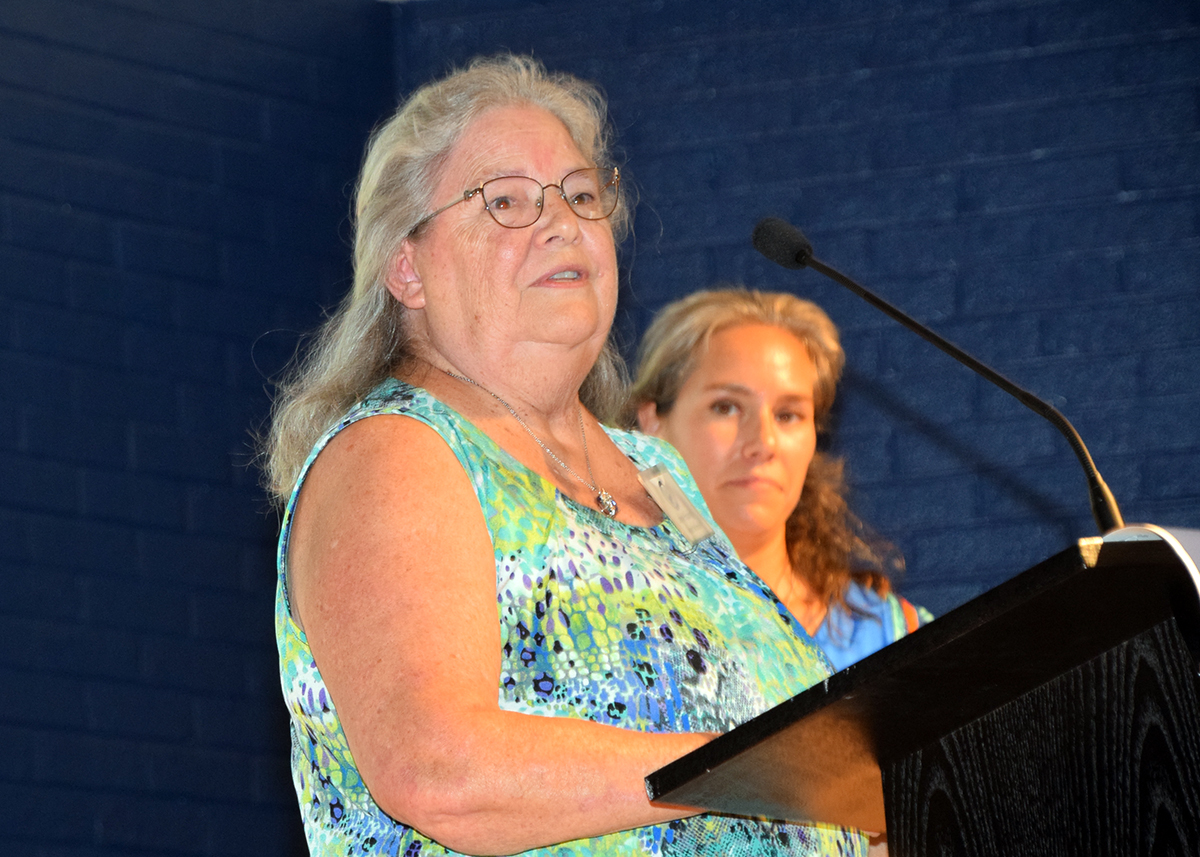
The retired educator, who was recognized for volunteering her time supporting coastal environmental education and inspiring students, told the audience that it is “an honor to be recognized for something we just have so much fun doing.” Having been an educator, “you never know the one that’s going to come back to you years later and say, ‘Well, remember when we did this, and because of that, we’re doing this now.’”
Sean Ellis “For Exceptional Volunteer Contributions to Coastal Stewardship and Community Service.”
The organization said Ellis is being recognized for his countless hours supporting the oyster shell recycling program and maintenance projects around the Wanchese office.
Ellis, who was unable to attend, said in a recording that the award means a lot to him, and thanked his family for their support, his friends at the Coastal Federation, and “most of all you, the sponsors and people who are here today, who keep this program going. Thank you for your continued support and confidence.”
Central coast awards
North River Laurel Road Ladies Outreach Committee “For Grassroots Leadership Advancing Coastal Resilience and Community Action.”
Based in Carteret County’s North River, Laurel Road, and Merrimon communities, the grassroots group was recognized for being trusted leaders and advocates who have “united neighborhoods, amplified local voices, and built partnerships that are helping these historic coastal communities respond to increasing coastal hazards,” according to the organization.
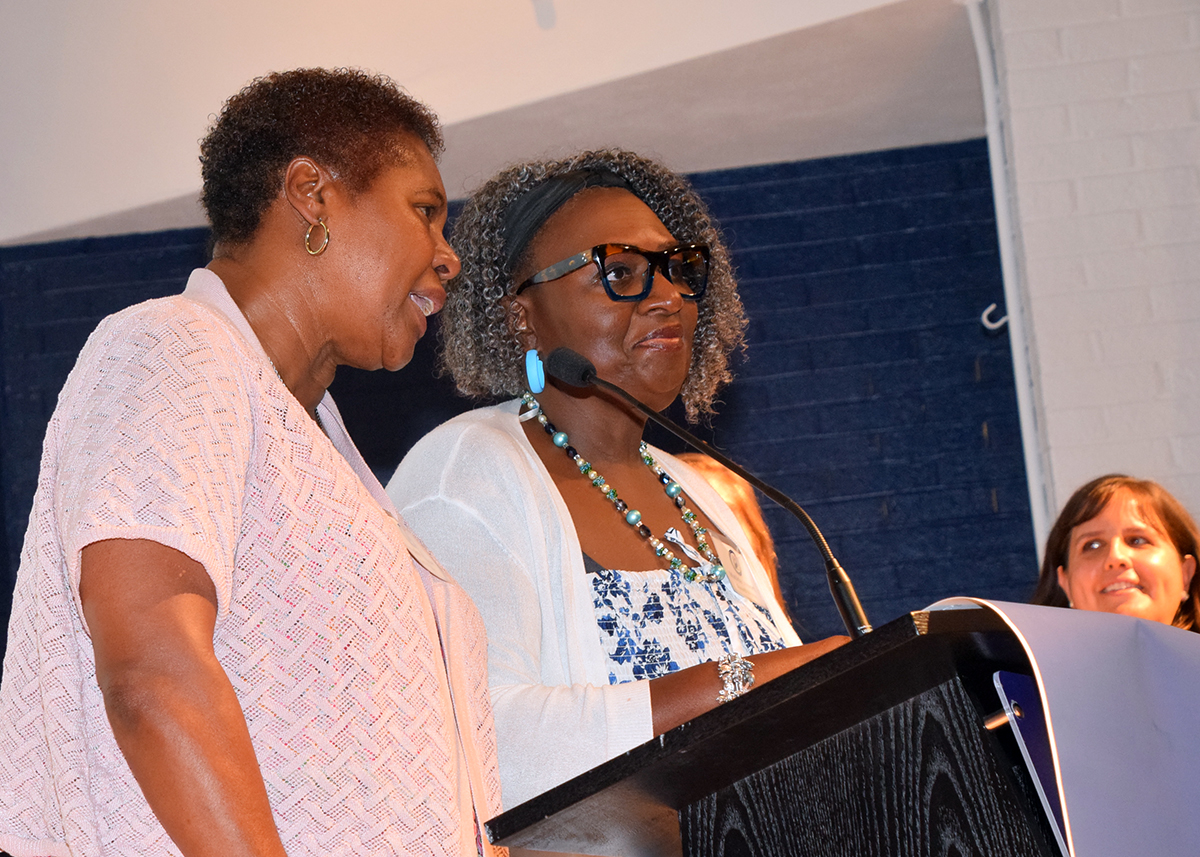
President Matilda Stewart and Vice President Mary Ann Monroe told the crowd that they were truly honored to receive the award on behalf of their community, adding that the “achievement belongs to us as a whole group. If there’s one thing that I’ve learned, it is that our big goals are only achieved with the help of others.”
Jason Vanzant “For Inspiring Future Coastal Stewards Through Education and Partnership.”
The schools in parks specialist for Hammocks Beach State Park was previously a classroom teacher who focused on science, technology, engineering and mathematics, or STEM, that has partnered with the Coastal Federation to connect students with nature-based solutions.
Vanzant said that he is both honored and humbled to receive the award that represents so many others, including the staff, rangers and superintendent of the state park.
Thomas L. Kirmeyer and Nan Bowles “For Dedicated Partnership and Commitment to Advance Watershed Restoration.”
The Coastal Federation recognized the couple for demonstrating “extraordinary conservation leadership” for selling their 8.25-acre waterfront property along Ward Creek in Carteret County at half its market value.
Bowles said that when she is asked what she does, “I respond, I’m a member of the marsh community of Ward’s Creek, along with my husband Tom and our dog Spot. We live on the edge of the forest, on the edge of the marsh, on the edge of Ward’s Creek, which flows in two directions, on the edge of North River, on the edge of Back Sound, on the edge of the Atlantic Ocean, with water that flows around.
“In the 37-plus years we have lived here, we have gained interconnections with members of the community. Community members such as the other people who live on our road. Leaping lizards, jumping frogs, the mosquitoes who remind us of the importance of, that we can offer respect and honor, even when someone irritates Us. Dragonflies who are skillful at changing direction. Great blue herons who show us how to see the bigger picture. The marsh grass, black needle rush, and vibrant green spartina grass, both of them having strong, firm roots, and the jumping mullet bringing us healthy humor and laughter. And when we dig beneath these interconnections, we discover stories and lessons that have to point us the way to being the best humans we can be.”
Southeast coast awards
Lindsay Addison “For Dedicated Partnership Advancing Coastal Habitat Conservation and Restoration.”
The coastal biologist for Audubon North Carolina has spent more than a decade protecting coastal birds and their habitats.
Addison told the audience that she is appreciative and honored that the Coastal Federation selected Audubon North Carolina’s Coastal Program for this award and recognition.
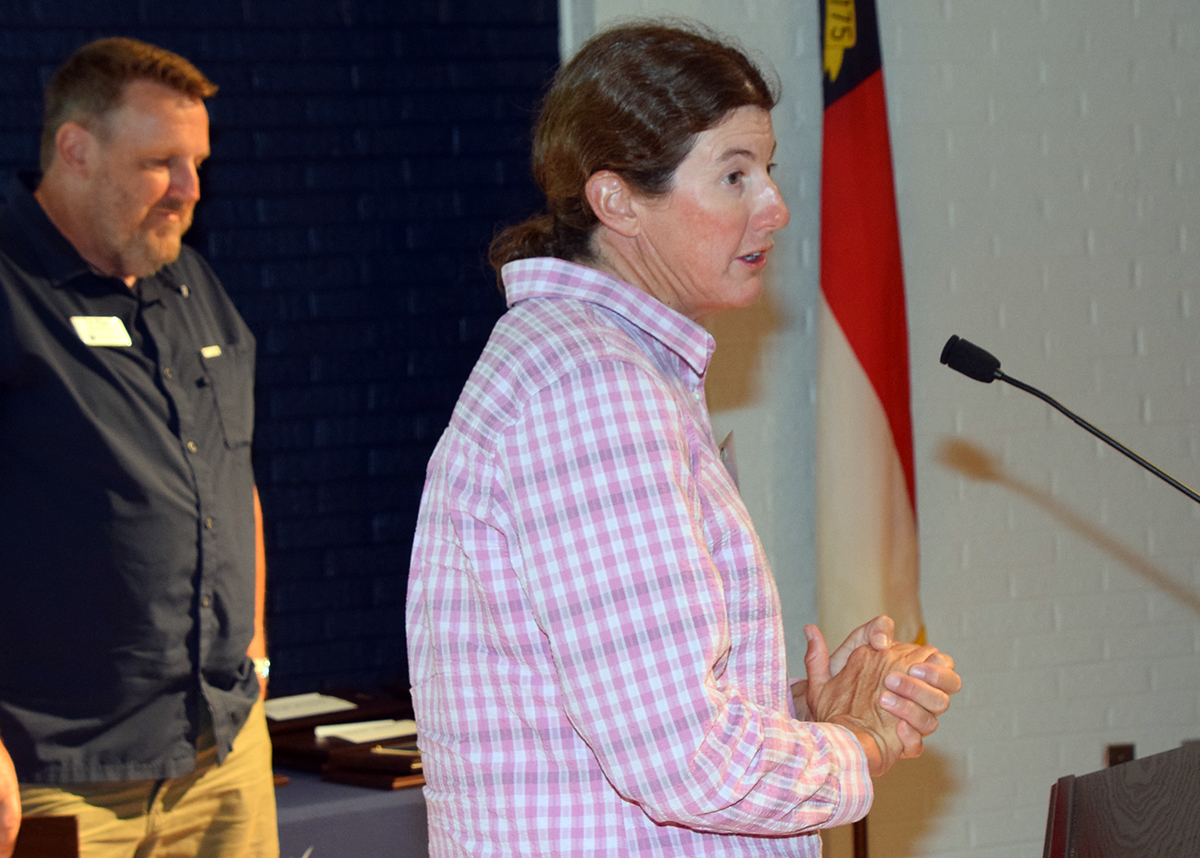
“I would be remiss if I didn’t say Audubon North Carolina manages 40% of the state’s nesting coastal waterbirds, and the way I feel about that is I feel to be a very fortunate, very lucky observer of these of these birds, these habitats, and in these landscapes,” Addison said, adding birds are an important part of the overall coastal ecosystems, and important indicators of the health of the coast.
Conserve the Point “For Community Leadership in Protecting and Stewarding the South End of Topsail Island.”
The nonprofit organization based on Topsail Island formed in 2022 to preserve and protect the south end of Topsail Beach, called The Point, from development. In 2024, the North Carolina Coastal Land Trust purchased the 150-acre property to save the undeveloped property.
The group’s secretary Nancy Pettens, said on behalf of the board, that the award is a “tremendous honor” that belongs to every donor, every volunteer, everyone who thought this place was worth saving. “Most of all, I think it belongs to the Topsail Beach community, near and far, whose passion and generosity made it a reality for us and for future generations.”
Warren Darrell “For Outstanding Volunteer Leadership in Coastal Resilience and Community Engagement.”
The organization called him an “exceptional volunteer whose passion for learning and sharing coastal science inspires communities across southeastern North Carolina.”
“I love this coast,” Darrell said. “The work of the Coastal Federation helps to mitigate the harmful effects of global warming by absorbing atmospheric carbonate our shoreline from erosion and by providing his biological habitat.”
Coastal media partnership
Coastal Review, which is published by the Coastal Federation, this year recognized the Hatteras Island-based online news service, Island Free Press “For Excellence in Collaborative Coastal Community Journalism.”
The two publications have partnered for the last decade to expand coverage of critical coastal issues affecting Hatteras and Ocracoke islands.
Editor Joy Crist said she and owner Donna Barrett were “beyond honored to receive this award” and thanked the Coastal Federation for “allowing us to cover so many stories that are positive or hopeful in a news cycle that’s busy and sometimes discouraging.”