In 1973, three young children were racing up the sand dunes of Jockey’s Ridge in Nags Head when they heard the squeaky treads of a bulldozer as it leveled the sides of the slopes. Stunned, they raced home, tearfully sounding the alarm to their mother, Carolista Baum.
Ms. Baum rushed over to the dunes and defiantly stepped in front of the bulldozer, stopping the destruction of this iconic geographical monument. For good measure, she later returned to remove the distributor cap to disable the mechanical beast.
Supporter Spotlight

With the town starting to trend as a tourist destination, real estate was booming. This enormous pile of sand was coveted, a target in the crosshairs of ambitious developers. With her bold act of protest, Ms. Baum threw a monkey wrench into the development plans of Jockeys Ridge, protecting a unique coastal landmark. In a short time, Jockey’s Ridge would soon become a state park, setting in motion the life work of one George Grantham Barnes, who died April 23. He was 73.
A geologic wonder, the grains of sand that form the Jockey’s Ridge dune system began piling up thousands of years ago. Ancient quartz sands from the Appalachian Mountains flowed down into the Atlantic Ocean. Hurricanes and storms eventually washed the sand up and onto the beaches. Their howling winds pushed the sand inland, creating monstrous dunes along a section of the North Carolina coast now known as the Outer Banks.
On Jockey’s Ridge, the salty winds blow life into the dunes, constantly reshaping the sand, creating a dynamic living system. These dunes have micro ecosystems of dune grasses, maritime shrub thickets, maritime forest, ephemeral ponds and an estuarine shoreline along the Roanoke Sound. It’s a place so unique that it was designated as a National Natural Landmark in 1974.
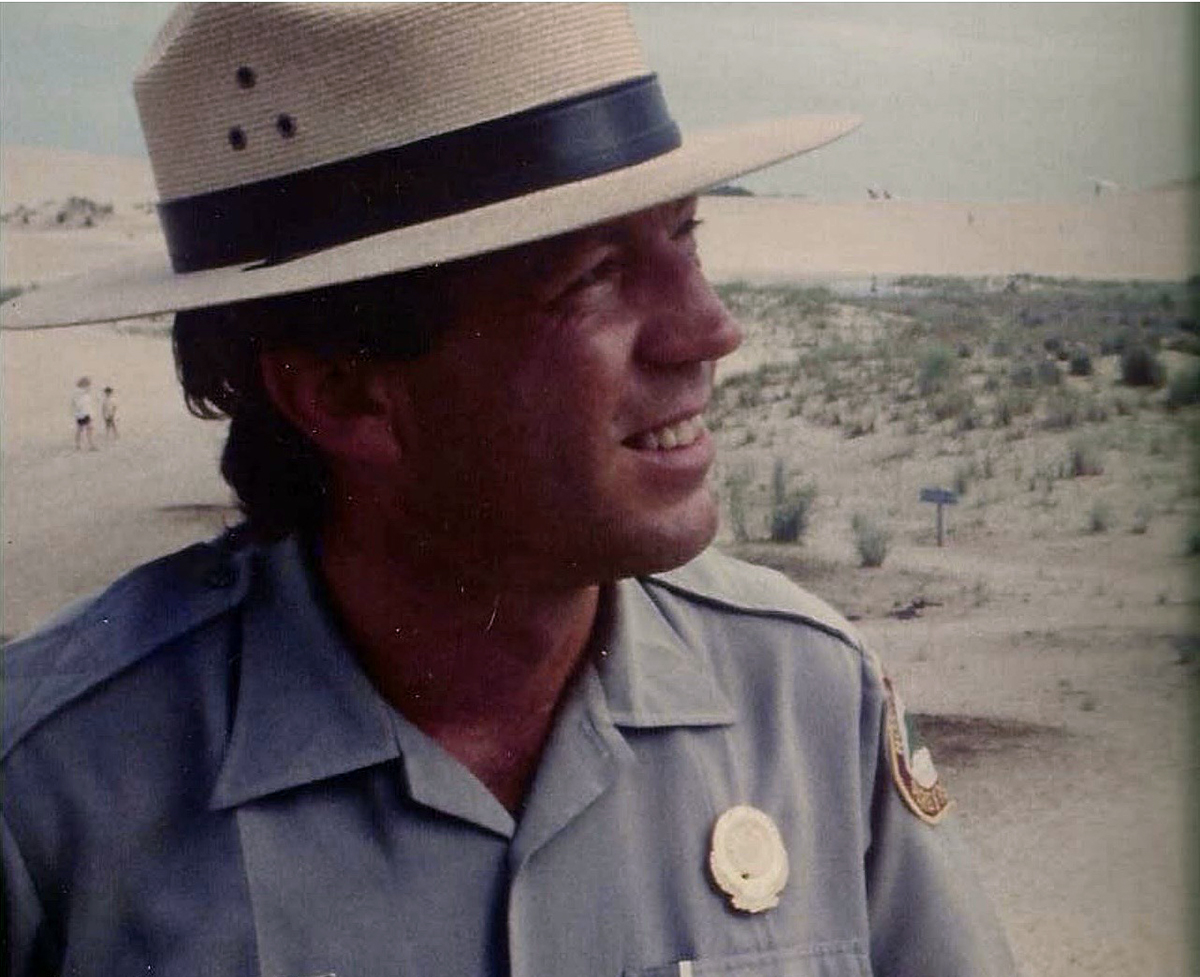
A native of Lumberton, George Barnes attended the University of North Carolina Wilmington. Not long after college, in the late 1970s, he first donned the green and gray uniform of a fledgling park ranger at Goose Creek State Park near Bath. Under the moss-laden live oaks that lined the quiet north shore of the Pamlico river, George settled in to the life of a park ranger.
Just east of Goose Creek, at Nags Head, the juggernaut of Ms. Baum and the nonprofit, People to Preserve Jockey’s Ridge, were successful with their “Save Our Sand Dune” initiative. Working with the N.C. Division of State Parks, the emergence of a new state park was now a reality. Truly a grassroots effort led by the residents of Nags Head. Their advocacy work, raising funds and lobbying politicians, was rewarded in 1975 when the North Carolina General Assembly appropriated funds to establish the park.
Supporter Spotlight

Private donations, federal funds and The Nature Conservancy also helped bankroll the purchase of the initial acreage.
During its inception, the first park ranger to patrol the dunes was Phyllis Goodwin. Her time at the ridge was brief, and by 1980, Ranger Barnes was selected by the superintendent of state parks to be the ranger in charge. At first, he commuted from Goose Creek, returning home each day. A real lone ranger, he was the only staff member at the park.
Starting from scratch, George was handed the metaphorical keys to a brand-new park. Given the opportunity of a lifetime, he was now the steward of a natural and cultural landmark so beloved that folks demanded its preservation — a daunting task that must have seemed overwhelming.
In the early days, when the dark summer thunderheads rolled in, he was lucky to have a fickle pickup truck to take shelter in. Ms. Baum checked in frequently to catch up on park operations and to let him know that he was not alone and that the community was there to help.
Carolista Baum’s feisty tenacious nature was buffered by George’s cool, laid-back style. They developed a mutual admiration for each other build on respect and their shared interest in making Jockey’s Ridge the best park it could be.
Ann-Cabell Baum and her siblings were the children who tattled on the bulldozer operator to their mom, Carolista. She remembers, as a child, riding over to the park with her mom on her visits to see George. Over time, she recalls, “he became one of the family, eating many meals with us outside under the shade of the porch.”
On occasion, George and Carolista clashed over their views on issues concerning the park. Recalling her mother, Ann-Cabell said, “She held his feet to the fire.” But despite any disagreement, “she always had his back.”
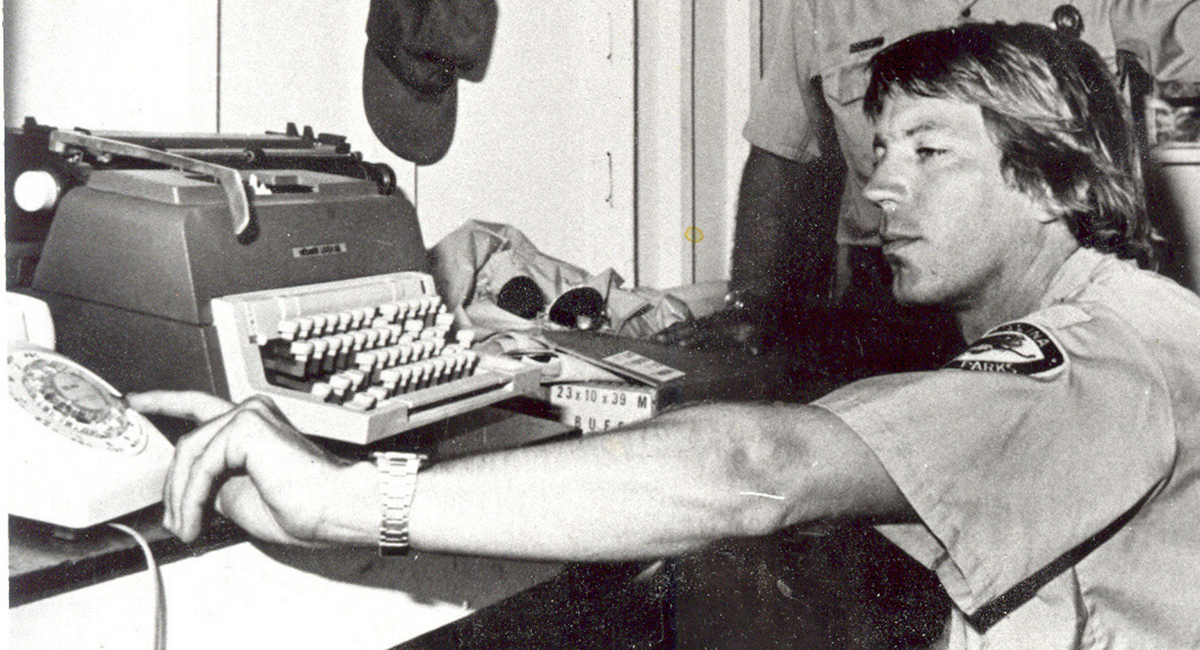
In 1981, George received some much-needed help when he hired Fran Crutchfield as an additional ranger for the park. She remembers the green, bare-bones, state-contract Chevy pickup truck with a “three on the tree” transmission. They shared the cramped truck cab as the park’s first unofficial office, along with a tiny windowless shed that housed a rotary-dial phone, manual typewriter and a makeshift assortment of tools.
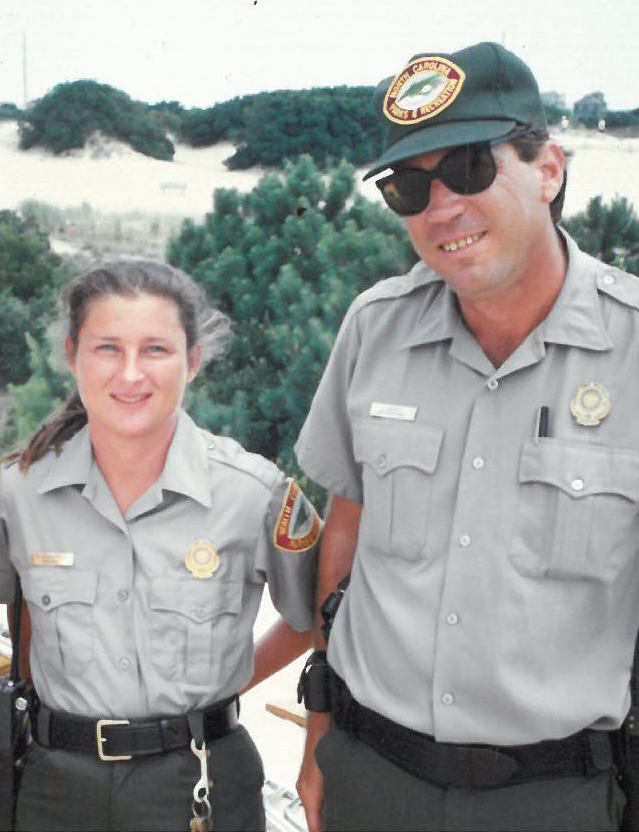
Weekly staff meetings were held, just the two of them, at a local restaurant that served as their conference room. Fran remembers, “We would catch up on things, problems, concerns, and goings-on at the park, over lunch at Sam & Omie’s (Restaurant in Nags Head).”
For many years, the only incoming calls on the shed phone were from N.C. State Parks District Superintendent Cliff Phillips. As George’s longtime supervisor, Mr. Phillips told me that Ranger Barnes faced unique challenges not found at other parks.
With the sand dune ridge now a park, many past activities there conflicted with the philosophy, values and regulations of a state park. It was Ranger Barnes’ duty to curtail those uses.
He also had the unenviable task of enforcing new opening and closing hours in an area that once had 24-7 access. Both changes were unpopular. When neighbors complained, George and Fran had to even shovel windblown sand from private property back onto to park property. Try as he might, George was unable to control the wind.
With the park falling completely within the town limits of Nags Head, it was understood that the performance of the new park staff would be highly scrutinized. At times, George was feeling the heat as if in a pressure cooker. His calm and good-natured demeanor was often taken to task. This iconic dune was important to the Outer Banks beach community. Individual special interests were not shy about expressing their thoughts on how the park should be managed. He tangled with commercial, recreational and civic concerns. At times, he felt political pressures as well.
Undaunted, Barnes seemed as comfortable in the presence of state senators and representatives as he did with his fellow surfers as they sat in the lineup waiting for the swells to roll in. His decisions were made in the best interests of the park to maintain the integrity and dignity of the resource. He operated from a legal mandate straight from the North Carolina Constitution to “… preserve as a part of the common heritage of this State its forests, wetlands, estuaries, beaches, historical sites, openlands, and places of beauty.” During these times, Ann-Cabell Baum said, “He never wavered. It must have been tough for him.”
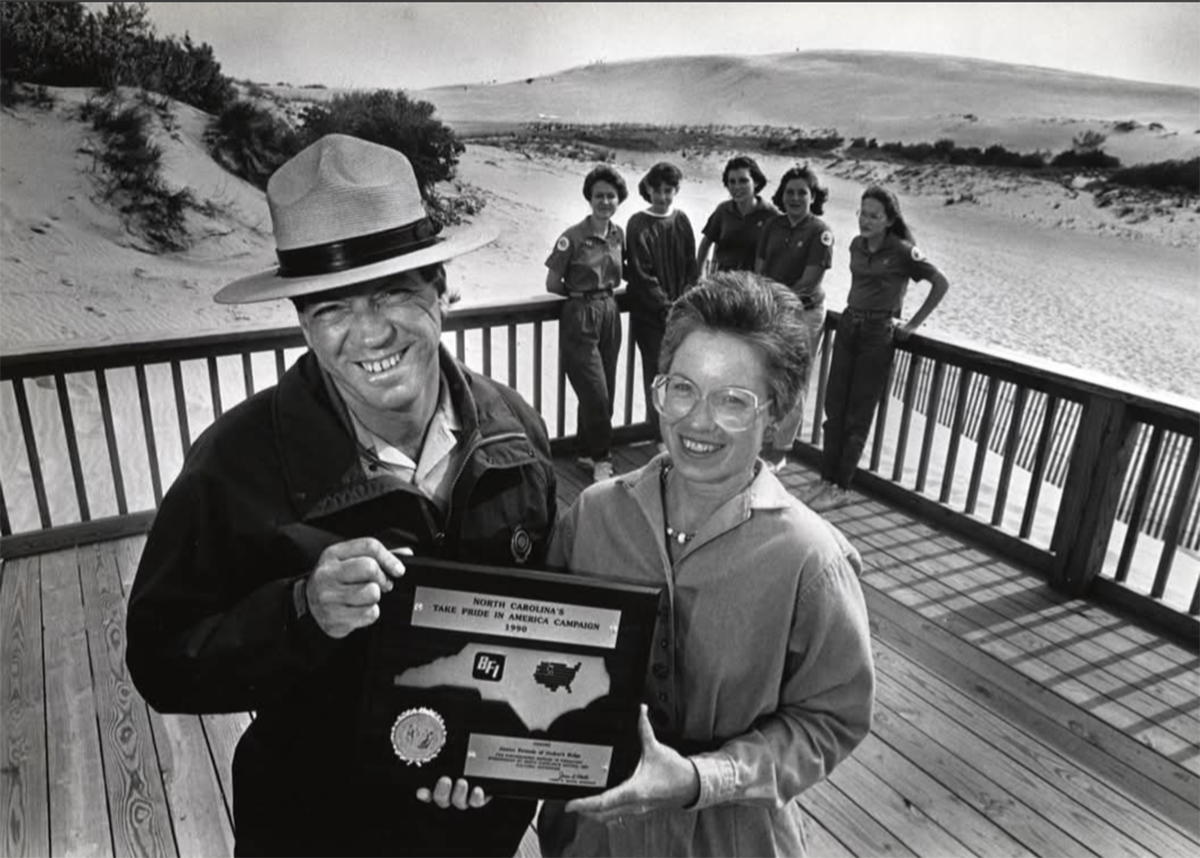
Mr. Phillips also remembered, “He rolled with the punches,” of which there were many.
George set about developing a park to address visitor interests while keeping intact the core park values of stewardship, conservation, recreation, education and safety. His easygoing demeanor, along with his trademark dark sunglasses, often hid the drive he had for his work. Slowly, the infrastructure commonly associated with a park began to grow: parking lots, restrooms, a staff office and maintenance shop, boardwalks, picnic shelters, a visitor/interpretive center, hiking trails and a recreational concession center.
Under his leadership, the staff grew. Rangers trained in environmental education, resource management, emergency medical, and law enforcement now patrol the park to service the growing visitation.
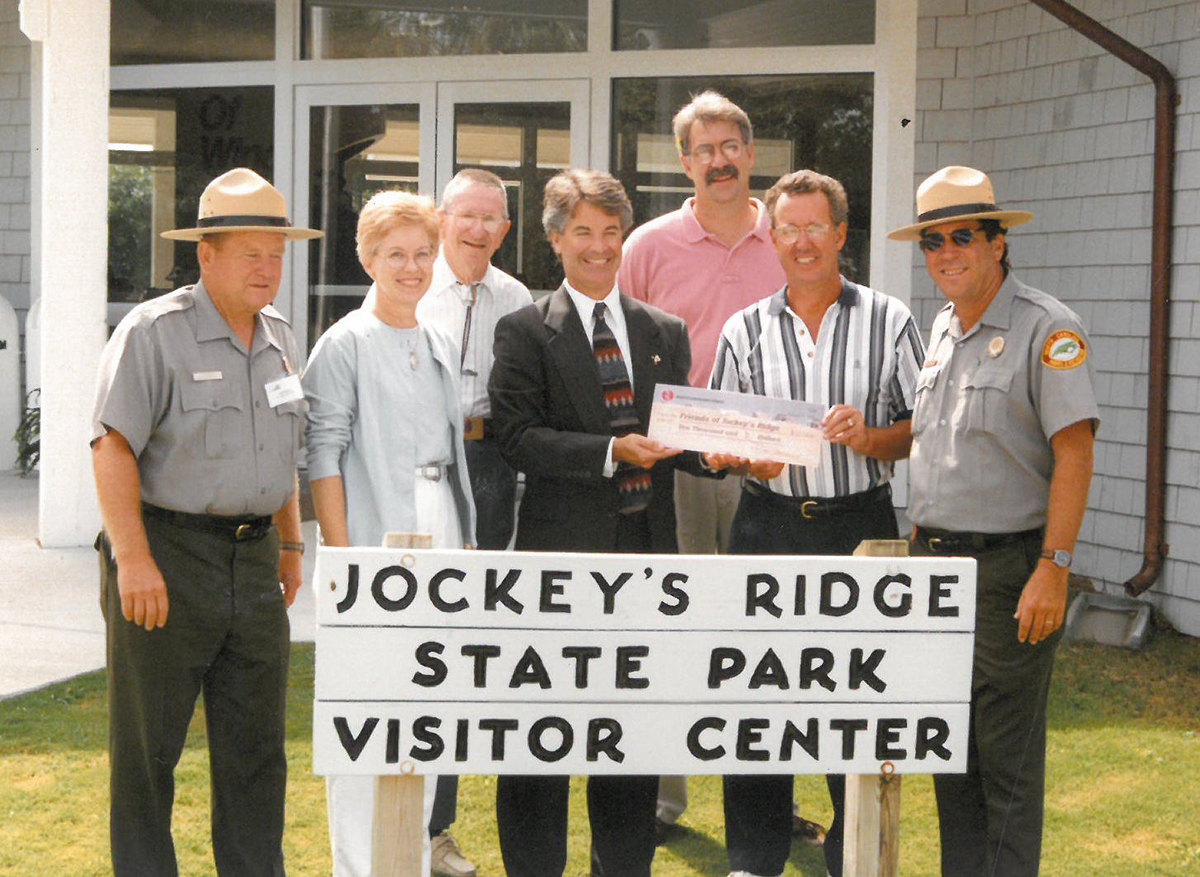
He also initiated coastal resiliency projects with the North Carolina Coastal Federation, including a living shoreline project along the Roanoke Sound boundary. Working with Southern Shores resident Peggy Birkemeier, a junior ranger program was established along with the Friends of Jockey’s Ridge, a nonprofit group supporting the park since 1990.
But George knew he didn’t accomplish all this on his own. He was quick to credit his supervisors, excellent rangers and the community that supported his vision of what the park could be. Throughout it all, Mr. Phillips said, “George Barnes led the way. He was loyal to the preservation of this park and was a dedicated person who can be given credit for his leadership in all areas of operations for Jockey’s Ridge.”
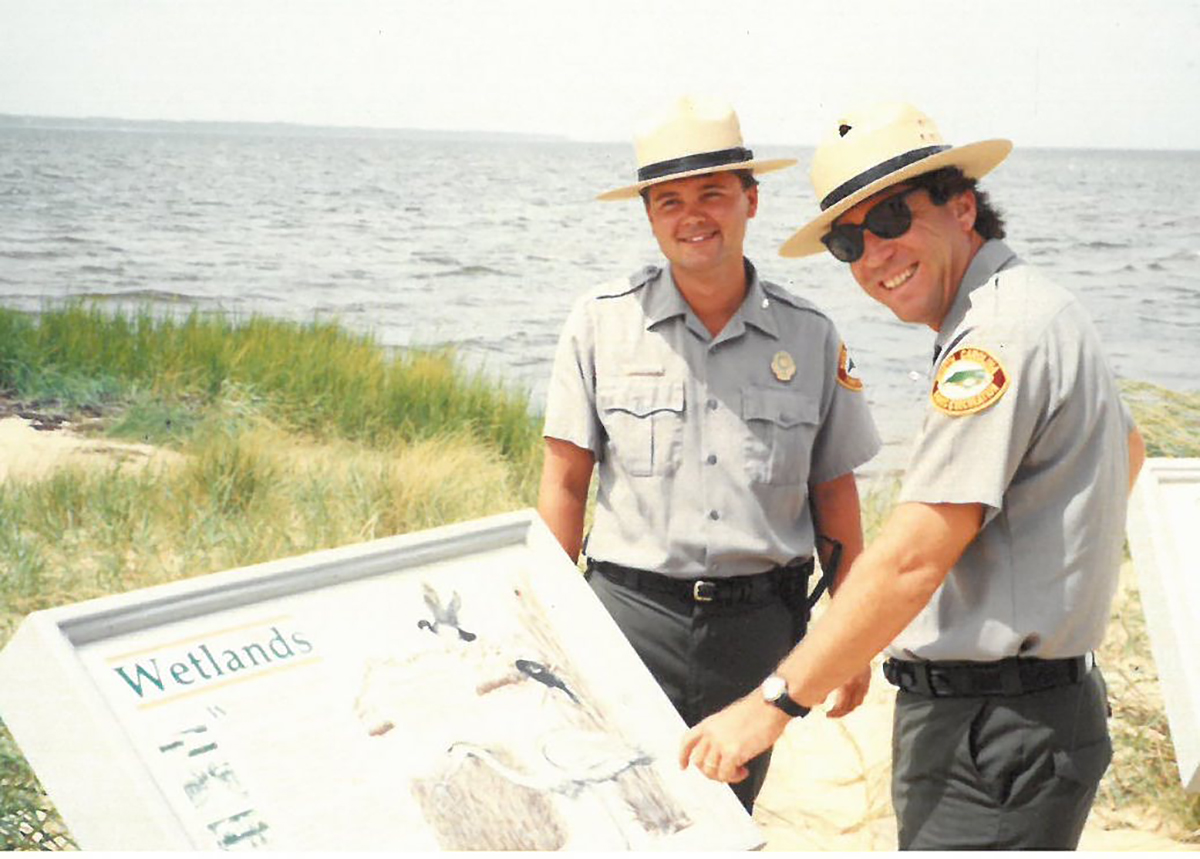
John Fullwood, who worked with Superintendent Barnes as a ranger at the park for 15 years, remembers George’s passion for his job.
“George had a big heart,” Fullwood said in a recent phone conversation. “If he loved something he gave 100 percent, and he loved Jockey’s Ridge.”
Over the years, George mentored hundreds of seasonal employees that wanted to work at this alluring state park. Many of these employees went on to work in careers involving management, protection and education fields related to environmental and natural resources. On such employee was Ben Wunderly, who worked at Jockey’s Ridge in the mid 1990s.
“His mentoring instilled in me an appreciation for the state park system and a deeper understanding of the connection one can have with a place, like the large sand dunes of Nags Head, or any natural area for that matter,” Ben said.
Ben has also gone on to have a long career, including as a park ranger. He is currently the central sites manager with the N.C. Coastal Reserves and National Estuarine Research Reserves.
As the tallest sand dune on the East Coast, its golden sands glow like a beacon on the horizon. For years, the ridge guided early sailors as they sought passage through the hazardous waters of the Graveyard of the Atlantic. Visible from the U.S. Highway 64 Virginia Dare Bridge, the dunes now flash like a neon sign guiding visitors to a natural oasis within a sea of rental cottages, hotels, restaurants, gift shops, outlet malls and miniature golf.
Here, visitors can learn about the park’s geology, weather, plants, wildlife, habitats and cultural history. Children — and adults — still race up to the top of the 80- to 100-foot-tall dune much like thousands before them. From the top, one can see far out to sea, catch the flicker of the Bodie Island Lighthouse and watch the endless swells as they race to the beach. In the evening, under the golden warmth of the setting sun, time seems stop, if only for a second. Over a million visitors a year are now drawn to the lumpy dunes of Jockey’s Ridge State Park, arguably the premier attraction for visitors to the Outer Banks.
After 32 years at the helm, George retired from Jockeys Ridge in 2009. He continued to keep his ear to the ground with his hand on the pulse of the park. Now, as a park watchdog, he continued to speak out on park issues that concerned him, as well as serving on the board of directors of the nonprofit Friends of Jockey’s Ridge.
Jockey’s Ridge had become part of his identity; it was who he was.
In retirement, he could often be found not far from the ridge, sitting on the beach at the end of Conch Street. In the good company of his family and dogs, he would be reading a novel, soaking in the beach life that he treasured so much. Wearing his Wayfarer sunglasses, with the wind in his hair and the sun on his face, George was in his nirvana.
George loved the Outer Banks. He didn’t need to go anywhere else, as he was already where he wanted to be.
In late April, George passed away after a long illness. Even though his footprints on the sandy slopes of Jockey’s Ridge have long since been erased, he is well remembered.
“The visitors that hike and play on the sands of Jockey’s Ridge may never know that this special place is intact due in large part to the hard work, long hours and dedication of this good man,” said District Park Superintendent Scott Daughtry, now retired, upon learning about Superintendent Barnes’ passing. “Thank you, old friend, for helping make the joy of the ridge part of the lives of uncounted people that you never knew.”
George’s good friend and Fort Macon State Park Superintendent Jody Merritt, also now retired, told me, “George had three main loves in his life: his family, the beach and state parks. These three things were all that George needed.”
Mr. Merritt added that the wind will always reshape the sands, “but the impression George left on the ridge is permanent. He spent his life guarding the shifting sands. His legacy is written upon the hearts and lives of those he served and the land he protected”.
We are all benefactors of the gift of his legacy. A legacy that the Outer Banks community, the Division of State Parks, the State of North Carolina and George Grantham Barnes can be proud of for generations to come.
Celebrations of George Barnes’ life are set for 2 p.m. May 30 at First Presbyterian Church in Lumberton, and 2 p.m. June 20 at Jockey’s Ridge State Park in Nags Head.