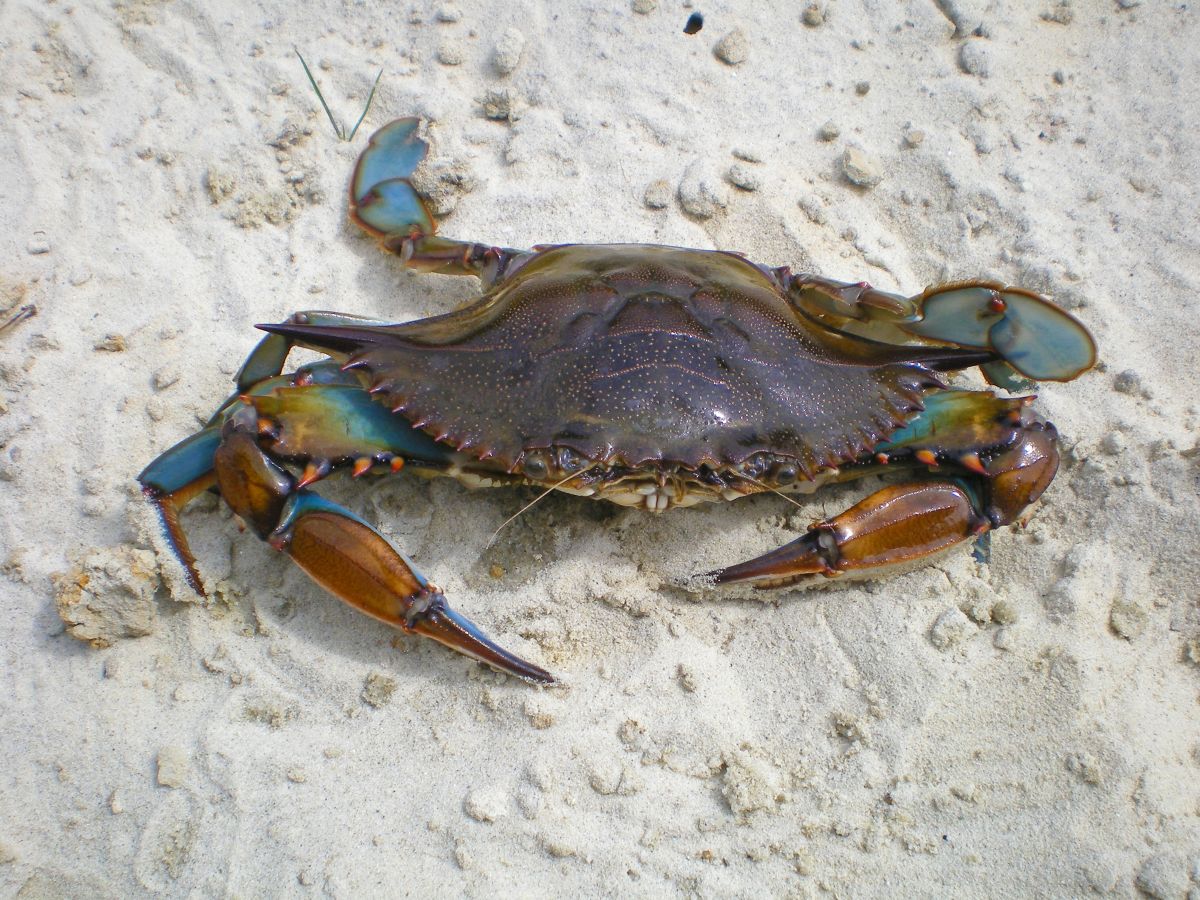
The Division of Marine Fisheries wants to bring the public into the blue crab stock assessment development process.
The division’s stock assessment scientists plan to review what a stock assessment is and how this data set is developed during a WebEx meeting from 6-8 p.m. Thursday, May 28. Register online to attend the webinar or attend the listening location at the N.C. Division of Marine Fisheries Central District Office in Morehead City.
Supporter Spotlight

The Marine Fisheries Commission, which puts in place rules, policies, and management measures for fisheries, adopted the original North Carolina Blue Crab Fishery Management Plan in late 1998, Amendment 1 in 2004, and Amendment 2 in 2013, according to the division’s website. The division, under the North Carolina Department of Environmental Quality, acts as staff to the commission.
A review of the management plan was scheduled for July 2018, but the commission decided in August 2016 to begin a formal review, assess the status of the blue crab stock and identify more comprehensive management strategies, and began developing amendment 3.
As part of that amendment, the division used data from 1995 to 2016 for a benchmark stock assessment, which is a comprehensive assessment conducted every five years by reevaluating data and modeling methods. Results indicate that the state’s blue crab stock was classified as overfished in 2016, according to the division.
The 2018 benchmark stock assessment shows the state’s blue crab stock is overfished, which means that the population size is too small, and overfishing is occurring, or the removal rate is too high.
Amendment 3 was adopted in February 2020 to rebuild the blue crab stock. All Amendment 3 management measures have been fully in place since January 2021.
Supporter Spotlight

The division attempted to update the stock assessment in 2023, but staff and external peer reviewers had concerns with model specifications and the results and decided not to use the update to manage the species.
Existing data from division sampling and monitoring programs indicate a continued decline of blue crab stock.
The division’s stock assessment team is going through data now to develop a new benchmark stock assessment and gave an update to the Marine Fisheries Commission during its business meeting May 14 in New Bern.
Stock Assessment Program Manager Matt Damiano explained that part of his motivation to hold the webinar at this stage in developing the assessment is because a member of the fishing community brought to his attention that historically, the only public-facing part of the division’s process has been the peer-review workshop, when the stock assessment is essentially done.
“This webinar is something of a halfway point to where I would like to go with our stock assessment process, which is to make it more public facing,” he said, adding that he has been planning the webinar for several months.
Damiano said that he and Stock Assessment Scientist Matt Zink, the other member of the program’s team, have made progress on the stock assessment update.
“We have been able to analyze all the sources of data that we’re interested in including in the stock assessment, that essentially involves Matt and I digging through the data and determining whether it is usable and what it is telling us,” he said, adding that they’re using data collected through different programs.
The estimated pattern for 1974 through 2024 has fluctuated quite a bit, as marine populations tend to, and saw the highest abundance during the 1990s followed by a marked decline in blue crab abundance after around 2010.
“There have been some modest increases toward the end of that time series, but overall, there is a negative trend for the last 14 years,” Damiano said.
During the same time, the size of blue crabs in the Pamlico Sound have gotten smaller in general, while blue crab size in Albemarle Sound has been stable.
The fishery-dependent data from fish houses points to the size structure being stable, “which is likely more a function of people bringing a really stable set of sizes of crab to market than it is having to do necessarily what’s going on in the population,” Damiano said.
“Another interesting feature is when we looked at abundance over space, it has declined most in the Pamlico Sound, but the Albemarle Sound is still essentially the one big hot spot for blue crab,” he added.
“If you are fishing in Albemarle Sound, things may seem better than they actually are for the population,” but Damiano stressed that “two things can be true at the same time. You can be doing very well if you’re fishing in a particular area, but the population throughout the whole state can still be moving in a different direction.”
Damiano told the commission that for the webinar May 28 he plans to give a brief review of what a stock assessment is and spend some time on what happened with the peer review of the 2023 updated stock assessment.
“I get a lot of comments on why that did not pass peer review and wasn’t recommended for use and management,” Damiano explained, but those who reviewed the assessment left a “clear roadmap for how to improve it,” he said. “It’s those exact steps that they recommended that Matt and I have been taking with this stock assessment and that’s going to give a lot of context to why we did the analyzes we did, and why we’re considering the methods we are for the stock assessment.”
Damiano added that while the peer reviewers did not recommend the model for use in management, and the division decided to heed that advice, “I think the peer review was actually a success in that sense, because they identified really clear problems that we need addressing in the next model.”
The peer reviewers were Dr. Jie Cao, assistant professor at N.C. State’s Center for Marine Sciences and Technology, or CMAST, and Dr. Yan Li, at Duke Cancer Institute Biostatistics Shared Resource at Duke University.
In an interview before the commission meeting, Damiano, who has been with the division about a year, pointed out that the only opportunity for the public to really engage with a stock assessment during the peer review, which is at the end of the process.
“That’s the only workshop that’s technically open to the public, and so I am trying to change that kind of incrementally as I learn what the communication needs are related to stock assessment. And it starts with this webinar,” he said.
“We’re trying to create a space where we can be transparent about the work that we’ve done so far on the blue crab stock assessment, which is still ongoing, and solicit some feedback from the people,” such as their concerns about population, other sources of data to consider and give the public background for “some of the choices that we’re making while we’re doing the analysis. Really, it’s more just me trying to show my work and begin the dialog where we previously really haven’t had.”
He added that he hopes the webinar opens a line of communication that wasn’t there before.