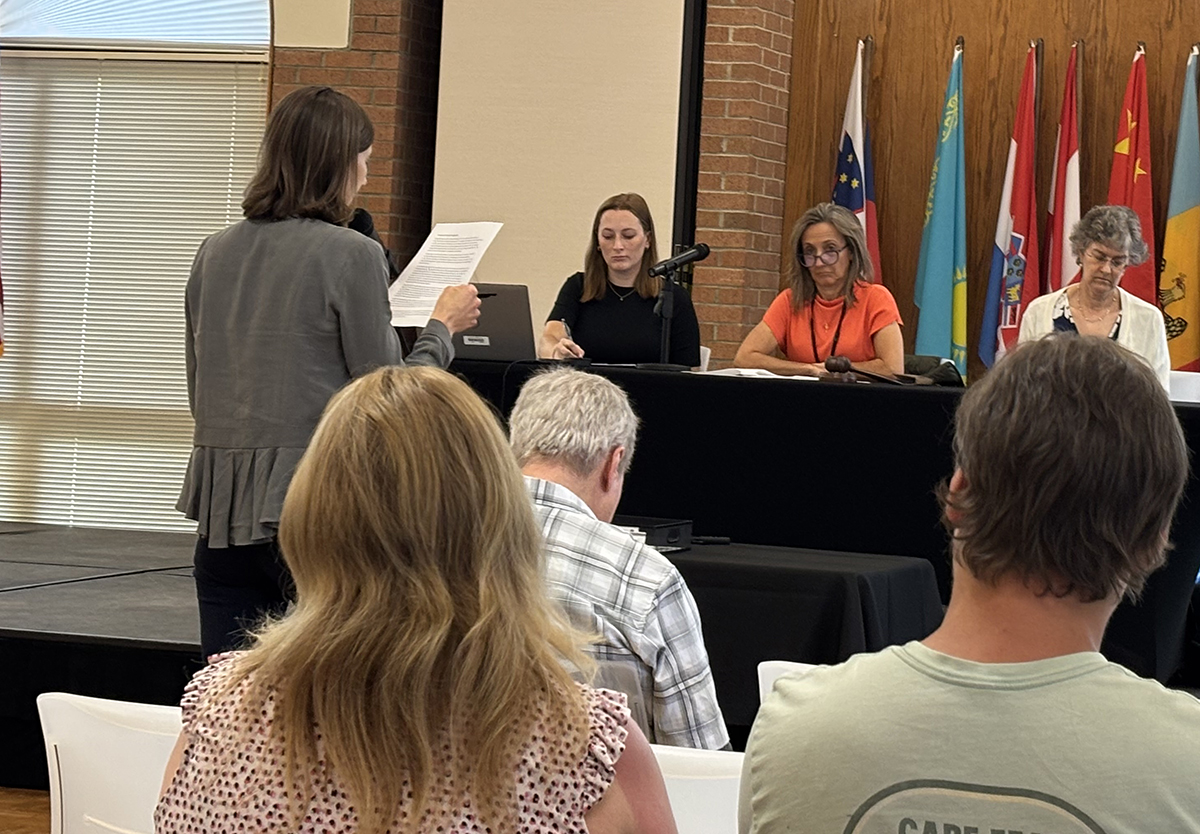
FAYETTEVILLE — Proposed monitoring and minimization rules for industrial dischargers of 1,4-dioxane and the public sewage plants that accept those facilities’ waste fail to protect North Carolinians’ drinking water, speakers at a public hearing said Tuesday.
All but one of the 13 people who spoke at the North Carolina Environmental Management Commission’s hearing at Fayetteville Technical Community College criticized the proposed rules, arguing those rules fall short in reducing the amounts of 1,4-dioxane discharged into people’s drinking water sources and lack enforcement.
Supporter Spotlight

Those comments mirror ones articulated at the commission’s April 9 hearing on the proposed rules in Hickory. A third hearing is scheduled for May 12 in Jamestown.
“The so-called monitoring and minimization rule establishes certain monitoring requirements, but the term minimization is misleading,” Fayetteville resident Madison Williams said. “The way the rule is promulgated is in a way that does not require polluters to reduce PFAS or 1,4-dioxane emissions into North Carolina drinking water supplies, and it imposes no consequences, even if those discharges increase. This in effect is a polluter written rule.”
Related: Public hearings set on proposed wastewater discharge rules
The commission is hosting separate public hearings, the first of which was held in Asheville last week, on a similar rule for per- and polyfluoroalkyl substances, or PFAS; perfluorooctanoic acid, or PFOA; perfluorooctanesulfonic acid, or PFOS; and GenX, a chemical specific to a manufacturing plant that sits near Cape Fear River in Bladen County.
Under the proposed rules, publicly owned treatment works that receive industrial wastewater, and their manufacturer customers, would be required to monitor for discharges of 1,4-dioxane, an industrial solvent, into rivers, creeks and streams.
Supporter Spotlight

Facilities would be required to conduct baseline monitoring every three months for one year. Based on those sampling results, dischargers may be required to conduct additional monitoring.
“If determined to need ongoing sampling the industrial direct discharger will be required to develop a minimization plan,” explained Bridget Shelton with the Division of Water Resources’ planning section. “A minimization plan is a strategy to reduce or eliminate pollutants at the source before they are discharged into the environment.”
Facilities that “meet certain criteria” may request exceptions from ongoing monitoring and minimization plan requirements, she said.
The proposed rules do not set specific discharge limits or penalties for violations.
That fact has drawn sharp criticism from residents, environmental groups and public drinking water providers who have been calling on the state to establish drinking water standards for PFAS and 1,4-dioxane and regulate direct dischargers of those chemicals.
“Over 1 million North Carolina residents consume water from the Cape Fear River, water that is contaminated with 1,4-dixoane, PFAS and other forever chemicals that will continue to proliferate without sufficient regulations at the federal and state levels,” said Jonelle Kimbrough, executive director of Fayetteville-based environmental nonprofit Sustainable Sandhills. “The proposed 1,4-dioxane minimization rules seem to be an attempt at regulation but, as written, they essentially do nothing to protect the natural resources or public health of our state and we need protection.”
Rob Clark, Cape Fear River Watch’s water quality programs manager, said the organization and its more than 1,000 members collectively opposed the proposed rules.
“These rules are completely inadequate when it comes to dealing with PFAS and 1,4-dioxane pollution in the Cape Fear River Basin,” he said. “The proposed minimization rules do not set enforceable limits on how much these toxic compounds can be discharged into our waterways. Instead, they rely on polluters to monitor their pollution and submit plans describing how they might reduce that over time. Do we really think that polluters are going to cut into their profits in order to do the right thing and stop discharging these chemicals into our waterways?”
Representatives of downstream public water suppliers said the proposed rules lack a clear objective to significantly decrease 1,4-dioxane levels in state surface waters.
Fayetteville Public Works Commission’s Environmental Programs Manager Rhonda Locklear pointed out that statewide monitoring has identified 1,4-dioxane primarily in the Cape Fear River Basin.
The North Carolina Department of Environmental Quality, “has sampled surface waters in 15 of North Carolina’s 17 river basins, confirming that most industrial 1,4-dioxane sources are in the Cape Fear River Basin, where 35% of these samples since 2017 were above non-detect thresholds, almost 10 times the rate in the Neuse River Basin, and nearly 200 times that of the Yadkin-Pee Dee River Basin,” she said. “The problem areas are well-defined, documented, and PWC expects DEQ to set meaningful regulations and reductions in the Cape Fear River Basin.”
Cape Fear Public Utility Authority Deputy Executive Director Kevin Morris said that the U.S. Environmental Protection Agency, which classifies 1,4-dioxane as a likely human carcinogen, warns that at even at concentrations of 0.35 parts per billion, long-term exposure to the chemical increases cancer risks to humans and may cause significant kidney and liver impacts.
“Downstream water systems continue to experience periodic spikes in 1,4-dioxane despite having no role in producing or discharging this chemical, which demonstrates the limitations of our current regulatory framework,” Morris said.
He highlighted how effluent from Asheboro’s wastewater treatment plant has periodically tested for elevated levels of 1,4-dioxane, concentrations of which far exceeded levels associated with long-term health risks.
“These discharges flow into waterways like the Haw and Cape Fear rivers,” Morris said. “They’re relied upon by downstream drinking water systems, and they require additional monitoring, treatment, adjustments and customer communication. The downstream public ultimately bears the risk from and the cost of managing contamination that they had no part in creating. Voluntary reduction measures are insufficient to ensure consistent outcomes or to protect downstream communities. Utilities can manage only what arrives at their intake.”
As of Wednesday, DEQ had received more than 2,000 public comments and counting on the commission’s proposed rules for 1,4-dixoane and PFAS, according to Josh Kastrinksy, DEQ’s deputy communications director.
“The comments we’ve received in writing have by and large reflected the comments we’ve received in person,” he said.
Andrew Mlot, chair of the North Carolina Pretreatment Consortium Inc., a nonprofit that represents more than 180 pretreatment professionals in 64 state-approved pretreatment programs across North Carolina, was the only person Tuesday to speak in support of the proposed rules.
But that organization has “several specific concerns” with the rules as they are currently written, he said.
“The costs to treat 1,4-dioxane at the POTW (publicly owned treatment works) level is staggering. Capital costs alone range from $10 million to $1.3 billion, making source control the only practical path forward,” he said.
The proposed rules would require public treatment works in Greensboro, Burlington, Asheboro, High Point and Reidsville, which have been conducting monitoring and minimization activities going back to 2015, to start over, Mlot said.
“We ask for an explicit offramp for POTWs that have already completed successful programs. Replace any detection with a workable screening threshold. As currently written, any detection of 1,4-dioxane triggers ongoing monitoring requirements and a full minimization plan. NCPC members do not believe this is workable. We support an alternative screening threshold based on meaningful concentrations or loading levels,” he said.
DEQ is accepting written comments through June 15. Comments may be submitted by email to publiccomments@deq.nc.gov with the subject heading “1,4-dioxane minimization, or by mail to Bridget Shelton, DEQ-DWR Planning Section, 1611 Mail Service Center, Raleigh, NC 27699-1611.