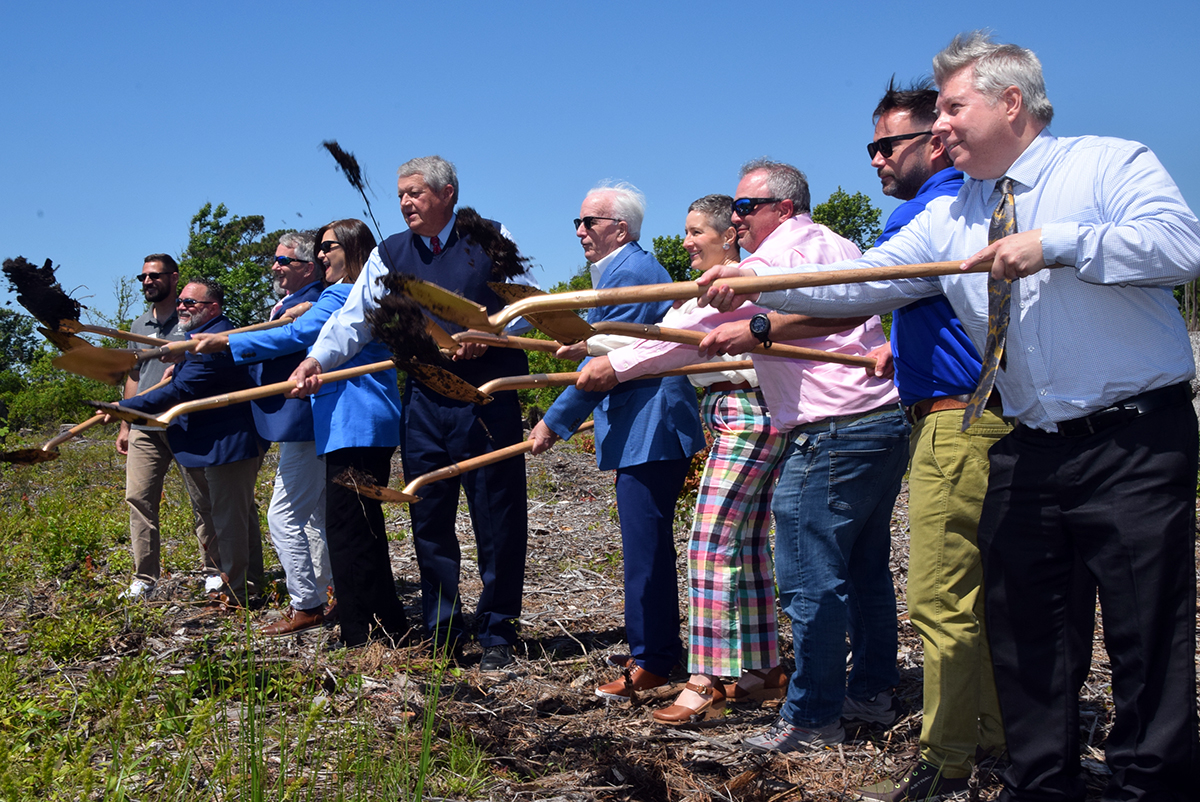
NEAR BEAUFORT — Officials wielded ceremonial gold-painted shovels Monday to break ground on an economic development project specifically tailored to the needs of coastal communities, a plan that one advocate likened to successful technology-incubation hubs but instead intended to support shellfish aquaculture jobs.
When construction begins at the recently cleared site this summer, the Shellfish Mariculture Hub will feature a 2,500-square-foot structure on county-owned land next to the boat ramp at Straits Landing, just across from Harkers Island. The building will be outfitted with cold storage, equipment, an outdoor workspace and crucial water access — shared resources for shellfish growers, officials said.
Supporter Spotlight

Tom Looney of Wrightsville Beach, a former vice president and general manager of Lenovo North America and a longtime board member with Coastal Review’s publisher, the North Carolina Coastal Federation, said he had been involved a decade ago in developing the Economic Development Partnership of North Carolina, which works to recruit new business, assist existing businesses, help companies with international trade, promote the state as a tourist destination and counsel small companies and startups.
“Today, it’s the number one workforce engine in the country for the last three out of four years,” Looney said. “We know how to attract businesses. We know how to create new businesses. What I learned in that role was, some of the most economically challenged regions in our state were our coastal communities. We had to find new ways to create jobs for people to feed their families, grow a business, have opportunity.”
Looney, who was an IBM man for more than 30 years, said that, since 2013, North Carolina’s oyster industry has grown more than 500%. Today, the state boasts one of the fastest-growing oyster industries in the country, generating more than $300 million annually.
“And let me tell you, folks, this hub will set it on fire, as far as North Carolina as a state,” Looney said.
That success will be the result of combined forces, including the shellfish aquaculture program at Carteret Community College, and provide a good return on the investments made by the legislature, the county, the Coastal Federation and others, he said. Looney praised Coastal Federation staff, including Chief Program Officer Ana Zivanovic-Nenadovic for shepherding the project.
Supporter Spotlight
“We’re doing it the right way. We’re creating jobs while protecting the culture and our coastal waters,” Looney said.
He said the mariculture hub would apply the same principle as American Underground, a Google tech hub for startups in Durham, but with oysters.
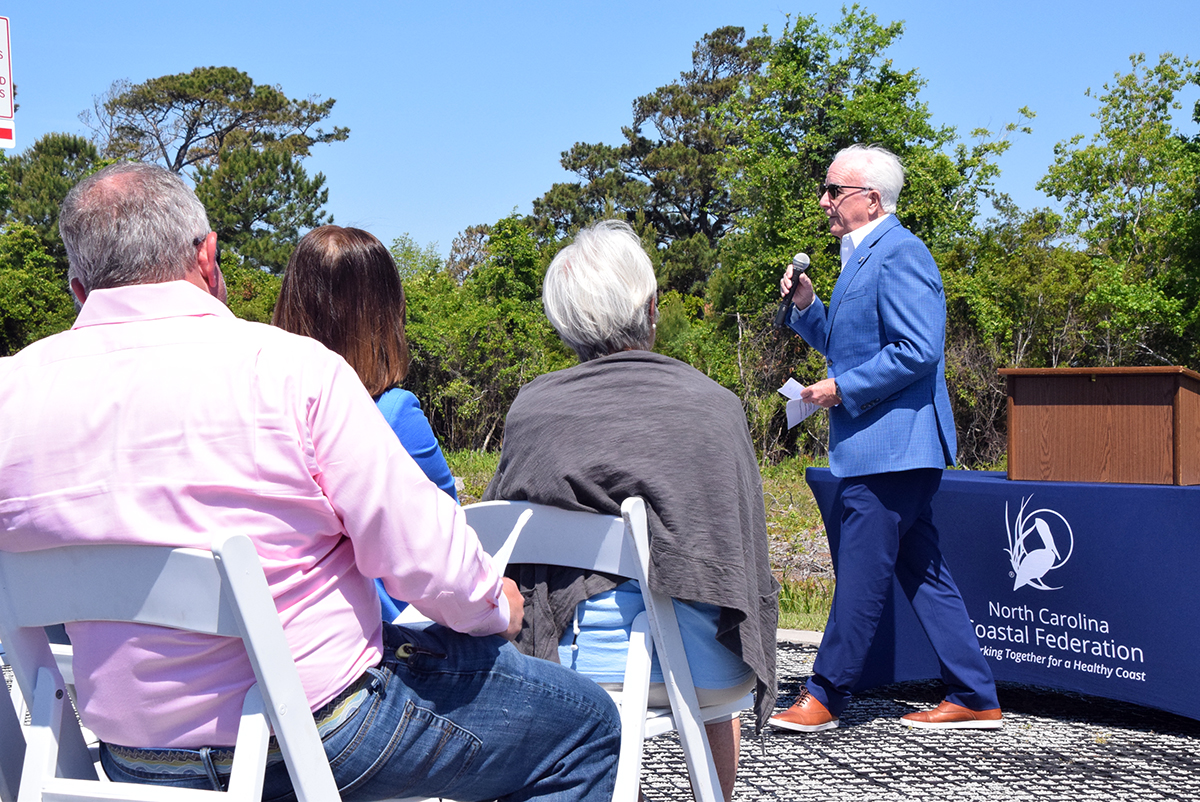
Coastal Federation Executive Director Braxton Davis said the hub project was “about putting down roots for an industry that has been proving its worth in eastern North Carolina and across the country for a long time now.”
Shellfish mariculture, Davis said, combines economic opportunity, environmental benefits and a unique cultural heritage in a way that few other industries can.
“It creates jobs, it supports working waterfronts, and it keeps seafood production local, which is fantastic,” Davis said. “And at the same time, our oysters are out there every day, quietly doing their work, cleaning the water, filtering the water, improving clarity and water quality across the coast. So, that all together is a combined return on investment that you rarely find and few industries can match. It’s driving economic growth while actively improving water quality and protecting the coast.”
Also on hand for the event was Sen. Norm Sanderson, R-Pamlico, and who also represents Carteret, Chowan, Halifax, Hyde, Martin, Warren and Washington counties. Sanderson explained how his district has a “very important role to play in our seafood industry,” as producers and consumers. He noted the move to transfer the Division of Marine Fisheries from the North Carolina Department of Environmental Quality to the Department of Agriculture as part of the Republican-led legislature’s regulatory reform efforts. “Because too many times, it hinders the growth that we could use here on the coast to create jobs and to make our economies more stronger and more prosperous.”
Sanderson described his district’s rankings in the state Department of Commerce economically distressed counties tier system. Under this system, the department ranks the 100 counties’ economic well-being and assigns a corresponding tier number, 1-3. Commerce designates the 40 most distressed counties as Tier 1, the next 40 as Tier 2 and the 20 least distressed as Tier 3.
“I have four counties, five counties that are Tier 1s, which is the most economically distressed counties in the state of North Carolina. And so anything that we can do to help those counties is going to be a blessing,” Sanderson said.
He said the Mariculture Hub was one of the few projects to get legislative support from all corners.
“This one is an easy one to sell, because I think people, first of all, they love seafood,” Sanderson said, adding that he hoped that the project becomes a prototype for others.
“We have over 300 farmers now farming oysters for at least a secondary income. We’re hoping that it will eventually become primary income for them,” he said.
Rep. Celeste Cairns, R-Carteret and Craven, also spoke at the event Monday. She said the project was “a real collaboration among state folks, local folks, and great organizations like the Coastal Federation, and I know I speak for Senator Sanderson as well when I say, when everybody is moving and pulling in the same direction, it is a rare and beautiful thing.”
Cairns said she had been told the total number of leases and franchises was about 500.
“Each of those, whatever the number — it’s a lot and growing — and each of those folks represents a small business or family or an individual trying to make a livelihood on the water.”
The Rocky Mount-based Golden LEAF Foundation, created by the North Carolina General Assembly to award proceeds from the 1998 National Cigarette Manufacturer Settlement Agreement, uses that money to create economic opportunities in rural, tobacco-dependent and poorer counties.
Golden LEAF’s early support and $200,000 in backing in August 2022 helped build momentum for the project. Jason Rochelle evaluates funding proposals for the organization, works to implement Golden LEAF priorities, and oversees project monitoring and compliance.
“At the time, the project represented a strong vision, one rooted in supporting local aquaculture, strengthening coastal economies and creating new opportunities for shellfish growers in the region,” Rochelle said. “Today, it’s incredibly rewarding to see that vision move forward. The shellfish hub is a strategic investment in the future of Carteret County and addresses real needs identified by the shellfish farming community by providing shared infrastructure such as dock access, refrigeration, storage, grading and loading equipment and a central point for distribution. This facility will make a meaningful difference in the day-to-day operations of local growers.”
Rochelle said the hub would serve up to 15 operations and generate around $2 million annually.
“By locating the facilities near the fishing waters, growers will be able to spend more time harvesting, less time on logistics,” Rochelle said. “This increased efficiency will translate to higher production, increased income and the creation of high-quality jobs in this community.”
Assistant Carteret County Manager Matt Reynal said the project reflects “who we are as a county, from Harkers Island to Cedar Island and all across Down East, our connection to the water has always been central to how we live and work. Shellfish mariculture builds on that tradition.”
Reynal said that economic development “isn’t just about bringing in something new or shiny” to Carteret County.
“It’s about supporting the industries that are already here and ensuring that we have the infrastructure to grow,” he said. “That’s why the county was proud to provide this land. We see the long-term value and what this project supports working waterfronts local businesses and innovative opportunity that stays rooted in our communities, and that’s especially important for Down East.”
Chris Matteo, president of the North Carolina Shellfish Growers Association, said that when he was first told of the plan, he “immediately agreed to participate.” He said Coastal Federation founder Todd Miller and Looney had seen a similar model in Australia, and that infrastructure helped fuel a thriving shellfish aquaculture industry there.
“And today we are finally breaking ground on our shared vision. I’m very excited for our local shellfish farmers and for our industry. This is a special day, not just because we are breaking ground on a new building, but because we’re laying the foundation for the next stage of growth in our young industry,” said Matteo. “This project took years of persistence, collaboration and a shared belief that working waterfronts and shellfish mariculture are critically important to North Carolina’s coast.”
The fun part lies ahead, Matteo said.
“This shellfish hub will create job local jobs, support family businesses and keep waterfront communities working on the water. It will do so while helping grow one of the world’s most sustainable and healthy animal proteins, and as if that wasn’t enough, it will also improve our estuaries. Every oyster grown in our waters does more than feed someone. It is filtering water, creating habitat, rebuilding public trust stocks of marine species, and proving that economic growth and environmental stewardship can go hand in hand.”
Matteo said he was especially proud that shellfish farms in North Carolina filter more than 600 million gallons of estuarine water every day.
“This hub will help us grow that number further,” he said. “As a shellfish grower here in North Carolina, I can tell you firsthand, this hub isn’t just a nice to have. It solves real-world problems that growers across the state deal with daily. While shellfish farming has enormous potential, the reality is, starting and scaling a farm is not easy. For many growers, one of the biggest barriers has always been access to waterfront infrastructure.”
For small operations, the costs can be terminal.
“Shellfish farmers haven’t been limited by demand or ability,” Matteo said. “They’ve been limited by not having a place to work on the water, the equipment to process and refrigerate their product and an efficient way to get it to market.”