For the past year, lifelong Carteret County resident Shannon Adams has been using the skills he’s built through his career in technology to digitize about five decades of the local newspaper for the county’s public library system.
He never expected that by taking on this volunteer project to get editions of the Carteret County News-Times from between 1963 and 2012 from microfilm to the computer screen would lead to a connection between his alma mater, Appalachian State University, and his hometown of Beaufort.
Supporter Spotlight

The News-Times has always been a part of Adams’ world. As a child, he said his mother would take him to the store to buy the most recent newspaper for herself and a treat for him.
“That’s kind of how I learned to read. Mom always had it on the table, and it just stuck with me for years. Even when I was away for school, I subscribed to the News-Times,” Adams said. “I think my whole life I’ve always been into local news.”
Adams said that as he got older, he started digitizing whatever media he could: family photos, yearbooks, old film, and home movies.
When he decided to take on the project to digitize the library’s microfilms, Adams recruited a friend also in the technology field, Kris Pettijohn, who resides in Minnesota.
Pettijohn, who told Coastal Review that he has an interest in preserving local history and records, came up with a way to digitize the microfilm using a camera and backlight setup, rather than using expensive commercial scanning equipment.
Supporter Spotlight
“A lot of it was trial and error, but it made large-scale digitization much more practical and affordable,” Pettijohn explained.
Once the digital copies were in front of Adams for processing and organizing, he said he would often find himself going “down rabbit holes” while looking through these decades-old editions.
One night in May of last year during one of these deep dives, Adams read a May 1977 article about five visitors from App State who spent a few days in Beaufort to record interviews with notable residents, including the late Grayden Paul, Shirley Babcock, Jean Kell and Eugene Pond, for the Appalachian Oral History Project. The project was launched in 1973 to collect oral histories from residents in Watauga, Avery, Ashe, and Caldwell counties.
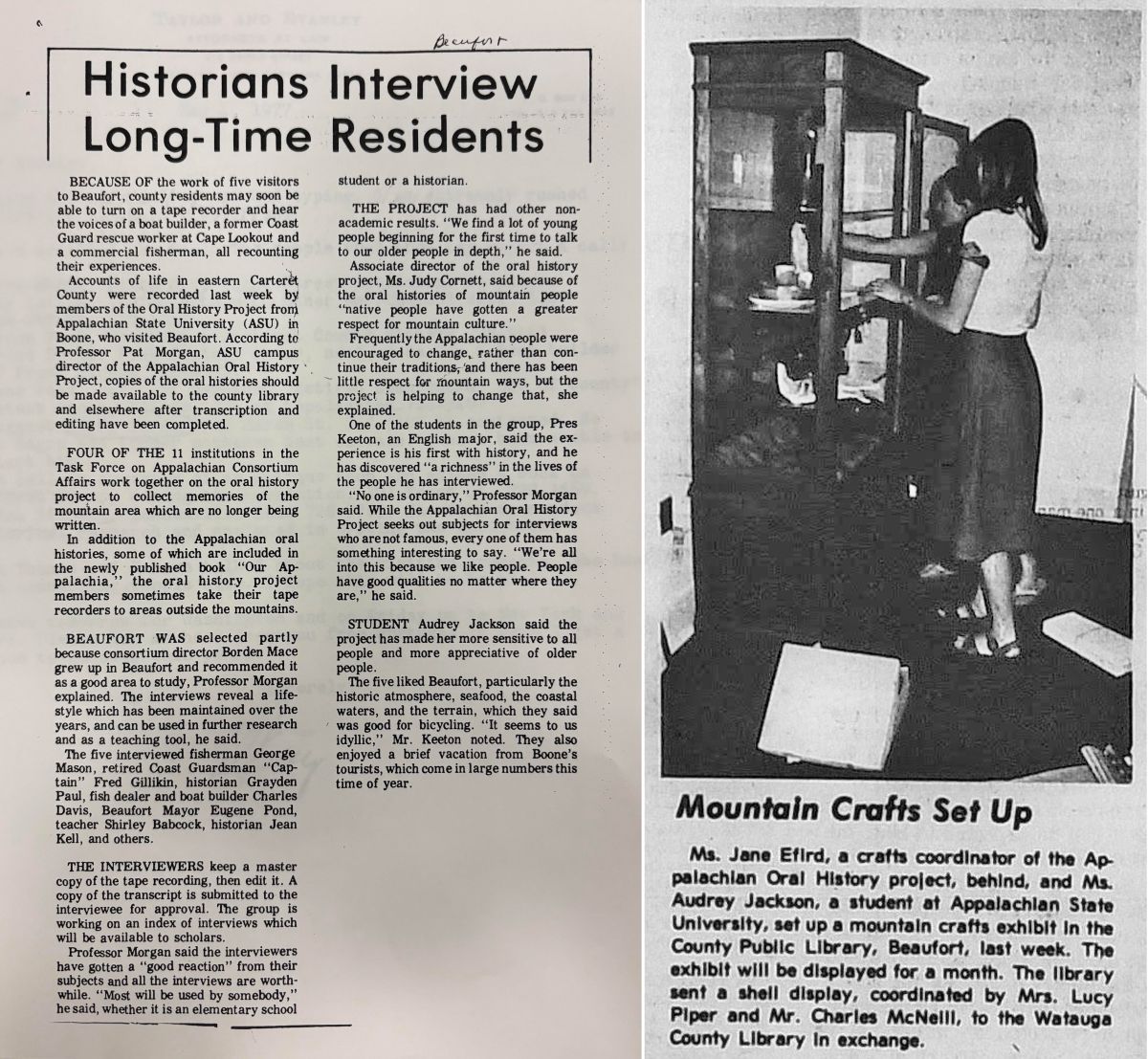
According to the article, the professor directing the project, Pat Morgan, was encouraged to go to Beaufort by Borden Mace, who was executive director of the Appalachian Consortium. No longer in operation, the consortium operated from 1970 to 2004 to preserve the region’s heritage.
Mace “grew up in Beaufort and recommended it as a good area to study,” Morgan explains in the article. Adding that the interviews with the town’s residents “reveal a lifestyle which has been maintained over the years and can be used to further research and as a teaching tool.”
Adams, who graduated from App State in 1993, immediately shared the article with fellow alum Karen Willis Amspacher, because “Karen and I have always connected over Appalachian because there aren’t many people in Carteret County who went there.”
Amspacher, a 1981 graduate, is executive director of the Core Sound Waterfowl Museum and Heritage Center on Harkers Island, and she encouraged Adams to find out what he could about those oral histories.
Adams then contacted the university and was connected to Mark Coltrain, an oral historian for the campus’s Special Collections Research Center.
Coltrain told Coastal Review that he was aware of the trip that Morgan took with his assistant and students to Beaufort in May 1977, because he had stumbled on some paper files about the visit in the project’s physical collection while researching another topic several years ago.
He later learned that the trip was at the behest of Mace, who “was inspired by the oral history project’s focus on documenting the memories, experiences, and traditions of rural mountain folks and wanted Morgan to explore a possible partnership that might initiate a counterpart of sorts in rural Carteret County,” he continued.
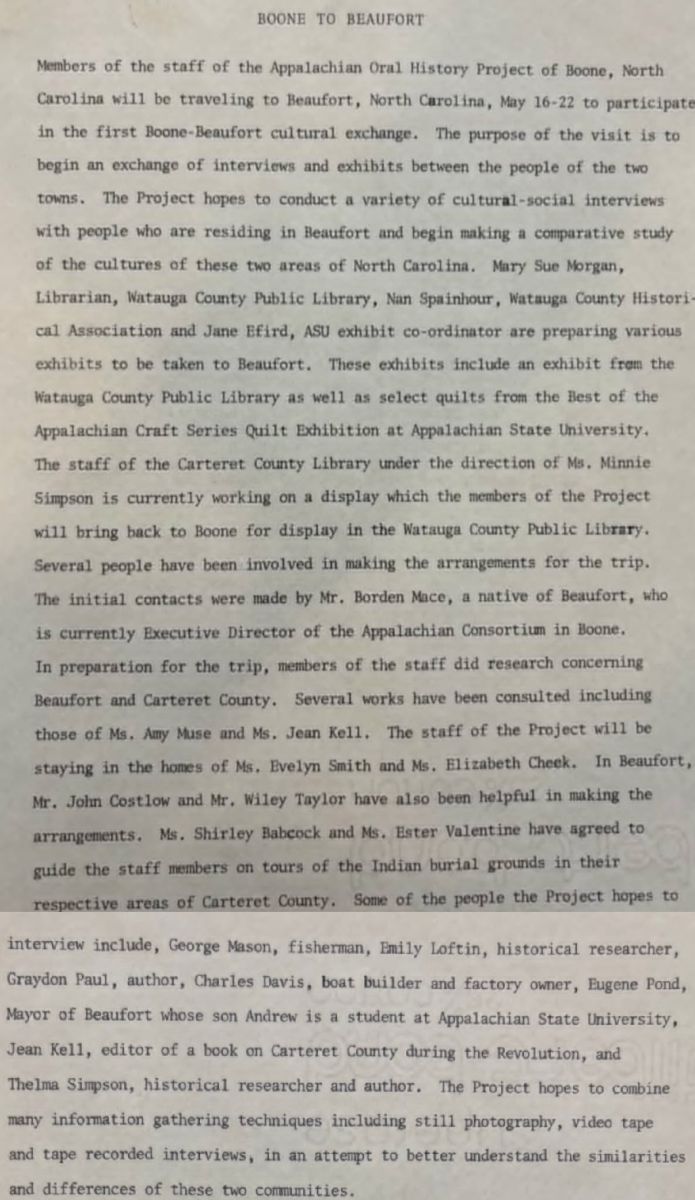
Another clue about the trip was found in the proposal, “Boone to Beaufort,” that had been stored in the archival collection, which Coltrain shared: “The purpose of the visit is to begin an exchange of interviews and exhibits between the people of the two towns. The Project hopes to conduct a variety of cultural-social interviews with people who are residing in Beaufort and begin making a comparative study of the cultures of these two areas of North Carolina.”
“It appears that ‘the Project’ never took off after that initial excursion but we are left with a small collection of fascinating, rich recordings documenting the experience. The recordings are a combination of tours the Appalachian State group took with local guides and oral history interviews they conducted with local residents,” Coltrain continued.
Coltrain was looped into the email conversation between Adams and the university archivist in May 2025, giving the 1977 trip even more significance.
“I recalled the documents I had seen previously. I dug a little deeper and soon found recordings from the trip.” He shared those finds with Adams, prompting his first visit to the research center.
Adams and his wife Cecilia, also an App State graduate, headed to the mountains in the following month to listen to the recordings and said he “was just blown away,” by the interviews. They returned to Boone a few months later with Amspacher.
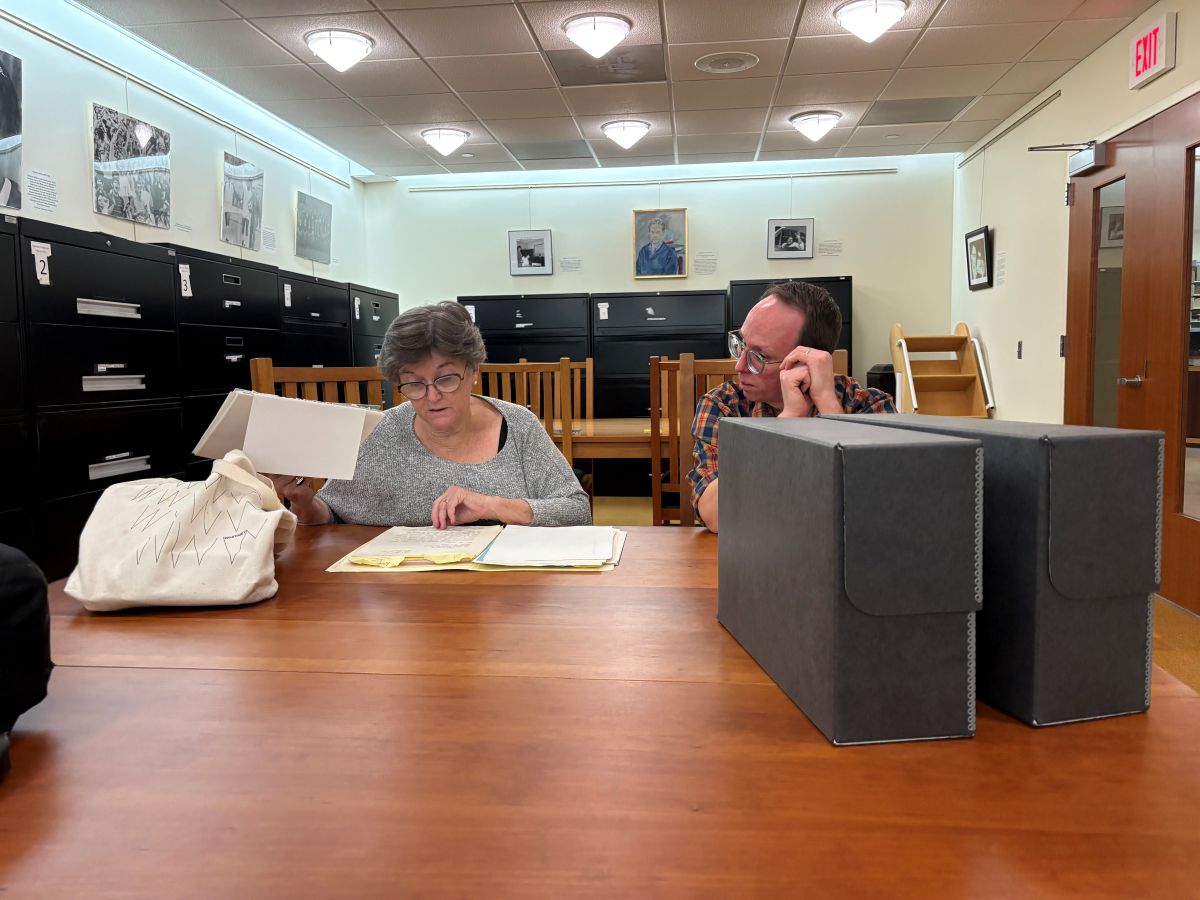
In the time since, Coltrain has been working to transfer the physical recordings to Core Sound and has been able to track down one of the five visitors to Beaufort, Audrey Jackson McGee, and connected her with Adams and Amspacher.
McGee, who grew up outside of High Point and lives in Vale now, attended the university from 1974 to 1979, and was in the same work-study program as Amspacher. That’s how McGee ended up in Beaufort with a few other students, Morgan, and another staff member.
While McGee remembers the trip, she said she doesn’t remember all the details. Memories that stick out are setting up the cultural exchange exhibit in the county library and staying in “one of the beautiful historic homes on the water.”
One aspect she found interesting about the project was being able to meet Beaufort residents and to hear about their lives, “about things that were so different from my own experience.”
McGee has revisited the recordings since being Coltrain contacted her, and it “has been wonderful to be able to hear those and some of the people that we met there.”
Coltrain said Adams’ “excitement at hearing some voices of people important to the history of Carteret County was palpable and contagious. These recordings had not been heard in years. It wasn’t long after Adams’ first visit and then his follow-up visit with Karen Amspacher in October 2025 that I knew these recordings should go back ‘home.’”
Amspacher knows more than most about the Appalachian Oral History Project. Her work-study assignment was to listen and transcribe the recordings, and it’s a large part of why the museum has such a sizable oral history collection.
During her first semester on the Boone campus in 1979, she worked “in this little white house” where the Appalachian Consortium was located, “and my job was to transcribe on an old IBM Selectric with headphones and foot pedals these oral histories from the mountain people.”
After about the third one in, she said she thought about home and wondered why oral histories weren’t being recorded in Carteret County.
“Oral histories are important on so many levels. It’s not only the information, but it’s the voices, it’s the time period they represent,” Amspacher explained in an interview. Adding that her top priority at the museum is oral history, and that is because of Appalachian State University and her work with the Appalachian Oral History Project.
Now, the Core Sound museum has more than 600 oral histories in its collection “and I don’t know if we’d have that if I hadn’t going to Appalachian and had that job,” she said. The museum has invested a lot of time, work, and grant money to build the collection because oral histories offer a perspective that documents or artifacts can’t.
To welcome the recordings that will grow the museum’s collection even more, Core Sound is holding an evening program Tuesday to talk about the chain of events leading to these recordings becoming part of the museum’s collection. The covered dish dinner starts at 6 p.m. and Coltrain and Michelle Moriarity Witt, Core Sound’s digital archivist, are to lead the program that begins at 7 p.m.
The museum has the recordings available online now and will be receiving the collection from Coltrain when he arrives for the program.
Amspacher and Adams both have been reaching out to the family members of the people who were interviewed to invite them to the special evening. They are encouraging anyone related to or interested in these recordings to come out to the museum for the special program.
They also contacted this reporter, a 2002 App State graduate and previously with the News-Times, to explain the chain of events.
Coltrain said working with and getting to know Adams and Amspacher has been a highlight.
“It is a real pleasure to connect with people so passionate about their community’s history and reinforces why I’m in this field. The fact that they are both Appalachian State alumni is icing on the cake,” Coltrain explained.
“As a steward of Appalachian State’s oral history collections, ensuring historical materials are in the community where they belong through methods like cultural repatriation is an important value that I take seriously,” Coltrain explained.
“The Core Sound Waterfowl Museum made sense to me as the organization where these materials should go because of Amspacher’s recognized work preserving her local community’s history through methods like oral history. Amspacher’s work, the work of the Appalachian Oral History Project half a century ago, and the continuing work of collecting and preserving oral histories at Appalachian State feels linked in a cosmic way that is impossible to ignore. I am honored to have a role in making these historical connections stronger and these voices more accessible to the community and the world.”