Guest Commentary
To stimulate discussion and debate, Coastal Review welcomes differing viewpoints on topical coastal issues.
When I was a little kid, my aunt used to point to the foam washing up on the beach and tell me it was whale poop. I wasn’t sure I believed her. I kept a cautious distance from the foam, just in case, but the idea stuck with me.
Supporter Spotlight

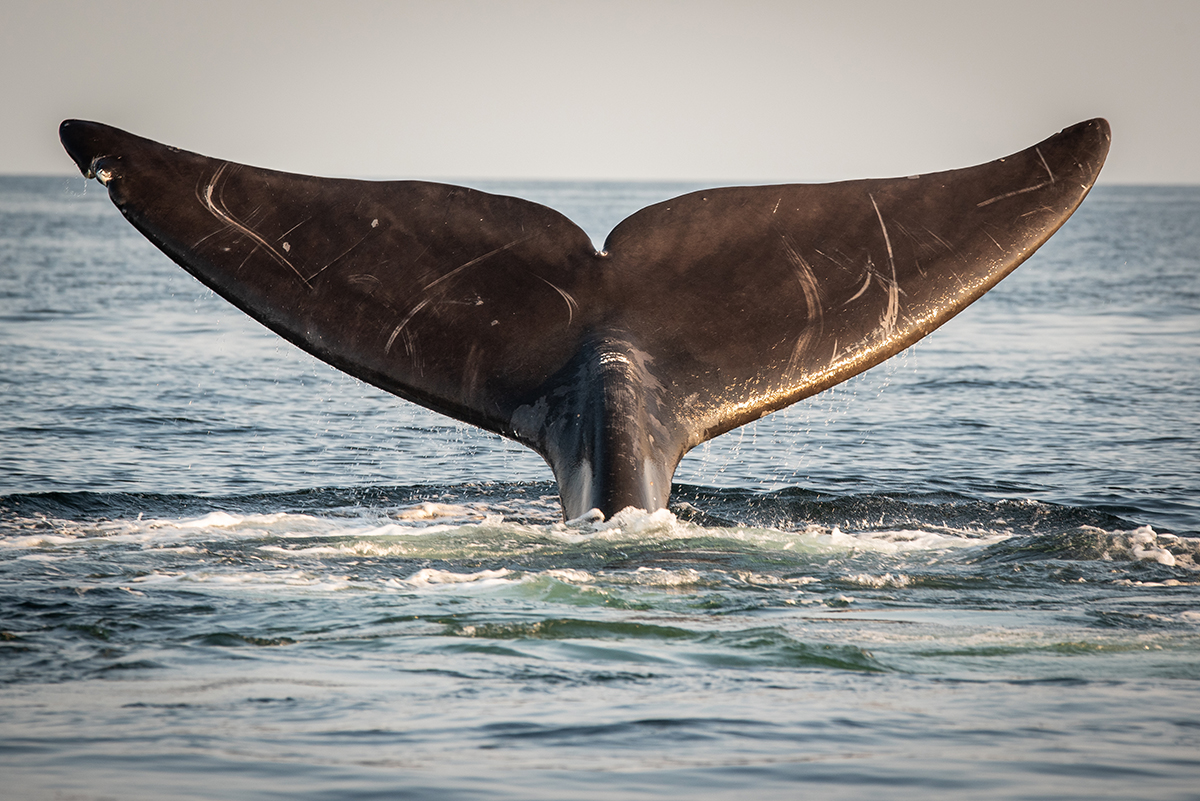
Sea foam, of course, isn’t whale poop. She knew that. But years later, I learned that my aunt wasn’t entirely off in spirit: Whales really are ecosystem giants, fertilizing the sea and fueling the plankton blooms that support everything from the fish we catch to the oxygen we breathe. Remembering that early sense of wonder now, it’s impossible for me to look at the decline of one species, the North Atlantic right whale, with anything but urgency.
These gentle giants called our North Carolina waters home long before our coastal towns had names. Today, though, these critically endangered whales are facing a crisis they can’t outswim — and a recent move by the federal government threatens to make a dire situation even worse.
Lethal cost of speed
On March 4, the National Oceanic and Atmospheric Administration (NOAA) issued an advance notice that it is considering deregulating the very rules designed to protect these endangered whales from boat strikes.
North Atlantic right whales are particularly vulnerable to ship strikes. They spend long periods near the surface, and they are hard to spot because they are dark in color and lack a dorsal fin.
The problem is simple but deadly: The faster a vessel is moving, the greater the chance that a collision will injure or kill a whale. Even a strike from a midsize boat can be fatal. And these impacts can be dangerous and devastating to boaters as well, including sinking boats and injuring passengers and crew.
Supporter Spotlight


That’s why in 2008, NOAA issued the Vessel Speed Rule. It established two types of management tools to slow large boats and protect North Atlantic right whales from boat strikes. First, the rule required boats 65 feet or longer to slow down to 10 knots in Seasonal Management Areas (SMAs) where North Atlantic right whales are expected to be present. Second, the rule established a voluntary speed limit of 10 knots in Dynamic Management Areas (DMAs), which are triggered by North Atlantic right whale sightings and acoustic detections. Off North Carolina, the SMA near Cape Fear is active from Nov. 1 through April 30 — the months when North Atlantic right whales migrate through our waters on their way to calving grounds farther south. The rule was designed to reduce the risk of collisions. Studies suggest boats traveling under 10 knots are less likely to kill North Atlantic right whales should they collide.
These seasonal protections cover a narrow window of time, but they align with when whales are expected or detected, and they remain one of the few safeguards the species has as it moves through some of the busiest shipping and recreational boating corridors on the East Coast. It’s a proven strategy. It works.
Mirage of technology vs. proven solution
Despite this, NOAA’s recent notice suggests that mandatory speed limits could be replaced with “advanced, technology‑based, strike‑avoidance measures.” While innovation is welcome, there is currently no technology proven to protect these whales at the scale and speed of East Coast boat traffic.

Relying on unproven technology while weakening mandatory speed limits is like removing a school zone speed limit because we hope one day cars will have better sensors. The only practical, proven, and scalable measure to protect right whales, particularly when they are migrating with their new calves, is the Vessel Speed Rule.
There are plenty of ways to strengthen the rule now, including updating the times and areas of speed zones to align with the whales predicted path today – not what it was in 2008, all speed zones mandatory, and including smaller boats in the protections. But to weaken or eliminate it all together will only hasten this species’ extinction. We cannot take away one of their best chance of survival.
More than just a whale: an ecosystem giant
The case for protecting right whales isn’t only about compassion for an endangered species. It’s also about safeguarding the health of the Atlantic. North Atlantic right whales act as ocean engineers, cycling nutrients as they migrate along the East Coast, which fuels the growth of phytoplankton, or plant-like organisms in the ocean.
The public comment period for NOAA’s proposal ends June 2. This is an opportunity for coastal communities to speak up about the value of our marine heritage. Instead of deregulating boat traffic and exposing North Atlantic right whales to more risk as they struggle to survive, NOAA should build on its past work and propose meaningful improvements to the current rules that protect these whales. Oceana urges NOAA to make demonstrable improvements in its whale risk strategy such as realignment of slow zones, inclusion of more boat types, and improved enforcement. Submit your substantive public comment to the Federal Register.
This plankton does more than just produce half of the world’s oxygen, it forms the base of the food web that supports our local fisheries and the vibrant marine life that draws millions of visitors to North Carolina’s beaches. Protecting whales means protecting the biological engine that keeps the Atlantic alive and fishy.
When I think back to those childhood days on the beach with my aunt, I’m pretty sure she wasn’t trying to teach me anything profound about the ocean. She was probably just teasing me, the way adults do with kids who take everything a little too seriously. But the joke stuck, and so did the feeling that the ocean was full of mysteries bigger than I could understand.
Now, years later, I know that whales really do shape the ocean in ways that are just as surprising as anything she could have made up. Losing them would mean losing far more than a species. It would mean losing a piece of the ocean that shaped us — the same ocean where I learned wonder, caution, and responsibility long before I had the words for any of it.
We have a choice now. We can let the North Atlantic right whale slip quietly into memory, or we can act with the urgency this moment demands. Defending and strengthening the Vessel Speed Rule is one of the simplest, most effective steps we can take to protect these whales and the ecosystem they support.
My aunt may have been wrong about the foam, but she wasn’t wrong about the ocean. Everything out there is connected — and right now, the North Atlantic right whales are depending on us.
Opinions expressed by the authors are not necessarily those of Coastal Review or our publisher, the North Carolina Coastal Federation.