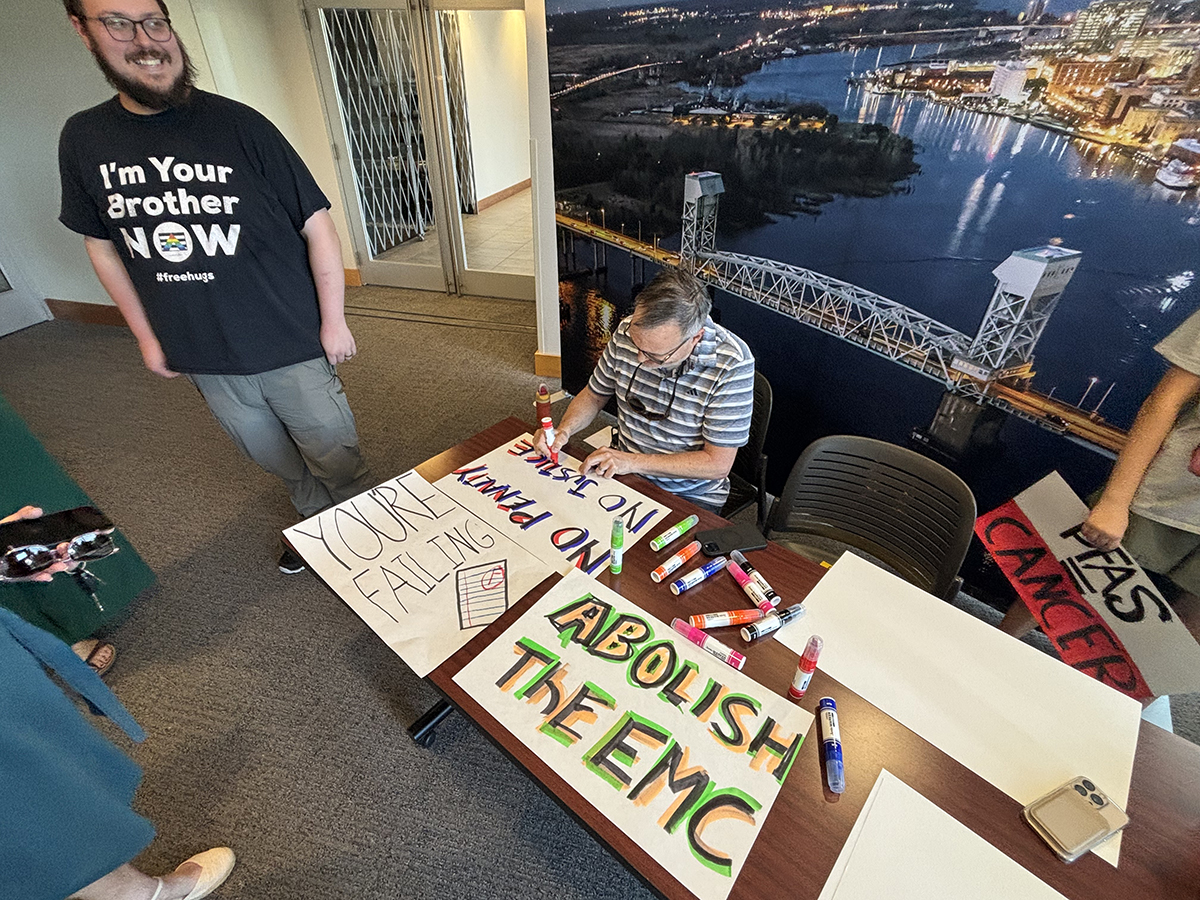
WILMINGTON – For more than two hours, residents in an area considered ground zero for PFAS contamination in North Carolina passionately, often angrily, chastised the Environmental Management Commission’s proposed PFAS monitoring and minimization rules.
Dozens of people who signed up to speak – 60 in all – at the public hearing Thursday in downtown Wilmington took turns at a podium unleashing what turned into a collective no-holds-barred rebuke of the proposed rules and, at times, the commissioners who pushed them forward for public comment.
Supporter Spotlight
Several of those who spoke in front of a crowd of about 230 people who filled a room in Wilmington’s Skyline Center shared stories about their own health issues, illnesses their loved ones have suffered, and family and friends they’ve lost to various forms of cancer.
Throughout the hearing, people snapped their fingers, signaling their agreement with those speaking at the podium. At the close of every short speech, the audience erupted in rousing applause and cheers.
The sheer number of people who signed up to speak prompted Environmental Management Commissioner Yvonne Bailey, the hearing officer that evening, to ask that residents limit their comments to two minutes.
“Those of us living here have advocated relentlessly at the local, state and federal level, and even at the U.N. for protection of our air and water,” said New Hanover County resident Priss Endo. The North Carolina Department of Environmental Quality “has proposed new surface water standards, but in response, the Environmental Management Commission is proposing regulations that will still allow 500 industries across the state to release PFAS chemicals.”
The hearing last week was the third and final the commission scheduled this year on its proposed monitoring and minimization rules for per- and polyfluoroalkyl substances perfluorooctanoic acid, or PFOA; perfluorooctanesulfonic acid, or PFOS; and a branded compound called GenX developed by DuPont spinoff Chemours. The commission has also been hosting public hearings on similar proposed rules for the monitoring and minimization of 1,4-dioxane, an industrial solvent and likely human carcinogen that has also been found in downstream drinking water sources.
Supporter Spotlight

PFAS are a mixture of chemicals used in a host of consumer products from nonstick cookware and food packaging to stain-resistant carpets, water-repellant attire, and makeup.
These chemicals have been found in numerous drinking water sources in North Carolina and traced back to discharges from industrial manufacturers, landfills, firefighting facilities and publicly owned treatment works that accept industry effluent.
Ongoing research into human health effects of PFAS, of which there are more than 15,000 related compounds, have found that some of the substances, including PFOA and PFOS, have been linked to health issues such as weakened immune response, liver damage, low infant birth weights, and higher risk of certain cancers.
Nearly a decade has passed since residents in the Lower Cape Fear region first learned through a local newspaper article that Chemours’ Fayetteville Works facility in Bladen County had for decades knowingly discharged PFAS directly into the Cape Fear River.

Since then, public drinking water utilities that pull raw water from the river have spent millions of dollars upgrading their facilities with filtration systems and methods to keep PFAS out of their final product.
Chemours, under a 2019 consent order, has had to test thousands of privately owned drinking water wells for contamination.
“The 2019 consent order was a start,” resident Jim Nesbit said. “It’s not enough. Your mission is to protect the health of the people of this state. Use the full authority you have to take on the pollution of corporations.”
The PFAS monitoring and minimization rules the commission agreed to put out for public comment have remained under a hail of verbal fire from residents, the public utilities that provide their drinking water, and environmental organizations throughout the Cape Fear region.
As written, the rules do not set specific discharge limits or penalties for PFAS dischargers found to be in violation of those rules.
“As a 33-year water professional and former EMC member, I am testifying that the voluntary minimization plans, as proposed, are ineffective,” Cape Fear Public Utility Authority Executive Director Ken Waldroup said Thursday. “They’re essentially empty facades that do not solve the problem. These minimization plans do not remove PFAS from the Cape Fear River because all reductions are voluntary. Voluntary plans are simply ineffective. Upstream dischargers have had decades to disclose and minimize their PFAS discharges. Unfortunately, history has shown that dischargers only do so in response to effective regulation with specific mandatory limits or mitigation.”
Dr. LeShonda Wallace, who serves on the advisory board for the GenX Exposure Study, one that is measuring GenX and other PFAS exposure in area residents, said the proposed rules ignore science.
Instead, the proposed rules prioritize corporate convenience over public health, she said.
“The impacts are also economic as well as generational,” Wallace said. “PFAS contamination reduces property values, and it shifts the cost away from the polluters and on to the rate payers. Environmental protection and justice requires that those who cause the pollution pay to prevent it and that they pay to clean it up, and I urge the commission to reject these ineffective minimization rules and adopt enforceable, evidence-based standards that reduce pollution at the source.”
Lifelong New Hanover County resident Chip Jackson carried a doll baby with him to the podium.
“I came here tonight to tell this panel how ignorant I have been. I’ve been ignorant because nine years ago I trusted you people. I trusted you to do something,” he said. “I’ll give y’all a pro tip. When you see a baby float by in a stream, you look upstream to see who threw it in the stream.”
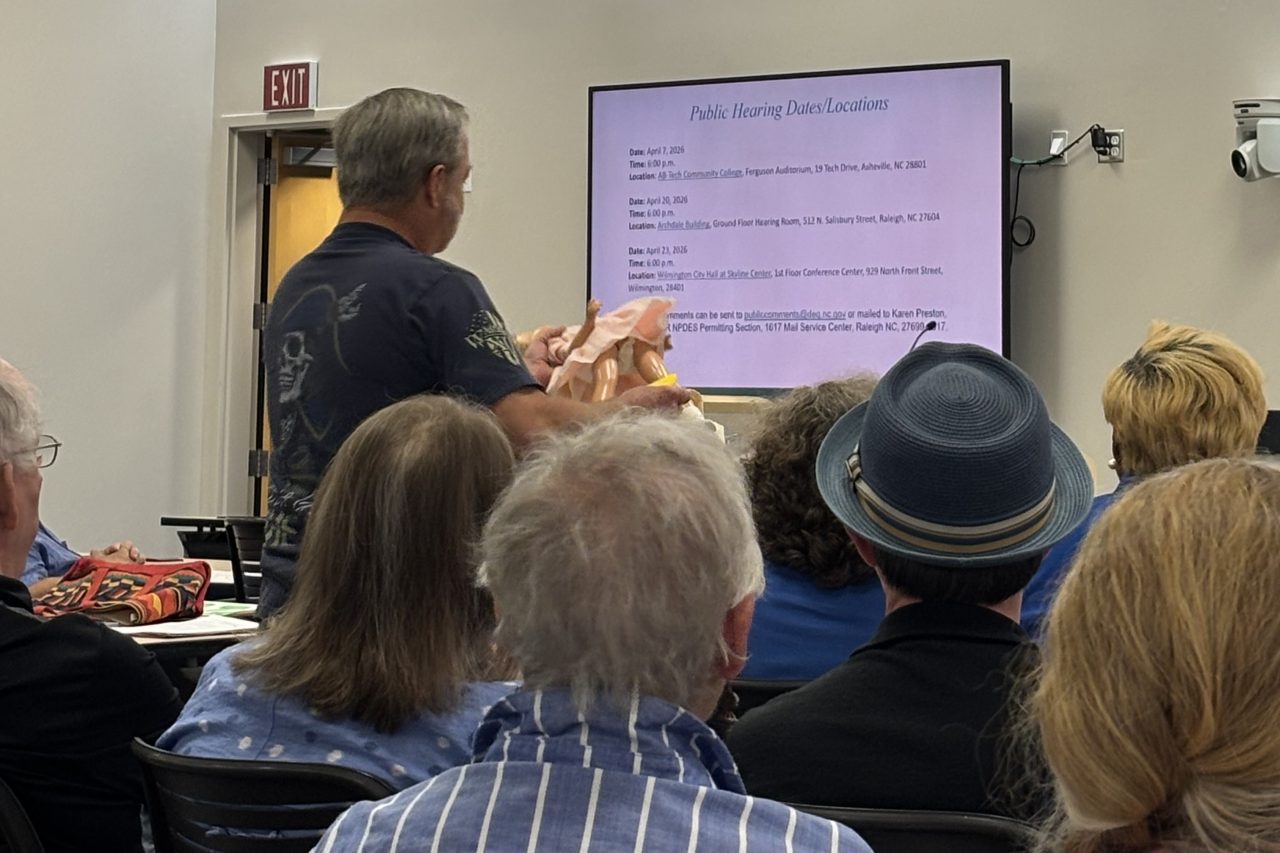
Resident Rosemary Schmitt said she simply wants to trust that the water coming out of her tap is not harmful.
“Drinking water should be safe, not something that comes with a list of side effects,” she said.
Just two weeks away from graduating with an undergraduate degree from the University of North Carolina Wilmington, Tyler Raines said he was in a conundrum.
“I don’t have much else to say that hasn’t already been said about the economic, environmental, and social impacts of PFAS on the health of all human beings,” he said. “As I think about where I’m planning to root myself post-graduation, I find myself at a loss. Do I stay here in Wilmington and get poisoned by PFAS or do I go back to my home in Fuquay-Varina and get poisoned by 1,4-dioxane?”
The Environmental Management Commission could decide as early as September to approve or reject the proposed rules. If adopted, those rules would go to the Rules Review Commission for final approval by early next year.
Written comments on the proposed PFAS monitoring and minimization rules are being accepted by email to publiccomments@deq.nc.gov with the subject title “PFAS minimization” or by mail to Karen Preston, DEQ-DWR NPDES Permitting Section, 1617 Mail Service Center, Raleigh, NC 27699-1617.