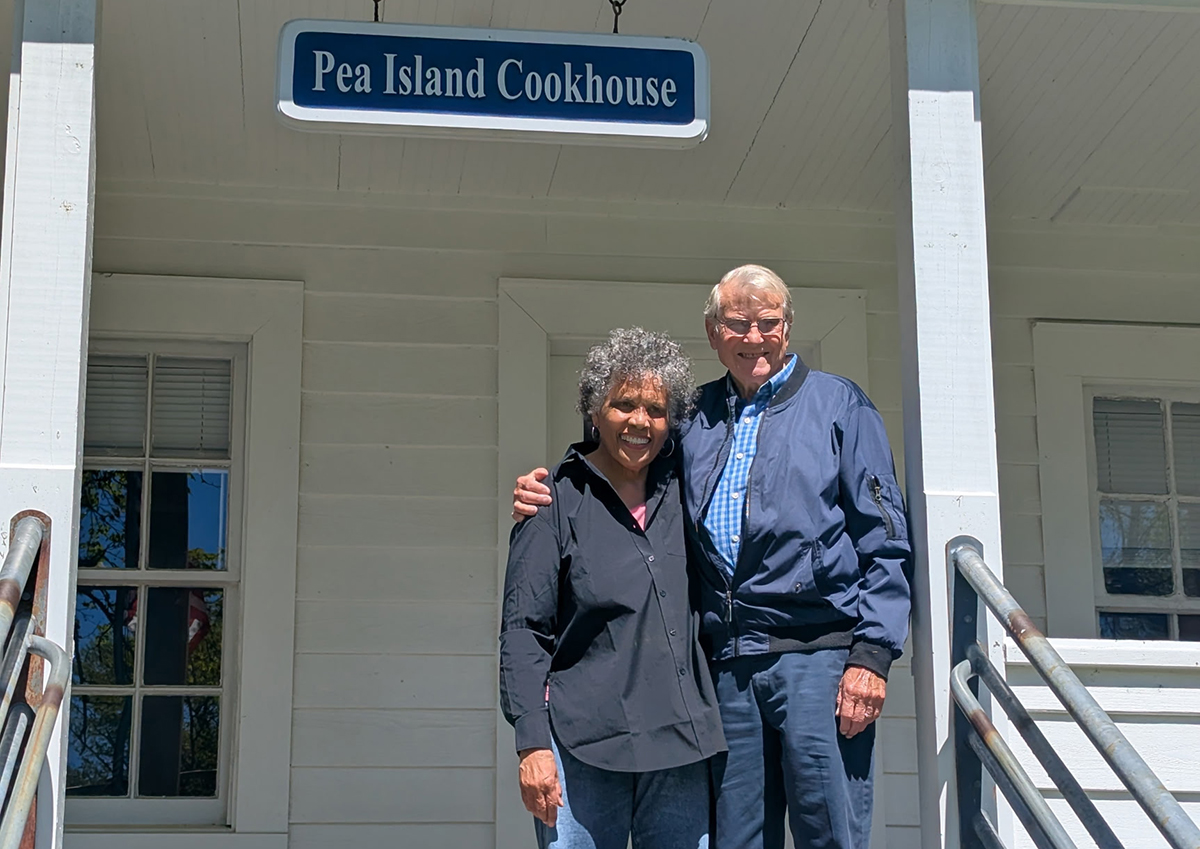
PEA ISLAND — Recently I had the pleasure of giving Johnnie Van Willis a tour of the historic Pea Island Cookhouse museum. Johnnie traveled to the museum from his home in Marshallberg, a historic fishing community situated on a peninsula in Carteret County and directly along the shores of the Core Sound.
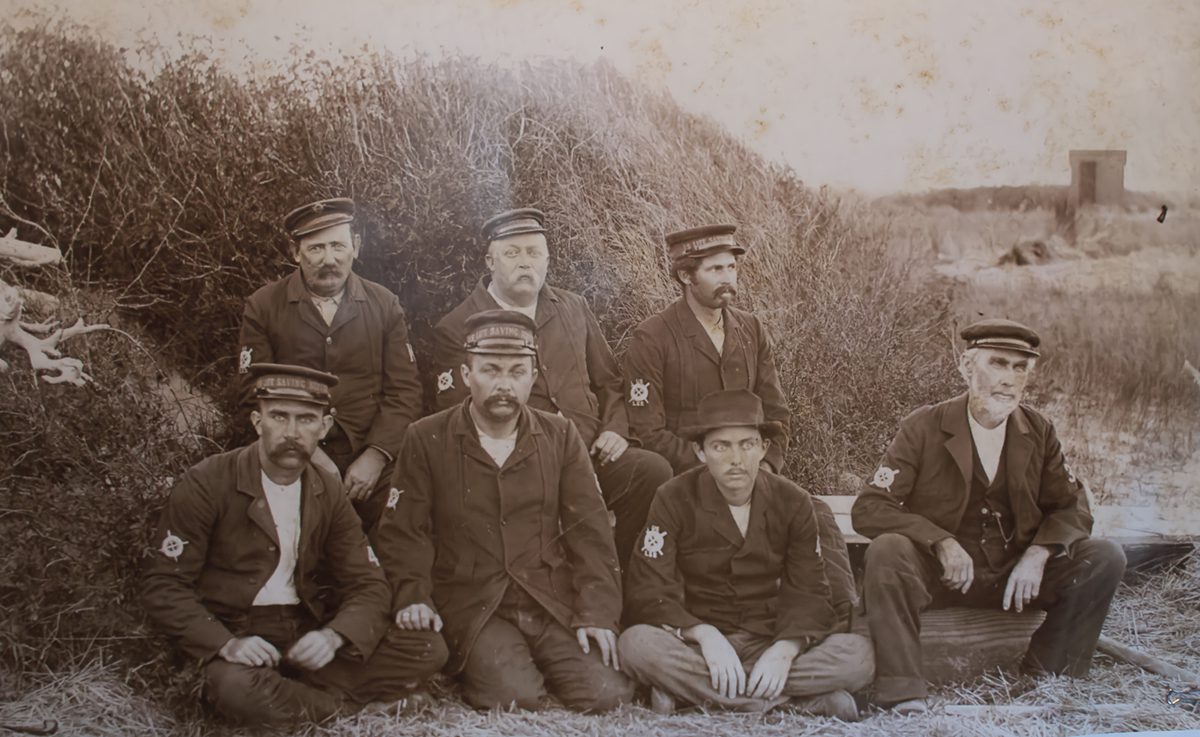
Marshallberg has been characterized as a sleepy, close-knit village with a rich history of commercial fishing, boatbuilding and family heritage. Johnnie’s great-grandfather was Isaac Van Willis Sr. He’s the surfman sitting in the middle top row in the only known photograph of a “Checkerboard Crew.” This term was used in the U.S. Life-Saving Service, the predecessor to today’s U.S. Coast Guard, to identify racially mixed surfmen crews, crews with both Black and white surfmen, like a checkerboard.
Supporter Spotlight
In March 2023, a painting depicting this image was unveiled at the College of the Albemarle – Dare County Campus. Both the photograph and painting are on display at the “Cookhouse,” the shortened name for the museum housed in what once was a building in which surfmen cooked and ate their meals.
As background, Johnnie shares both his middle and last name with his great-grandfather and grandfather, Isaac Van Willis Sr. and Isaac Van Willis Jr. In spring 2018, Johnnie took a road trip with his wife and daughters in search of his great-grandfather’s grave. Through a friend, he had learned it was somewhere near the Marshall and Gussie Collins Trail, a trail named after my grandparents at the Collins homestead. They were part of a small and closely knit community of Black residents of Roanoke Island. It included those connected to the Freedmen’s Colony on Roanoke Island, as well as the rich Native American history here.
Like many Black people in their community, my grandparents were known for their hard work, family, friends, and record of service. They once owned a home and farmland near where the trail is now, including much of the property that surrounds the Dare County Governmental Center and not far from the Virginia Dare Memorial Bridge.
I had noticed when Johnnie and two of his daughters were walking on the trail and struck up a conversation with them. They told me they were searching for the gravesite but couldn’t find it, and they were super excited when I revealed that it was a just a few yards away. Leading them there, I sensed our special connection.
Johnnie did not know much about his great-grandfather, other than that he had worked several years in the Life-Saving Service.
I quickly realized the parallels and differences associated with our two families. My great-grandfather also worked in the service. We both had family members and friends who had lived in small, tightly knit communities and had grown up fishing, oystering, catching crabs, building boats, farming, hunting, and going to church together. Yet, we also shared the understanding that history shows the lives and experiences of our two families were very different, simply because of race.
Born in January 1873, my great-grandfather, Joseph Hall Berry, began his career initially serving as a “substitute” surfman when the legendary Keeper Richard Etheridge commanded the historic Pea Island Life-Saving Station. He enlisted in February 1902, the same month that my father would do the same 37 years later. My great-grandfather Berry is also the only of several family members who served in both the Life-Saving Service and the Coast Guard. He retired in February 1917 after serving for 15 years.
Supporter Spotlight

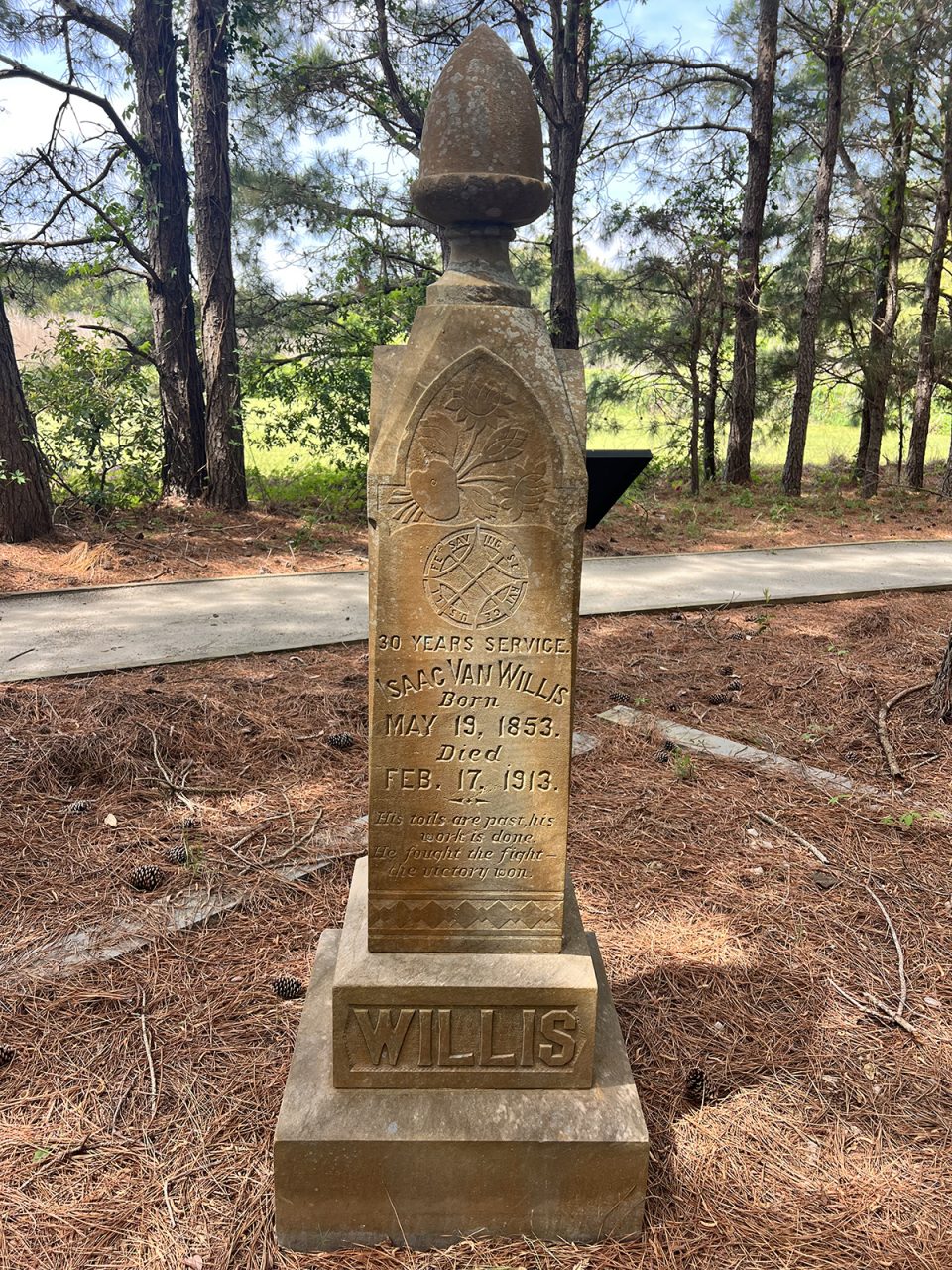
The trail signage at Isaac Van Willis Sr.’s grave shows he served for 30 years. Given that Life-Saving Service stations that once stretched along coast were spaced about seven miles apart and that our great-grandparents worked at neighboring stations, in all likelihood they knew each other. They could have each lived on Roanoke Island, but I am uncertain where Isaac Van Willis Sr. may have lived. They also likely participated in joint rescues. Before motorized equipment was available, these rescues were especially difficult and dangerous, often requiring the manpower of several stations.
Today, Johnnie still chuckles when he recalls how we met. When I realized who he was, the first thing I told him was to wait a few minutes, that his visit was important and I needed to I grab a pen and piece of paper. Yet, as we stood talking, I realized that, other than knowing his great-grandfather spent several years in the service, Johnnie knew little about him. He died when Johnnie was just a small child.
Johnnie knew more about his grandfather, Isaac Van Willis Jr., had who worked in the U.S. Lighthouse Service at the Cape Lookout Lighthouse.
In 2018, I also knew little about Isaac Van Willis Sr., and the story of Checkerboard Crews. Yet, each time I looked at the gravesite, I sensed he was important. His prominent marker, which includes the Life-Saving Service emblem and information about his wife on the opposite side, has always intrigued me. I was delighted a few days ago to receive a call from one of Johnnie’s daughters telling me that she wanted to bring her father back to Roanoke Island and to visit the Cookhouse. The trip was quickly planned. Johnnie and his daughters were thrilled to see a framed copy of the 1910 photograph and the vibrant oil painting of the same, each showing Isaac Van Willis Sr. They had never seen either image before. The discovery even brought tears to one granddaughter’s eyes.
I also made Johnnie aware of a letter that I had discovered about Isaac Van Willis Sr. several years ago. I promised to search for it in the research material I have collected over the years. At the time he was Surfman No. 1 at the Oregon Inlet station, the position typically next in line to become Keeper. Although I haven’t looked at it for several years now, I still recall being surprised to find Keeper Richard Etheridge’s signature on it. He and several others had signed it in support of Isaac Van Willis Sr.’s desire to become Keeper. Before Johnnie left, I promised to search for it and send him a copy.
Likewise, although Johnnie did not have any pictures of his great-grandfather, he had brought along something very special for me to see. He showed me a cherished framed photograph of Isaac Van Willis Jr., a photograph showing him doing work inside the lantern at the Cape Lookout Lighthouse. He promised to send me a copy of the photo when he returned home.
After a day that began with a seafood lunch, then a long visit at the Cookhouse, and ended with a cherished joint return to the Isaac Van Willis Sr. gravesite, I have concluded that our chance encounter eight years ago was destiny, simply something meant to be.
The broader story of Checkerboard Crews is a planned topic for “Cookhouse Chats,” a new initiative for 2026 that started in February. These periodic chats are to provide information on lesser-known stories associated with the history that the Cookhouse represents. Our next planned chat will be announced soon.